JUI-F Leaders Banned Sargodha Slams Door On Maulana Fazl For 30 Days
Sargodha Bars Maulana Fazl: 9 JUI-F Leaders Banned From District For 30 Days
The political temperature in Punjab has reached a boiling point after the local administration issued a sweep of restrictive orders targeting the leadership of Jamiat Ulema-i-Islam (JUI-F). In a move that has intensified the growing confrontation between the veteran politician and the federal coalition, JUI-F Leaders Banned Sargodha district authorities initiated an unyielding 30-day exclusion order against party chief Maulana Fazlur Rehman and eight other senior figures.
The emergency notification, issued by the Deputy Commissioner of Sargodha under the West Pakistan Maintenance of Public Order (MPO) Ordinance, 1960, took effect just as the religious-political party was gearing up for a massive public rally scheduled in the district. Rather than cooling the flames of political dissent, the administration’s crackdown has triggered widespread protests, roadblocks, and a flurry of arrests across Punjab, marking a volatile new chapter in Fazl’s escalating rift with the ruling coalition.
Understanding the Crackdown: Who Was Targeted?
The official directive, issued under Section 7(1) of the Maintenance of Public Order Ordinance, explicitly prohibits Maulana Fazlur Rehman and eight key associates from entering, residing, or remaining within the territorial limits of Sargodha district for a full 30 days.
| Leader Name | Party Designation / District | Key Affiliation |
| Maulana Fazlur Rehman | JUI-F Central Chief | Dera Ismail Khan |
| Maulana Naseer Ahmad Abrar | Senior Leader | Lahore |
| Maulana Amjad Khan | Central Executive Member | Lahore |
| Prof Ghazanfar Aziz | Provincial Spokesperson | Lahore |
| Maulana Safi Ullah | Regional Scholar | Bhakkar |
| Maulana Muhammad Noor Khan Hans | Party Organizer | Multan |
| Maulana Muhammad Zakria Shah | Local Executive | Faisalabad |
| Maulana Muhammad Yahya Abbasi | Senior Cleric | Muzaffargarh |
| Maulana Jamal Abdul Nasir | District Leader | Dera Ghazi Khan |
The sweep of this order highlights a deliberate, multi-district strategy. By ensuring key JUI-F Leaders Banned Sargodha entry, administrative officials hoped to decapitate the organizational structure of the planned Nov 26 rally.
Security Concerns vs. Democratic Rights
The official justification provided by the Sargodha administration rests on an assessment provided by the District Police Officer (DPO). According to the notification, police intelligence suggested that the listed figures were “firebrand speakers” known for delivered provocative and inflammatory speeches. The administration argued that their presence posed an imminent threat to public order, warning that they could unlawfully assemble crowds and incite public sentiment against state institutions.
Critics, however, view the timing with extreme skepticism. The administration enforced the restrictions on the eve of a major opposition gathering, raising questions about whether the public order ordinances are being used as a political shield. The controversy surrounding JUI-F Leaders Banned Sargodha actions points to a broader trend of utilizing colonial-era preventive detention laws, such as the MPO, to curb legitimate opposition gatherings.
While local authorities claim the orders were necessary to preserve civic peace, the immediate result was not calm, but chaos. Across Sargodha and neighboring Khushab, local police launched coordinated raids, detaining dozens of local party activists and serving formal notices for alleged violations of Section 144.
Defiance on the Highway: Fazl’s Push Toward Sargodha
Despite the heavy police presence and mounting blockades on Punjab’s transit routes, Maulana Fazlur Rehman remained defiant. In a video message released to his supporters directly from transit, the veteran politician announced that he was proceeding toward Sargodha regardless of the administrative roadblocks. JUI-F Leaders Banned Sargodha Slams Door On Maulana Fazl For 30 Days
“We are moving forward despite the state siege and illegal barriers,” Fazl declared, demanding that the government immediately lift all restrictions, release detained workers, and respect basic constitutional liberties. JUI-F Leaders Banned Sargodha Slams Door On Maulana Fazl For 30 Days
Party workers across the province took the cue. JUI-F Punjab spokesperson Hafiz Ghazanfar Aziz condemned what he termed the government’s “high-handed tactics,” reporting that thousands of supporters were stranded on highways due to police barricades and shipping containers. JUI-F Leaders Banned Sargodha Slams Door On Maulana Fazl For 30 Days
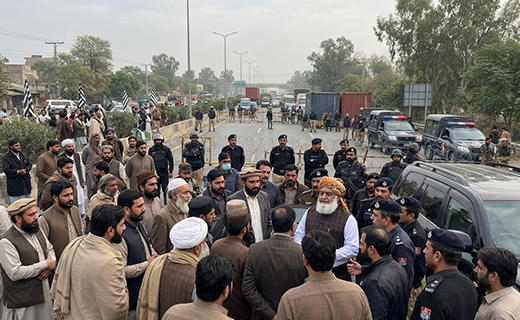
He alleged that police were conducting arbitrary nighttime raids and registering terrorism and public-disruption cases against peaceful activists across Punjab. With multiple JUI-F Leaders Banned Sargodha access points barricaded, highways leading into the central Punjab district quickly turned into flashpoints of standoff between riot police and determined crowds.
The Government’s Response: “Avoid a Dead End”
On the federal side, Information Minister Attaullah Tarar attempted to downplay the crisis while simultaneously urging the JUI-F chief to moderate his rhetoric. Appearing on national television, Tarar suggested that traffic disruptions and local administrative measures were routine and “not a big matter.“
However, Tarar issued a sharp warning against what he called an “anti-Pakistan, pro-Afghanistan narrative” emerging from recent opposition rhetoric. He urged the veteran politician to maintain political decorum:
“One should retain space for dialogue in politics and not enter a dead end. We have always accorded respect to Maulana Fazlur Rehman, but senior politicians should not promote unrest or confrontation in the country.”
Tarar maintained that the government remained open to resolving disputes through dialogue rather than street agitation, noting that the administration had previously engaged respectfully with Fazl on critical matters like the governance of Khyber Pakhtunkhwa. When questioned about recent accountability notices issued to members of Fazl’s family, the minister claimed independent state institutions were merely performing their duties without political interference.
Root Causes: Why Did the Fazl-Government Alliance Collapse?
The escalation in Sargodha is not an isolated incident; it is the culmination of months of deteriorating relations between Fazl and the ruling coalition. Just days earlier, Fazl claimed he was placed under an hours-long “state siege” at his Lahore residence, preventing him from attending a multiparty conference hosted by the Lahore High Court Bar Association. JUI-F Leaders Banned Sargodha Slams Door On Maulana Fazl For 30 Days
The rift centers on several deep-seated grievances:
-
The KP Governor’s Rule Dispute: Fazl vigorously opposed federal maneuvers in Khyber Pakhtunkhwa, accusing the Centre of attempting to sideline provincial representation.
-
Broken Promises: Despite acting as a mediator between the PML-N coalition and the PTI opposition, Fazl accuses the government of reneging on key political commitments.
-
Provincial Rights: Fazl has increasingly adopted a regionalist posture, accusing federal authorities of usurping provincial resources and autonomy.
With JUI-F Leaders Banned Sargodha maneuvers drawing a clear line in the sand, the political landscape in Punjab is now deeply fractured.
What Lies Ahead for JUI-F and Punjab Politics?
As the 30-day ban remains in effect, both sides find themselves at a perilous crossroads. For JUI-F, the restrictions have served as a rallying cry, transforming a regional rally into a national cause of civil liberties. JUI-F Leaders Banned Sargodha Slams Door On Maulana Fazl For 30 Days
For the government, maintaining the ban requires an ongoing, resource-heavy security deployment that risks further alienating religious conservatives across Punjab and Khyber Pakhtunkhwa. JUI-F Leaders Banned Sargodha Slams Door On Maulana Fazl For 30 Days
Ultimately, with JUI-F Leaders Banned Sargodha under emergency ordinances, the confrontation is likely to shift toward the courtroom and parliament. Whether the two sides find an off-ramp through quiet mediation or continue hurtling toward direct conflict remains the defining question of Pakistan’s current political cycle. JUI-F Leaders Banned Sargodha Slams Door On Maulana Fazl For 30 Days