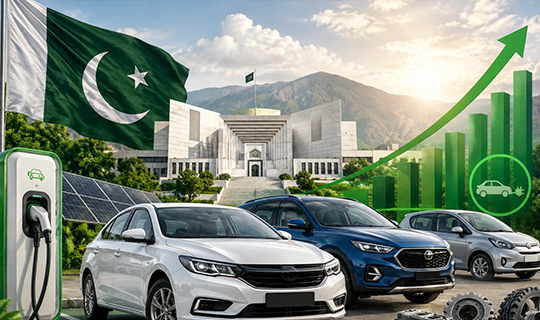
Major Positive Shift Pakistan Unveils 5 Key Auto Policy Reforms for Cheaper Cars & EVs
Major Positive Shift Pakistan: New Auto Policy Promises Cheaper Cars and EV Benefits
Pakistan’s federal government has introduced a new automobile policy aimed at making vehicles more affordable, strengthening local manufacturing and accelerating the adoption of electric vehicles (EVs). The policy focuses particularly on middle-class and lower-middle-class families who have struggled with rising car prices.
The announcement could bring a Major Positive Shift Pakistan has been waiting for, as the government plans to reduce production costs, encourage exports and introduce new incentives for electric vehicles.
Information Minister Attaullah Tarar and Prime Minister’s Adviser on Industries and Production Haroon Akhtar Khan announced the policy during a press conference in Islamabad on Saturday. They explained that the cabinet approval process had started and that the government wanted to clarify the policy before moving forward.
According to Akhtar, Prime Minister Shehbaz Sharif personally took an interest in developing the new framework.
Six Major Pillars of Pakistan’s New Auto Policy
The new automobile policy is based on six important pillars:
- Making vehicles affordable, particularly for middle-income families.
- Increasing automobile exports.
- Promoting local manufacturing and localisation.
- Improving vehicle safety standards.
- Encouraging electric vehicle adoption.
- Ensuring transparency in the automobile market.
The government believes these measures can make the industry more competitive and reduce its dependence on imported vehicles and components.
Car Prices Expected to Decrease Gradually
One of the biggest announcements concerns vehicle prices. The government has promised to reduce duties on completely built units (CBUs), assembly plants and automobile components over the next five years.
Haroon Akhtar Khan said the objective was to lower manufacturing costs and pass the benefits on to consumers.
He explained that prices of most vehicles, except luxury models, are expected to decrease gradually as the tariff structure changes.
This could become a Major Positive Shift Pakistan needs to make car ownership more affordable for ordinary citizens.
However, the actual reduction in showroom prices will depend on the final approved policy and how automobile manufacturers adjust their prices.
Government Targets $6 Billion in Auto Exports
Increasing exports is another major objective of the new policy. Pakistan’s automobile industry has traditionally focused on the domestic market, with overseas shipments largely consisting of vehicle parts rather than completely manufactured cars.
The government has now established a cumulative export target of $6 billion over five years. Major Positive Shift Pakistan Unveils 5 Key Auto Policy Reforms
To achieve this target, manufacturers will be encouraged to improve production quality, expand their facilities and develop vehicles that can compete internationally.
The policy also makes localisation mandatory, requiring manufacturers to increase the use of locally produced components. Major Positive Shift Pakistan Unveils 5 Key Auto Policy Reforms
New Rules to Control On-Money Charges
The government has also announced measures to address additional booking charges, commonly known as on-money.
Under the proposed policy, automobile manufacturers will not be allowed to demand advance payments exceeding 20 per cent of a vehicle’s total price at the time of booking.
This measure aims to improve transparency and protect customers from excessive booking requirements.
If properly implemented, the new rule could make the vehicle purchasing process fairer and more transparent. Major Positive Shift Pakistan Unveils 5 Key Auto Policy Reforms
Export Incentives and Penalties for Manufacturers
The government plans to introduce a rewards-and-penalties system to encourage automobile manufacturers to achieve their export targets.
Eligible exporters will receive a 5 per cent Duty Drawback of Local Taxes and Levies (DLTL). An additional 10 per cent incentive will be available for incremental annual export growth.
However, manufacturers must also achieve their local manufacturing targets.
Companies that fail to meet the required targets could face penalties and may lose access to export-related incentives.
The government says this approach will encourage manufacturers to invest in local production, create employment opportunities and strengthen Pakistan’s industrial base.
This could represent a Major Positive Shift Pakistan needs to develop a sustainable automobile manufacturing sector.
45 Additional Vehicle Safety Standards Introduced
Vehicle safety is another important part of the new policy.
According to Akhtar, the government plans to introduce 45 additional safety standards in line with the United Nations’ WP.29 framework.
These standards are intended to improve the safety of vehicles manufactured and used in Pakistan.
The government has expressed concerns about inadequate safety features, particularly in some imported used vehicles. Problems such as defective brakes and tyre failures have also raised questions about road safety.
Stronger safety requirements could improve vehicle quality and provide better protection for drivers and passengers. Major Positive Shift Pakistan Unveils 5 Key Auto Policy Reforms
Major Tax Benefits Announced for Electric Vehicles
Electric vehicles are receiving significant attention under the new automobile policy.
The government aims to transition 30 per cent of all new vehicles in Pakistan to electric power by 2030. However, Akhtar suggested that the target could be achieved earlier than expected.
The government has proposed three different sales tax rates:
- 1 per cent: Fully electric vehicles.
- 6 per cent: Range-extended electric vehicles (REEVs).
- 9 per cent: Hybrid electric vehicles.
These proposed tax rates are subject to approval by the International Monetary Fund (IMF).
Additionally, electric vehicles priced up to $50,000 will be exempt from capital value tax (CVT), withholding tax and federal excise duty (FED), according to the announced proposals.
Electric vehicles costing more than $50,000 will be treated as luxury items and taxed under normal rules.
These incentives could bring a Major Positive Shift Pakistan needs to encourage cleaner and more affordable transportation.
EV Financing Limit Increased to Rs10 Million
The government has also announced plans to expand financing facilities for electric vehicle buyers.
Under the proposed arrangement, the State Bank of Pakistan’s existing car financing limit of Rs3 million for ordinary vehicles will be increased to Rs10 million for electric vehicles.
The financing period will also increase from three years to five years.
This could make electric vehicles more accessible to buyers who cannot afford to pay the full purchase price upfront.
However, the availability of charging stations, battery costs and maintenance facilities will remain important factors in the wider adoption of EVs.
What the New Auto Policy Means for Pakistan
Pakistan’s new automobile policy presents an important opportunity for consumers and manufacturers.
Lower production costs could help reduce vehicle prices, while export incentives may encourage companies to expand their operations. Improved safety standards and transparent booking rules could also benefit customers.
The government still needs to complete the approval process, while the proposed EV tax incentives require IMF approval. Major Positive Shift Pakistan Unveils 5 Key Auto Policy Reforms
The success of the policy will ultimately depend on effective implementation, consistent monitoring and manufacturers meeting their commitments. Major Positive Shift Pakistan Unveils 5 Key Auto Policy Reforms
If the government delivers on these promises, the policy could bring a Major Positive Shift Pakistan needs to build a stronger automobile industry, create new employment opportunities and make vehicles more affordable for millions of people.


Pingback: Strong Defence Khawaja Fires Back at Critics After 3 Major