KP Emergency Crisis TTAP Files 1st Challenge to Illegal Governor Rule
TTAP Demands Judicial Review Amid Escalating KP Emergency Crisis
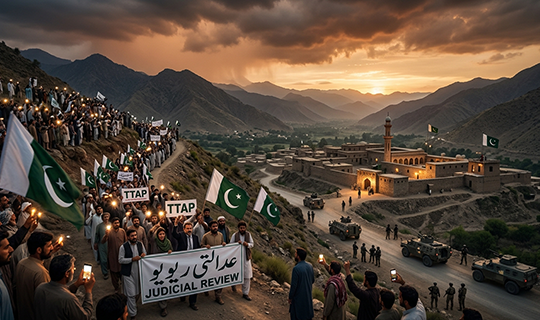
The Tehreek-e-Tahafuz-e-Ayin-e-Pakistan (TTAP) has issued a forceful call for a transparent judicial review of the constitutional grounds surrounding the imposition of governor’s rule and a state of emergency in Khyber-Pakhtunkhwa (K-P). The opposition alliance’s joint declaration warns that such centralized governance systems severely erode provincial autonomy, subvert the public mandate, and undermine the foundations of parliamentary democracy.
The declaration was finalized following extensive consultations among key opposition figures, including Leader of the Opposition in the National Assembly Mahmood Khan Achakzai, Leader of the Opposition in the Senate Allama Raja Nasir Abbas, and senior Pakistan Tehreek-e-Insaf (PTI) leader and former NA speaker Asad Qaiser.
1. Legal Battles and Jurisdictional Hurdles
The legal pathway to challenging executive actions in the province has grown increasingly complex. On November 7, the Peshawar High Court (PHC) removed all pending petitions challenging governor’s rule, emergency measures, and 3-MPO detentions from its cause list. This move came in the wake of a Federal Constitutional Court ruling that stripped the PHC of jurisdiction over cases originating after October 12, following a November 5 order barring the high court from hearing 3-MPO detention cases.
| Timeline | Legal & Political Event |
| October 11 | President Zardari approves governor’s rule & emergency under Articles 232 and 234. |
| Pre-Nov 5 | PHC grants bail to 23 PTI workers and seeks responses from provincial authorities. |
| November 5 | Federal Constitutional Court bars PHC from hearing 3-MPO cases; TTAP forms APC committee. |
| November 7 | PHC removes emergency and governor’s rule petitions from cause list due to jurisdictional ruling. |
| Current |
TTAP issues joint declaration demanding transparent judicial review.
|
Prior to these jurisdictional restrictions, the PHC had granted bail to 23 PTI workers detained under the ordinance and sought formal responses from the governor and provincial assembly speaker regarding the emergency declaration.
2. Navigating the KP Emergency Crisis and Constitutional Overreach
Opposition leaders emphasize that arbitrary governance models must be subjected to rigorous judicial examination. Managing the ongoing KP Emergency Crisis requires strict adherence to constitutional boundaries rather than executive mandates. Political analysts monitoring the KP Emergency Crisis note that bypassing local representative bodies risks long-term instability. As public frustration grows, every development in the KP Emergency Crisis underscores the tension between federal authority and provincial rights.
Furthermore, legal experts argue that managing the KP Emergency Crisis through central enforcement erodes regional trust. Resolving the KP Emergency Crisis demands a return to constitutional supremacy and parliamentary oversight. Until democratic norms are restored, the KP Emergency Crisis will remain a central point of political friction.
The alliance noted that safeguards for provincial autonomy and parliamentary democracy must remain non-negotiable, regardless of security challenges. In addition, the declaration paid tribute to JUI-F chief Maulana Fazlur Rehman for his steadfast position on constitutional matters, highlighting that personal attacks against political leaders and their families contradict democratic traditions.
3. High-Profile Detentions and Demands for Transparency
Beyond structural constitutional concerns, the opposition alliance raised urgent demands regarding the health and legal rights of detained political figures.
┌────────────────────────────────────────────────────────┐
│              TTAP KEY MEDICAL & LEGAL DEMANDS          │
│                                                        │
│  1. Public release of full medical reports for Imran   │
│     Khan and Bushra Bibi without delay.                │
│  2. Immediate transfer of Imran Khan to Shifa          │
│     International Hospital per Supreme Court ruling.   │
│  3. Medical care delivered in the presence of personal │
│     physicians.                                        │
│  4. Court presentation of arrested leaders, including  │
│     Sohail Afridi and Babar Saleem Swati.              │
└────────────────────────────────────────────────────────┘
The TTAP called for the immediate public release of comprehensive medical examination reports for the PTI founding chairman and Bushra Bibi. The alliance urged swift compliance with the Supreme Court order directing the former prime minister’s transfer to Shifa International Hospital, stressing that his care must be conducted under the supervision of his personal physicians.
The declaration also addressed the recent arrests of several high-profile leaders following political demonstrations, including suspended K-P Chief Minister Sohail Afridi and Assembly Speaker Babar Saleem Swati. Demanding clear explanations from federal authorities, the TTAP reiterated that elected representatives must be presented before relevant courts and that denial of legal rights to political workers must cease immediately. The alliance further demanded the prompt release of all detained political workers, including Imran Khan’s sisters—Aleema Khan, Uzma Khan, and Noreen Niazi.
4. Origins of the Executive Action in K-P
The current administrative setup stems from executive orders issued on October 11, when President Asif Ali Zardari approved Prime Minister Shehbaz Sharif’s advice to invoke Articles 232 and 234 of the Constitution. The federal government cited deteriorating security conditions, a sharp rise in terrorist attacks, and an alleged lack of effective counter-terrorism cooperation from the provincial administration.
Under these emergency provisions:
-
Executive Authority: Powers were transferred to K-P Governor Faisal Karim Kundi, assisted by an advisory council.
-
Cabinet Removal: Chief Minister Sohail Afridi and his cabinet were removed from executive duties.
-
Targeted Emergency: Specific emergency measures were instituted across 12 provincial districts.
The PTI leadership rejected the federal government’s justifications, characterizing the invocation of Articles 232 and 234 as an unconstitutional power grab following weeks of strained negotiations over regional anti-terrorism strategies.
5. Economic Fallout and Political Escalation
The ongoing KP Emergency Crisis has created ripples beyond the political sphere, impacting local commerce and administrative planning. Governance uncertainty surrounding the KP Emergency Crisis continues to stall key public development initiatives. As political forces struggle to address the KP Emergency Crisis, civil society groups urge all parties to prioritize stability and constitutional adherence. Market observers warn that failing to resolve the KP Emergency Crisis promptly could exacerbate regional economic strain.
                  ┌──────────────────────┐
                  │ Federal Executive    │
                  │ (Governor's Rule)    │
                  └──────────┬───────────┘
                             │
                     Opposition Protests
                             │
                  ┌──────────▼───────────┐
                  │   TTAP Alliance      │
                  │   (APC Committee)    │
                  └──────────┬───────────┘
                             │
                     Public Mobilization
                             │
                  ┌──────────▼───────────┐
                  │ Countrywide Movement │
                  └──────────────────────┘
The TTAP announced that its democratic movement against political victimisation and unconstitutional actions will continue to expand. Having already established a coordination committee on November 5 to prepare for an upcoming All Parties Conference (APC), the alliance is preparing to launch countrywide protests against current executive measures.
Whether the constitutional challenges reach the country’s highest judicial forums or remain confined to parliamentary debate, the political landscape in Khyber-Pakhtunkhwa remains intensely contested. The opposition alliance maintains that restoring constitutional supremacy, protecting fundamental rights, and upholding provincial autonomy remain essential to resolving the country’s ongoing political impasse.