
Pakistan Saudi Turkey Face 1st Severe Test of Joint Defense Pact!
Pakistan Saudi Turkey Face Crucial Test Over Trilateral Defense Pact in Islamabad
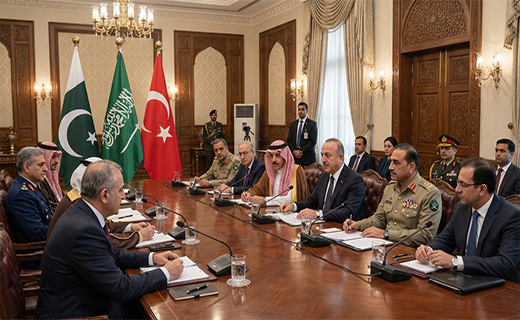
As top diplomats gather in the Pakistani capital this week, Pakistan Saudi Turkey face a defining moment that could reshape the security architecture of the Middle East and South Asia. What began as a high-profile political declaration in Mecca this past August is now moving into a critical operational phase. With the foreign ministers of Saudi Arabia and Turkey arriving in Islamabad for two days of intensive talks on Friday and Saturday, the world is watching closely to see if this emerging bloc can translate diplomatic ink into credible military deterrence.
For months, regional analysts have speculated on how this trilateral alliance would function in practice. Now, as cross-border threats escalate and traditional security guarantees appear increasingly uncertain, Pakistan Saudi Turkey face the urgent task of proving that their mutual defense pact is more than just symbolic solidarity.
The Road From Mecca to Islamabad
The trilateral defense agreement was originally signed on August 7 in the holy city of Mecca. The timing was no coincidence. Amid growing alarm over the intensifying US-Israeli conflict with Iran and persistent regional instability, leaders in Riyadh, Ankara, and Islamabad recognized the need for an indigenous, Muslim-majority security framework.
Since that summer signing, the three nations have moved swiftly to formalize their commitments through their respective legal channels:
-
Pakistan completed its domestic ratification of the pact on October 23.
-
Turkey followed suit shortly after. Following a decisive parliamentary vote of 279 to 119 on November 5, Ankara officially published the ratifying law in its Official Gazette on November 14.
Structured across 16 comprehensive articles, the treaty carries no fixed expiration date. Notably, its binding terms lock all three signatories into the alliance for a minimum of ten years before any party can formally initiate a withdrawal. However, moving from parliamentary ratification to battlefield readiness is a complex leap, and Pakistan Saudi Turkey face significant logistical and political hurdles as they sit down at the negotiating table in Islamabad.
Complementary Strengths on Paper
On paper, the strategic logic behind uniting these three nations is undeniable. Each member brings a distinct, heavyweight asset to the table, creating a formidable geopolitical triangle:
| Country | Primary Strategic Asset | Key Contribution to the Alliance |
| Turkey | NATO’s second-largest standing military | Advanced drone technology, naval power, and defense industry expertise. |
| Saudi Arabia | Custodian of Islam’s two holiest sites & top global oil exporter | Massive financial backing, strategic geographic depth, and regional influence. |
| Pakistan | The world’s only nuclear-armed Muslim state | Battle-hardened ground troops, ballistic missile capabilities, and air defense systems. |
Despite these impressive combined credentials, Pakistan Saudi Turkey face a glaring structural gap: the treaty currently lacks a unified military command.
A Mutual-Defense Pledge Without a Joint Command
At the heart of the agreement lies Article 2. This pivotal clause obligates all three signatories to provide immediate assistance if any single member comes under armed attack, calling for the deployment of the “full range of mutual assistance measures” at their disposal.
While the language echoes the collective defense principles of alliances like NATO, it remains deliberately broad. Article 2 does not automatically create an integrated military headquarters, nor does it establish pre-approved rules of engagement for joint operations. As a result, Pakistan Saudi Turkey face tough questions regarding how rapidly and cohesively they could actually respond if a crisis erupted tomorrow.
Nowhere is this ambiguity more pressing than along Saudi Arabia’s southern border. Continued drone and missile attacks launched by Houthi forces in Yemen have repeatedly tested Riyadh’s defenses. These ongoing strikes raise an uncomfortable question for the Islamabad summit: can this new pact effectively deter future Houthi aggression, and what exact steps will Ankara and Islamabad take if deterrence fails?
Pakistan’s Footprint vs. Turkey’s Caution
To understand the complexities of the alliance, one has to look at the differing postures currently adopted by Islamabad and Ankara.
Pakistan already maintains a substantial military footprint inside the Kingdom under a longstanding bilateral defense arrangement. According to defense reports from May, Islamabad has deployed roughly 8,000 troops to Saudi Arabia, backed by a squadron of approximately 16 fighter jets—primarily JF-17s—alongside two drone squadrons and a Chinese-made HQ-9 air defense system. Riyadh fully finances this deployment. Furthermore, sources familiar with the bilateral framework indicate that in the event of a full-scale regional emergency, Pakistan could theoretically surge up to 80,000 troops to defend Saudi territory.
Yet, while Pakistan’s boots-on-the-ground presence gives the alliance immediate teeth, Pakistan Saudi Turkey face the reality that bilateral deployments do not equal a coordinated trilateral force. Institutional mechanisms to synchronize Pakistani, Turkish, and Saudi military assets are still in their infancy.
Meanwhile, Turkey is signaling a far more cautious approach to active combat roles. Turkish Defense Minister Yasar Guler recently stated that Ankara does not envision entering into a direct shooting war with the Houthis. Instead, he framed Turkey’s prospective role as strengthening overall regional deterrence. This nuance highlights a critical friction point: even with formal ratification complete, Pakistan Saudi Turkey face the challenge of aligning their domestic political red lines with their collective treaty obligations.
Regional Outreach and Shifting Alliances
Beyond immediate battlefield mechanics, this trilateral pact represents a broader strategic pivot by Saudi Arabia. For decades, Riyadh relied almost exclusively on Washington as its ultimate security guarantor. However, growing doubts over the long-term reliability and scope of American military backing have pushed Saudi leadership to aggressively diversify its defense partnerships.
By bringing Turkey and Pakistan into a formal security embrace, Riyadh is attempting to construct a self-reliant geopolitical shield that blends hard military power with immense diplomatic weight across the Islamic world. Earlier efforts to operationalize this vision saw military chiefs from all three nations convene in Riyadh on October 5 following a spike in Houthi strikes. During those talks, commanders explored collective deterrence strategies and discussed transferring military capabilities to Saudi Arabia, strictly subject to each nation’s domestic laws.
As the weekend meetings unfold, Pakistan Saudi Turkey face the scrutiny of both regional rivals and global powers. Turning a promising geopolitical partnership into a seamless, war-fighting alliance requires trust, shared intelligence, and clear command structures. Ultimately, Pakistan Saudi Turkey face a simple truth in Islamabad: a defense pact is only as strong as the political will behind it when the first shots are fired. If they succeed in bridging their operational gaps, Pakistan Saudi Turkey face a future as the premier security bloc in the Muslim world.