Iran Issues 1 Fierce Warning as Trump Pushes Risky Hormuz Plan
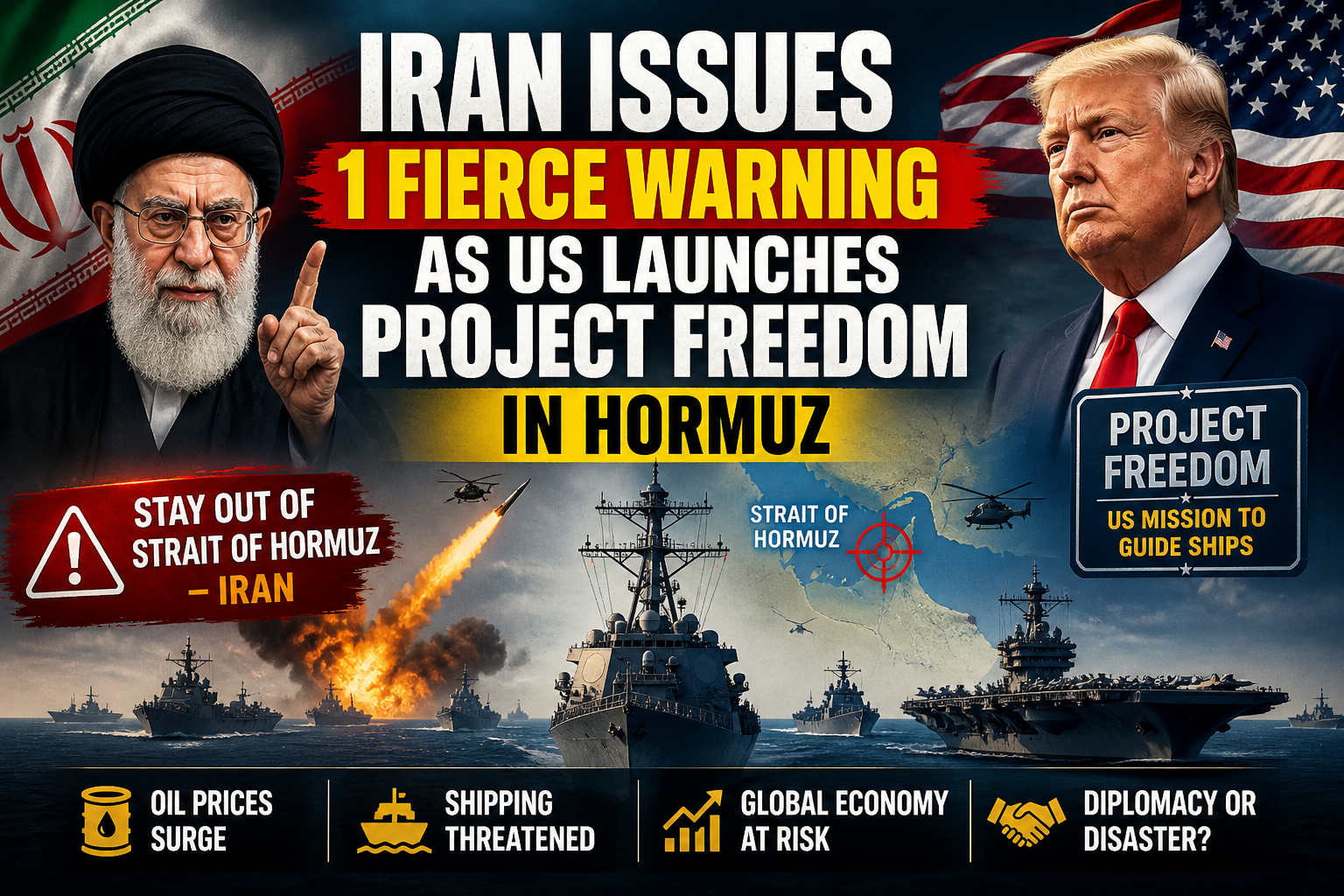
Iran Issues 1 Fierce Warning as US Launches Project Freedom in Hormuz
Tensions in the Middle East have taken a sharp turn after Iran Issues 1 Fierce Warning to the United States over its latest military move in the Strait of Hormuz. The situation is becoming increasingly fragile as both nations signal strength, raising concerns about a possible escalation that could impact global trade and energy markets.
The conflict intensified when US President Donald Trump announced the launch of “Project Freedom,” a mission aimed at guiding stranded commercial ships through the Strait of Hormuz. According to Trump, the initiative is meant to ensure safe passage for vessels stuck due to ongoing military tensions in the region.
However, Iran has responded strongly. In a direct message to Washington, Iran Issues 1 Fierce Warning that any US military presence inside the strait will be met with force. This warning has added a new layer of uncertainty to an already volatile situation.
Rising Tensions in a Strategic Waterway
The Strait of Hormuz is one of the most important shipping routes in the world, handling a significant portion of global oil transport. Any disruption here sends shockwaves across international markets. That’s why when Iran Issues 1 Fierce Warning, it is not just a regional concern—it becomes a global issue.
Iran’s military leadership made it clear that foreign forces, especially the US Navy, should stay away. They emphasized that their control over the strait remains firm and any attempt to interfere will trigger a military response.
This comes at a time when Iran has already been restricting shipping movements for over two months. As a result, oil prices have surged, and inflation pressures are rising in several countries, including the United States.
Project Freedom: A Risky Move?
President Trump described Project Freedom as a humanitarian and economic necessity. He stated that many ships are running low on essential supplies and need safe passage. But critics argue that the move could provoke Iran further.
Despite the stated intentions, Iran Issues 1 Fierce Warning that even a defensive mission could be seen as an act of aggression. This raises an important question: is Project Freedom truly about safety, or is it a strategic move to challenge Iran’s control?
The US Central Command (CENTCOM) has already deployed thousands of personnel, aircraft, and naval assets to support the operation. This massive military presence only adds to the tension, making the region more unpredictable.
Conflicting Claims Add Confusion
Adding to the uncertainty, reports emerged from Iranian media claiming that missiles struck a US warship near the Strait of Hormuz. The United States quickly denied these claims, calling them false.
Still, the situation remains tense. When Iran Issues 1 Fierce Warning, even unverified reports can trigger panic in global markets and among international observers.
Maritime agencies have also raised alarms. The United Kingdom Maritime Trade Operations (UKMTO) has labeled the threat level in the strait as “critical.” Ships have been advised to take alternative routes, including passing through Oman’s territorial waters.
Economic Impact Felt Worldwide
The ongoing standoff is not just about military power—it’s also about economic consequences. With shipping disrupted, oil supplies are tightening, pushing fuel prices higher.
In the United States, petrol prices have already jumped significantly since the conflict began. This has added pressure on consumers and contributed to rising inflation.
When Iran Issues 1 Fierce Warning, it directly affects global energy markets. Investors become cautious, supply chains slow down, and uncertainty spreads across economies.
Risk of Dangerous Escalation
Experts warn that the situation could spiral out of control. Iran has a strong presence in the region, including drones and small naval vessels that can challenge larger warships.
Military analysts believe that if even a single US ship is attacked, the consequences could be severe. Retaliation would be almost certain, potentially leading to a broader conflict.
This is why Iran Issues 1 Fierce Warning carries so much weight—it signals that the situation is close to a breaking point.
Diplomatic Efforts Continue
Despite the rising tension, there are still efforts to resolve the crisis through diplomacy. Iran has proposed a 14-point plan aimed at ending the conflict, while the United States has responded with its own counterproposal.
However, progress has been slow. Iranian officials have criticized the US for making unrealistic demands, suggesting that negotiations are far from reaching a resolution.
Even so, diplomacy remains the only viable path to avoid conflict. While Iran Issues 1 Fierce Warning, it is also engaging in discussions, showing that both confrontation and negotiation are happening side by side.
A New Reality in Hormuz
According to regional analysts, the dynamics in the Strait of Hormuz have changed. Iran appears determined to maintain control, regardless of international pressure.
This shift means that any future operations in the region will have to consider Iran’s stance. And as long as Iran Issues 1 Fierce Warning, the risk of confrontation will remain high.
The situation has also exposed the fragile balance of power in the Middle East. A single misstep could disrupt not only regional stability but also global trade.
What Happens Next?
Looking ahead, much depends on how both sides handle the situation. If the US continues with Project Freedom, and Iran follows through on its threats, the chances of escalation increase significantly.
On the other hand, if diplomatic efforts gain traction, there may still be hope for de-escalation. For now, the world is watching closely.
One thing is clear: whenever Iran Issues 1 Fierce Warning, it is a signal that the stakes are incredibly high.
Conclusion
The Strait of Hormuz crisis is a reminder of how quickly geopolitical tensions can escalate. With the US pushing forward with its mission and Iran standing firm, the situation remains uncertain.
As Iran Issues 1 Fierce Warning, global leaders face a critical moment. The choices made now will shape not just the future of the region, but also the stability of the global economy.

Pingback: Powerful Pope Declares Global Peace Mission After 1 Bold