
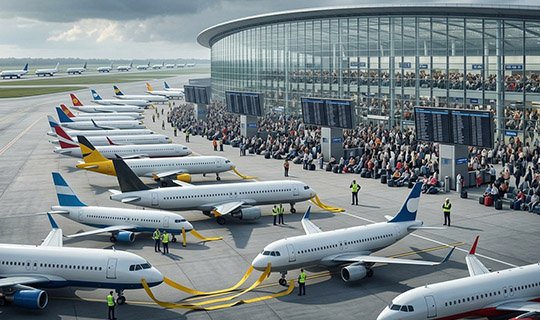
Urgent Ground Stop 3 Smart Tips to Save Your Trip
Urgent Ground Stop: Everything We Know About the Nationwide US Flight Halt and Your Passenger Rights
The United States aviation sector experienced unprecedented disruption on Friday after the Federal Aviation Administration (FAA) implemented—and subsequently lifted—the longest nationwide flight suspension since the September 11, 2001 attacks. Lasting more than four hours, this Urgent Ground Stop rippled across global airspace, stranding tens of thousands of travelers and triggering thousands of delays and cancellations.
According to official statements from the Federal Aviation Administration, the sudden halt was triggered by “extraordinary circumstances” stemming from a critical communication failure that impacted air traffic control centers nationwide. Addressing public safety concerns shortly after the incident, Homeland Security Secretary Markwayne Mullin confirmed that there was no indication of a cyber-attack and assured travelers that everyone remained safe throughout the ordeal.
Scale of the Disruption: Thousands of Flights Grounded
The operational fallout from the Urgent Ground Stop was immediate and massive. Flight tracking data from FlightAware revealed that Friday’s outage resulted in more than 8,500 delayed flights and nearly 8,000 outright cancellations across the United States.
Timeline of the domestic airspace closure:
-
15:54 EST (20:54 GMT): The FAA issued its initial directive halting all departing domestic flights across the US until further notice.
-
Airborne Traffic: At the exact moment the Urgent Ground Stop went into effect, over 3,500 aircraft were already airborne. While some planes were diverted to nearby airports, others were cleared to continue safely to their scheduled destinations.
-
Gradual Reopening: Several hours into the crisis, limited departures were permitted to resume from San Francisco International Airport before the FAA officially reopened US skies at 20:15 EST.
Global Ripple Effects on International Travel
Because the United States serves as a primary hub for global aviation, the Urgent Ground Stop quickly extended beyond American borders, halting inbound international traffic from multiple continents.
All US-bound flights originating from the 42 member states of Eurocontrol—which encompasses dozens of European Union nations, the United Kingdom, Turkey, Israel, and Morocco—were temporarily suspended.
Across the Atlantic and Pacific, major international hubs reported varying levels of disruption:
-
United Kingdom: Several US-bound flights from London Heathrow Airport were delayed or canceled, with authorities warning passengers of lingering disruptions into Saturday morning. Conversely, Manchester Airport reported minimal impact, and London Gatwick Airport maintained normal operations.
-
Australia: Sydney Airport, the country’s largest international gateway, temporarily grounded all US-bound departures during the height of the Urgent Ground Stop, though normal schedules have since resumed.
-
Canada: Air Canada canceled multiple cross-border routes between the US and Canada in response to the American airspace closure.
When Will Airline Schedules Return to Normal?
Although the skies have reopened, travelers should prepare for residual delays over the coming days. Speaking at a Friday night press conference, US Transportation Secretary Sean Duffy warned that unwinding the backlog created by the Urgent Ground Stop will take considerable time.
“It’s going to take us some time to unwind what’s happened this afternoon,” Duffy explained, noting that tens of thousands of passengers were left stranded in terminals nationwide—many without immediate certainty regarding overnight accommodations.
Major carriers have issued varied recovery timelines as they work to reposition aircraft and flight crews:
-
Delta Air Lines and United Airlines: Both carriers confirmed they are actively resuming operations.
-
American Airlines: Stated its teams are focused on operating as many remaining scheduled flights as possible.
-
JetBlue: Announced plans to resume full flight operations on Saturday morning.
-
British Airways: Advised customers on affected transatlantic routes to monitor their flight status closely while still traveling to the airport as planned.
Know Your Rights: Refunds, Compensation, and Care
When an Urgent Ground Stop disrupts travel plans, understanding your legal protections is essential. Across the US, UK, and European Union, airlines are generally only required to pay financial compensation when a delay or cancellation falls within their direct control, such as mechanical failures or crew shortages. Because air traffic control outages are classified as extraordinary circumstances outside an airline’s control, carriers are not legally obligated to issue cash compensation for Friday’s stoppage.
However, passengers still retain vital statutory rights depending on their departure point and carrier:
Protections Under US Federal Law Under the US Department of Transportation guidelines established by the FAA Reauthorization Act of 2024, passengers whose flights are canceled or “significantly delayed”—defined as three hours or more for domestic routes and six hours or more for international itineraries—are entitled to either alternative transportation or a full ticket refund if they choose not to travel.
Key refund rules following an Urgent Ground Stop include:
-
Credit Card Purchases: Airlines must process refunds within seven business days of a passenger’s request.
-
Other Payment Methods: Refunds for tickets bought via cash, check, or debit must be issued within 20 days.
-
Rebooking Caveat: Travelers who accept an alternative flight forfeit their right to a refund.
-
Meals and Hotels: US law does not require airlines to provide complimentary hotel rooms or meal vouchers during air traffic control delays, though some carriers may offer goodwill assistance.
Additional Protections for UK Travelers Passengers departing from the UK or flying aboard a UK-registered airline enjoy broader duty-of-care protections under regulations enforced by the UK Civil Aviation Authority. Regardless of what caused the Urgent Ground Stop, airlines must provide:
-
A reasonable amount of food and refreshments, typically distributed via airport vouchers.
-
Access to communication, such as reimbursing essential phone calls.
-
Free hotel accommodation if an overnight stay becomes necessary.
-
Ground transportation between the airport and the hotel.
If an airline is overwhelmed and unable to arrange these essentials directly, travelers have the right to book reasonable accommodations and meals independently and submit itemized receipts for reimbursement later.
What Caused the System Failure?
Preliminary assessments suggest that the Urgent Ground Stop was triggered by compatibility issues between modern software upgrades and aging federal infrastructure. Attempting to integrate new technological equipment into a decades-old air traffic control network reportedly overwhelmed the system’s capacity.
“This is analogue telecom. Our switches, our routers actually got overloaded with data and they went down,” Secretary Duffy stated during his Friday briefing.
Aviation analyst Miles O’Brien echoed these infrastructure concerns, comparing the current air traffic network to “a house that’s about to be condemned.” He noted that engineers were layering advanced software onto legacy architecture that still relies on thin, outdated copper wiring to link regional air traffic control facilities—a vulnerability that ultimately culminated in Friday’s Urgent Ground Stop.