Betrayal Israel Gets $1B In Military Aid Despite Trump Ending Vow
Betrayal: Israel Gets Continued Military Aid Despite Trump’s Election Vow
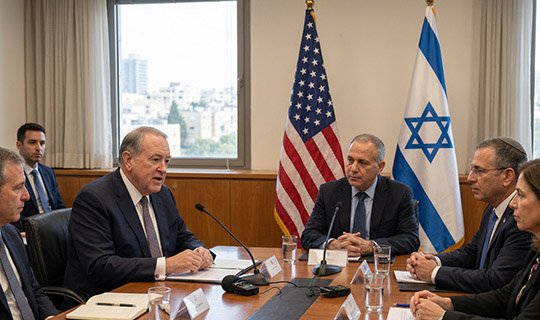
A major foreign policy rift is emerging in Washington after U.S. Ambassador to Israel Mike Huckabee cast serious doubt on whether the United States can actually halt military funding to Israel by the end of the year. For voters who took President Donald Trump at his word on Election Day, the shift feels like a stark betrayal: Israel gets multi-year financial backing locked in by congressional appropriations, making an abrupt cutoff nearly impossible without legislative intervention.
Speaking in an interview with Israel’s Institute for National Security Studies (INSS) released on Tuesday, Huckabee explained that legal and budgetary mechanisms already in motion supersede campaign-trail rhetoric. While Trump stated on the morning of the November 3 midterm election that aid to Israel had become a “bad talking point” for Republicans and promised it would conclude by year’s end, the reality on the ground tells a very different story. Betrayal Israel Gets $1B In Military Aid Despite Trump Ending Vow
Why Congress Holds the Keys to Military Funding
According to Huckabee, the core obstacle to an immediate freeze lies within the existing bilateral Memorandum of Understanding between Washington and Jerusalem, which guarantees American security assistance through 2028. Because those funds have already been allocated, critics arguing betrayal: Israel gets billions in pre-approved defense packages that the executive branch cannot simply erase overnight.
“I’m not certain that there will be a cessation on an abrupt basis by the end of this year,” Huckabee stated candidly during the interview. “I’m not sure it can happen unless Congress were to act. Otherwise there are appropriations in place that will extend into that period of time.” Betrayal Israel Gets $1B In Military Aid Despite Trump Ending Vow
Huckabee noted that Israeli leadership is acutely aware of the shifting political winds in the United States. Officials in Jerusalem recognize they are increasingly getting “beat up” by domestic critics over foreign aid packages. Yet, despite that bipartisan friction, betrayal: Israel gets framed by anti-interventionist conservatives as a broken promise to put domestic priorities first.
Escalating Tensions and Potential Strikes Against Iran
Beyond the debate over defense budgets, Huckabee delivered a stern warning regarding Tehran, confirming that President Trump remains fully prepared to restart direct military operations against Iran if diplomatic demands go unmet. Washington’s red lines remain non-negotiable: Iran cannot be permitted to acquire a nuclear weapon or seize control over the strategic Strait of Hormuz.
While the ambassador acknowledged that a negotiated settlement remains theoretically possible if Tehran accepts Washington’s conditions, he expressed deep skepticism about Iranian credibility, noting that officials there are “not known” for honoring their side of an agreement. Betrayal Israel Gets $1B In Military Aid Despite Trump Ending Vow
“If Iran is unwilling, the President has already demonstrated twice in the last year and a half that he is willing to use military action, and he’s made it very clear he’s willing to do it again,” Huckabee warned. Notably, this posture comes months after Israeli Prime Minister Benjamin Netanyahu reportedly pushed for additional strikes against Iranian targets, only to face pushback from his own senior military commanders. For skeptics of deeper Middle Eastern entanglement, it feels like another betrayal: Israel gets unconditional American military backing even when top Israeli generals urge restraint.
Fractures Within the Republican Party Over Gaza
The ambassador’s remarks also exposed growing daylight between Huckabee and other prominent voices inside the administration and the broader Republican Party regarding the ongoing war in Gaza. While several GOP figures have recently pressured Jerusalem to move swiftly toward a comprehensive ceasefire, Huckabee placed the blame for diplomatic delays squarely on Hamas.
“Hamas has failed to live up to its agreement that they would disarm,” Huckabee insisted. “They’ve not given up one bullet, one bomb, one rifle, one pistol, one rocket, nothing.”
That hardline stance contrasts sharply with warnings issued earlier this week by key Trump allies:
-
Sen. Dave McCormick: The Pennsylvania Republican, who chairs the Senate Foreign Relations Middle East subcommittee, publicly urged Israel to “fulfill its commitments” to Trump’s Board of Peace initiative.
-
Jared Kushner: The president’s son-in-law and special envoy cautioned that Israel’s “current trajectory” risks turning the nation into a global pariah.
Despite these high-level warnings from inside Trump’s own orbit, Huckabee refused to budge, reiterating that “the real stall in the peace process is Hamas.” To populist voters who backed Trump expecting an immediate end to regional conflicts, the messaging gap reads like a betrayal: Israel gets diplomatic cover from its U.S. ambassador even as the White House’s own envoys sound the alarm.
Huckabee Defends the Alliance as a “Two-Way Street”
Addressing growing skepticism from both progressive Democrats and “America First” Republicans, Huckabee pushed back against the narrative that the U.S.-Israel partnership drains American resources without delivering tangible returns. Calling Democratic opposition to Israel “unfortunate,” he argued that U.S. national security relies heavily on intelligence sharing from Jerusalem.
“I want America to recognize that this is not a one-way street,” Huckabee emphasized. “Every day, American lives are saved because we pick up intelligence from our partners in Israel.”
Still, that argument does little to quiet the political storm brewing back home. For fiscal conservatives and isolationist voters who rallied behind Trump’s November 3 pledge to cut off foreign expenditures, watching the timeline quietly slip past 2026 feels like a betrayal: Israel gets insulated from budget cuts while domestic economic pressures mount.
What Comes Next for U.S.-Israel Policy?
As Washington heads toward the end of the year, the gap between Trump’s campaign rhetoric and diplomatic reality is widening. Unless Congress takes the highly unlikely step of rescinding previously approved defense appropriations, the flow of weapons and financial support to Jerusalem will continue uninterrupted into 2027 and beyond.
Ultimately, the episode underscores the enduring power of entrenched defense agreements over sudden political promises. Whether voters view the outcome as pragmatic diplomacy or a betrayal: Israel gets the security guarantees enshrined in the 2028 Memorandum of Understanding. Meanwhile, with Iran refusing to back down and ceasefire talks in Gaza deadlocked, the administration faces mounting pressure to reconcile its promises of restraint with the reality of deep military commitments abroad—a balancing act where critics increasingly argue betrayal: Israel gets the upper hand over American voters’ expectations.