PPP Demands Urgent Resignation of Mohsin Naqvi Over 2 Severe Proposals
Political Crisis in Pakistan: Why PPP Demands Urgent Resignation of Interior Minister Mohsin Naqvi
In a major political escalation that has sent shockwaves through Islamabad and Karachi, the Pakistan Peoples Party (PPP) Sindh leadership has taken a firm stance against Federal Interior Minister Mohsin Naqvi. Addressing a press conference at the party’s secretariat in Karachi,
PPP Sindh President Senator Nisar Ahmed Khuhro—flanked by Labour Minister Saeed Ghani and General Secretary Waqar Mehdi—launched a direct critique of the interior minister.
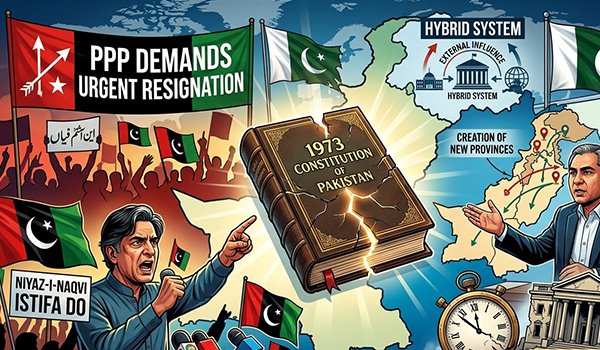
The trigger for this sharp reaction was Naqvi’s recent public statements declaring that Pakistan’s current system of governance has “collapsed” and calling for a “hybrid system” alongside the creation of up to 22 new provinces. As tension mounts between coalition allies, the PPP Demands Urgent Resignation of the interior minister on both moral and constitutional grounds.
The Summit Speech That Sparked Controversy
The political friction began shortly after Interior Minister Mohsin Naqvi held high-level discussions with President Asif Ali Zardari at Bilawal House. Just two days later, Naqvi delivered an address at the Pakistan Economic Summit in Islamabad.
During his speech, he asserted that the existing governance framework in Pakistan had failed to deliver efficiency, emphasizing a need to reshape administrative structures and create more provinces.
For the PPP, a major ally in the ruling setup, these remarks represented a direct challenge to the 1973 Constitution and parliamentary democracy. Leaders in Sindh pointed out that a sitting cabinet member cannot remain in power while publicly discrediting the constitutional order they took an oath to protect.
It is in this backdrop that the PPP Demands Urgent Resignation from Mohsin Naqvi, asserting that his comments undermine public faith in elected representative institutions.
Constitutional Boundaries and the Question of New Provinces
One of the most contentious aspects of Naqvi’s address was his push for creating multiple new provinces across Pakistan. In response, Nisar Khuhro firmly stated that provincial boundaries cannot be altered at the whim of federal ministers or through unconstitutional experiments.
Under the Constitution of Pakistan, creating a new province requires a formal constitutional amendment and a two-thirds majority resolution passed by the relevant provincial assembly. Khuhro highlighted that no such demand or legislative process exists within Sindh.
Pointing to historical precedents, Khuhro noted that while the Punjab Assembly had previously passed a resolution regarding administrative division, any debate on new provinces must follow established constitutional channels. As political rhetoric intensifies, the PPP Demands Urgent Resignation to halt what it views as a calculated effort to create unnecessary constitutional instability.
Constitutional Procedure for New Provinces:
├── Article 239 Requirements
├── Two-Thirds Majority in Concerned Provincial Assembly
├── Federal Constitutional Amendment Approval
└── Unanimous Agreement across Key Democratic Forums
Protecting Democratic Continuity and Military Neutrality
A core concern raised by the PPP leadership during the press conference was the impact of Naqvi’s remarks on Pakistan’s armed forces. The military leadership has consistently stated its commitment to remaining apolitical. However, PPP leaders argued that repeatedly invoking military-backed hybrid governance models risks dragging the armed forces into active political debate.
“By repeatedly invoking the name of armed forces for political purposes, the interior minister is damaging both democracy and the reputation of the military,” Khuhro stressed.
Because these comments risk creating friction between state institutions, the PPP Demands Urgent Resignation of Naqvi to restore clear boundaries between civilian executive roles and the military establishment.
To understand the broader context of governance dynamics in Pakistan, read our detailed analysis on Pakistan’s 1973 Constitution and Federal Governance Framework.
Economic Realities: Can Pakistan Sustain 22 Provinces?
Beyond constitutional arguments, the PPP raised sharp questions regarding the financial feasibility of expanding the bureaucratic footprint. Pakistan is currently navigating economic recovery where every rupee of public spending is subjected to close scrutiny.
Creating up to 22 new provinces would entail establishing dozens of new provincial assemblies, chief minister offices, expanded cabinets, and massive administrative structures. At a time when citizens face high inflation and economic constraints, spending billions on new administrative setups is financially unviable.
Financial Burden of Multi-Province Expansion:
1. Establishment of New Provincial Assemblies & Secretariats
2. Massive Recurrent Budgets for Expanded Cabinets
3. Bureaucratic Duplication and Administrative Overlap
4. Heightened Fiscal Deficits During Economic Stabilization
Because an unnecessary political distraction threatens to divert attention away from urgent economic reforms, the PPP Demands Urgent Resignation to ensure federal focus remains firmly on economic relief.
Coalition Friction and Regional Dynamics
The timing of this dispute adds another layer of complexity to the national political landscape. The PPP is a major coalition partner in the federal government, making public calls for an interior minister’s exit a significant political signal. While the PPP has consistently supported political stability, party leaders emphasized that keeping quiet on fundamental constitutional breaches is not an option.
During the press interaction, Khuhro also touched upon regional matters, including the pending Jalalpur Canal issue currently before the Council of Common Interests (CCI). By taking a firm stand on provincial rights, the PPP Demands Urgent Resignation to send a message that federal ministers must respect provincial autonomy.
For a deeper look into coalition dynamics, check our report on Pakistan’s Ruling Coalition and Inter-Party Governance Challenges.
The Danger of Extra-Constitutional Experiments
Pakistan’s political history has seen frequent political disruptions and governance experiments that ultimately weakened democratic institutions. The PPP leadership reminded the media that uninterrupted democratic governance is the only viable model for long-term stability and economic growth.
Khuhro warned against narratives that portray democratic setups as inherently flawed. When a senior cabinet member endorses a hybrid governance model over parliamentary rule, it creates uncertainty among domestic stakeholders and international partners alike. It is precisely to prevent another unconstitutional adventure that the PPP Demands Urgent Resignation from the interior minister.
Institutional Accountability and Public Response
The demand raised by Sindh’s ruling party has ignited widespread discussion across political circles and constitutional forums. Constitutional experts and civil society members have echoed concerns regarding cabinet ministers making statements that contradict the basic framework of the Constitution. PPP Demands Urgent Resignation of Mohsin Naqvi Over 2 Severe Proposals
When a public official expresses a lack of confidence in parliamentary democracy, stepping down becomes a standard ethical requirement. Therefore, the PPP Demands Urgent Resignation as a necessary step toward upholding parliamentary dignity and enforcing executive accountability.
Stay updated on legislative developments at the National Assembly of Pakistan Official Site.
Conclusion: Upholding the Constitution Above All
The ongoing friction highlights the delicate balance between federal authority and constitutional parameters in Pakistan’s political setup. The demand put forward by the PPP Sindh leadership goes beyond a simple disagreement over a speech; it touches upon core principles of parliamentary democracy, provincial sovereignty, and federal stability.
As the political debate unfolds across the country, the stance that the PPP Demands Urgent Resignation serves as a stark reminder that extra-constitutional narratives will face resistance from democratic forces.
Upholding the 1973 Constitution and ensuring institutional respect remain essential for navigating Pakistan through its political challenges. PPP Demands Urgent Resignation of Mohsin Naqvi Over 2 Severe Proposals