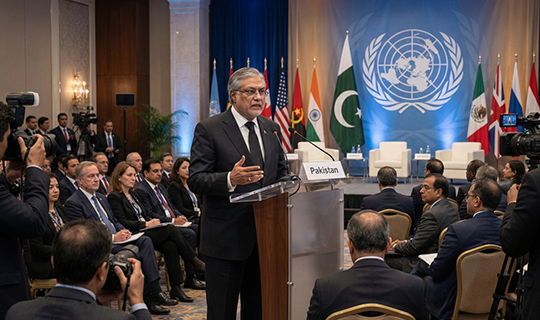
In an era marked by deepening geopolitical fractures and escalating regional conflicts, Pakistan’s Deputy Prime Minister and Foreign Minister Ishaq Dar has issued a clear call for global cooperation over division. Speaking in a wide-ranging interview with Euronews, Dar Slams Bloc Politics and unilateral power plays as unsustainable strategies that fail to resolve international crises. Instead, he emphasized that an independent foreign policy anchored in dialogue, mutual respect, and multilateral engagement remains the only viable path toward lasting peace.
As major powers increasingly retreat into rival spheres of influence, Pakistan’s diplomatic posture seeks to bridge divides rather than deepen them. Throughout the interview, Dar Slams Bloc Politics while pointing to Islamabad’s recent high-stakes mediation between the United States and Iran, its economic ambitions in the mineral sector, and its principled stances on regional security with neighboring Afghanistan and India.
Rejecting Rivalries in Favor of Multilateralism
Addressing the shifting dynamics of global diplomacy, Ishaq Dar left no ambiguity regarding Islamabad’s worldview. He stated that Pakistan’s foreign policy is fundamentally independent and rooted in the principles of the United Nations Charter. When Dar Slams Bloc Politics during his remarks, he underscored that modern global challenges—ranging from armed conflict to supply chain disruptions—cannot be solved by isolated actors or competing alliances.
“We believe in multilateralism,” FM Dar said, stressing that even in today’s turbulent environment, nations must work “double hard” to uphold collective frameworks. “Bloc politics or unilateral politics will not work.”
Mediating the US-Iran Conflict: A Historic Breakthrough
A major portion of the interview highlighted Pakistan’s pivotal behind-the-scenes role in de-escalating the intense military standoff between the United States and Iran. Reaffirming that diplomacy is the only viable alternative to war, Dar noted that the more effort nations invest in dialogue, the greater the likelihood of achieving a durable breakthrough.
Dar traced Pakistan’s involvement back to February 28, noting that Islamabad was the first country to condemn Israel’s attack on Iran. The very next day, Dar contacted his Iranian counterpart to urge restraint and discourage retaliation. While clarifying that his appeal specifically aimed to prevent strikes against other Middle Eastern and Gulf nations, he expressed regret that those countries were subsequently hit, noting that Iranian officials had assured Islamabad they were targeting solely American military bases.
Pakistan’s persistent backchannel diplomacy gradually yielded tangible results:
-
Late March Pause: Alongside Turkiye and Egypt, Pakistan played an instrumental role in securing a five-day pause announced by US President Donald Trump on planned strikes targeting Iranian energy infrastructure.
-
Early April Ceasefire: Following weeks of intensive negotiations largely credited to Islamabad’s mediation, Washington and Tehran agreed to a two-week ceasefire.
-
Direct Talks After 47 Years: Even during earlier indirect discussions in Oman, both sides agreed that Pakistan’s presence would be essential for direct negotiations. This culminated on April 11–12, when Islamabad hosted the first round of direct US-Iran talks in 47 years.
-
The June 18 Islamabad MoU: After further diplomatic heavy lifting, the US and Iran signed the Islamabad Memorandum of Understanding on June 18, 2026, aimed at reopening the Strait of Hormuz and winding down hostilities across the Middle East.
Despite subsequent violations of the agreement, Dar insisted that Pakistan’s diplomatic mission is far from over. “Pakistan hasn’t given up. We are still working hard. We continue to persuade both parties to respect and honour what they signed on June 18,” he affirmed.
Even as Dar Slams Bloc Politics on the world stage, Islamabad’s practical mediation proves how middle powers can facilitate dialogue between bitter adversaries.
Securing Maritime Trade and New Security Architectures
Beyond bilateral negotiations, the foreign minister warned of the severe economic fallout caused by maritime insecurity. Calling the free movement of commercial vessels through international sea routes an absolute “must,” Dar expressed hope that full freedom of navigation would be restored soon. He noted that disruptions to global energy supply chains and surging fuel prices were inflicting hardship on ordinary citizens worldwide, while commending the Pakistani government for shielding low-income households through targeted fuel subsidies.
Looking toward the future, Dar argued that it is “high time” the international community established regional peace through a mutually agreed mechanism, adding, “We all have to see the new security architecture.” In making this case,
Dar Slams Bloc Politics once again, arguing that inclusive regional security frameworks—supported by institutions like the
United Nations Security Council—are far superior to zero-sum military alignments.
Unlocking Pakistan’s $10 Trillion Mineral Potential
Turning to domestic economic management, the deputy prime minister struck an optimistic tone regarding Pakistan’s long-term financial trajectory. While acknowledging the weight of the country’s $130 billion external debt, Dar pointed to vast untapped natural wealth as the key to economic transformation.
Highlighting initiatives such as the Pakistan Minerals Investment Forum, he revealed that the estimated value of Pakistan’s mineral reserves and rare earth elements stands between $6 trillion and $10 trillion. “We have the potential and the capacity to match it. It’s a matter of time,” he said, emphasizing that strategic international partnerships—rather than restrictive geopolitical alignments—will help unlock these resources. Just as Dar Slams Bloc Politics in diplomatic arenas, his economic vision welcomes broad global investment without ideological barriers.
Regional Ties: Afghanistan and India
On neighborhood diplomacy, Dar reiterated that no country desires a stable, prosperous, and economically viable Afghanistan more than Pakistan. However, he addressed security concerns candidly, noting that following major terrorist attacks last October, Islamabad shared credible evidence with international bodies tracing the attacks back to Afghan soil and alleging external sponsorship.
Dar pointed out that the Afghan administration has yet to provide verifiable proof of concrete action against terrorist networks. Emphasizing Pakistan’s immense sacrifices—over 100,000 lives lost and Rs150 billion in economic damages—he stated plainly, “We genuinely want terrorism to be eradicated and eliminated.”
Regarding relations with India and the future of the Indus Waters Treaty (IWT), the foreign minister noted that progress rests largely on New Delhi’s willingness to engage constructively. He also reiterated Pakistan’s longstanding position that
UN resolutions on Jammu and Kashmir grant the Kashmiri people their fundamental rights, which remain central to lasting South Asian peace.
A Principled Path Forward
Throughout his interview with Euronews, Ishaq Dar presented a cohesive diplomatic doctrine: reject rigid ideological camps, prioritize dialogue over confrontation, and build economic resilience through open cooperation. FM Dar Slams Bloc Politics 3 Stark Reasons Unilateralism Will Fail
Every time Dar Slams Bloc Politics, he reinforces the message that peace in the Middle East, South Asia, and beyond depends on shared rules and mutual accountability. As global tensions test the limits of international diplomacy, Dar Slams Bloc Politics not out of isolationism, but out of a conviction that multilateralism remains humanity’s best safeguard against conflict.
Ultimately, when Dar Slams Bloc Politics, it serves as a timely reminder that sustainable global stability can only be built through inclusion, dialogue, and collective responsibility. FM Dar Slams Bloc Politics 3 Stark Reasons Unilateralism Will Fail