
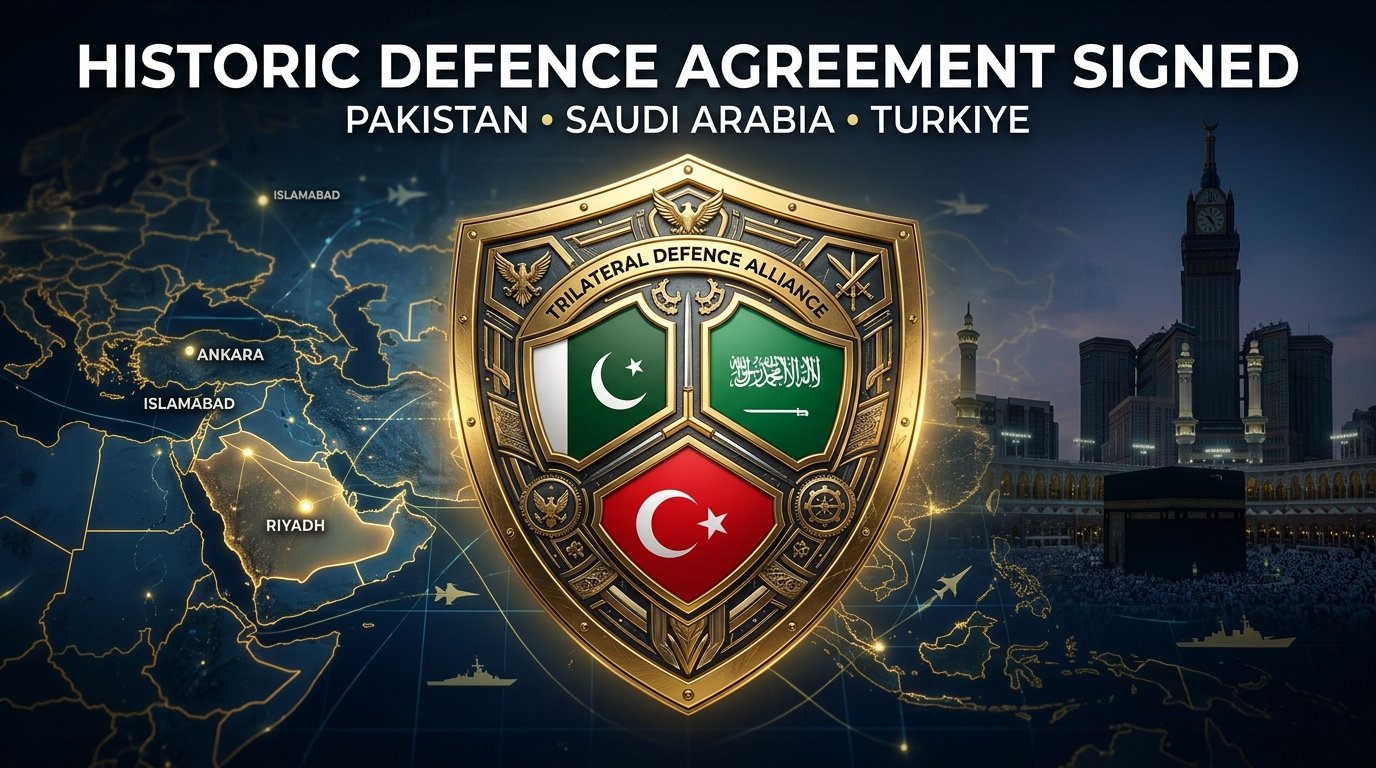
3 Nations Sign Historic Makkah Defence Pact as Pak, Saudi, Turk Unite
A Paradigm Shift in Regional Security: Pakistan, Saudi Arabia, and Türkiye Form Collective Defence Pact
In a momentous development at the heart of the Islamic world, Pakistan, Saudi Arabia, and Türkiye have officially entered into a landmark collective security arrangement. Formally concluded during the Makkah Al-Mukarramah Summit for Joint Defence at the Al-Safa Palace, this tripartite treaty fundamentally reshapes security dynamics across the Middle East, South Asia, and broader global geopolitical corridors.
As these three Nations Sign Historic Makkah defence guarantees, they signal a unified stance against external aggression while establishing a robust mechanism for mutual protection.
The agreement unites three distinct military and economic powers: Pakistan, the sole nuclear-armed state in the Muslim world; Saudi Arabia, home to Islam’s holiest sites and an energy superpower; and Türkiye, which commands NATO’s second-largest standing army. Together, this triad establishes an unprecedented deterrent framework built upon shared strategic interests, historical brotherhood, and economic synergies.
Understanding the Core Provisions of the Makkah Pact
At the foundation of the newly minted treaty lies a straightforward yet profound commitment: an armed attack against any single member state will be treated as an attack against all three. This clause mirrors the collective defense principle made famous by NATO’s Article 5, establishing a clear line of deterrence for potential adversaries.
┌─────────────────────────────────────────────────────────────────┐
│              MAKKAH JOINT DEFENCE AGREEMENT TRIAD               │
├────────────────────────┬───────────────────┬────────────────────┤
│        PAKISTAN        │   SAUDI ARABIA    │      TÜRKIYE       │
├────────────────────────┼───────────────────┼────────────────────┤
│ • Strategic Deterrence │ • Global Economic │ • Advanced Defence │
│   & Nuclear Status     │   & Energy Power  │   Tech & NATO Arm  │
│ • Experienced Troop    │ • Regional Anchor │ • Maritime & Air   │
│   Capabilities         │   & Host          │   Industry Assets  │
└────────────────────────┴───────────────────┴────────────────────┘
When these leading Nations Sign Historic Makkah pact commitments, they create a formal legal obligation to coordinate military, diplomatic, and defensive responses in times of crisis. Beyond immediate mutual defense, the framework calls for comprehensive cooperation across defense industries, joint military exercises, technology transfer, and intelligence sharing.
Diplomatic observers note that when these Nations Sign Historic Makkah collective defense initiatives, the emphasis remains squarely on defensive deterrence rather than offensive projection. Representatives from all three capitals have stressed that the arrangement complies with Article 51 of the United Nations Charter, preserving the inherent right of individual and collective self-defense.
For more context on international defense frameworks and security law, explore the UN Charter on Collective Self-Defense and review detailed coverage of Middle Eastern Strategic Security Alliances.
Strategic Motivations and Geopolitical Realities
The timing and venue of the signing carry immense weight. Sealing the treaty in Makkah, Islam’s holiest city, imbues the agreement with deep symbolic solidarity. However, behind the symbolism lie practical defense realities driven by an increasingly volatile global security climate.
Regional disruptions, maritime supply chain risks in the Red Sea and Gulf waters, and recurring regional conflicts have highlighted the need for self-reliant security structures. By ensuring these key Nations Sign Historic Makkah strategic security accords, the signatories lessen their sole dependence on external global powers while establishing localized conflict prevention mechanisms.
Complementary Strengths of the Signatories
-
Pakistan’s Military Readiness: Brings decades of operational warfare experience, specialized counter-terrorism capabilities, and strategic deterrence capacity.
-
Saudi Arabia’s Strategic Depth: Offers unmatched economic backing, pivotal geographical position, and leadership within the Gulf Cooperation Council (GCC).
-
Türkiye’s Technological Expertise: Supplies cutting-edge defense production—including unmanned aerial vehicles (UAVs), naval warships, and advanced electronic warfare systems—backed by NATO operational standards.
As these prominent Nations Sign Historic Makkah mutual defense pacts, the combination of these three assets forms a well-rounded security architecture capable of addressing both conventional and asymmetric challenges.
Key Statements from High-Level Leadership
The signing ceremony at Al-Safa Palace brought together top diplomatic and military leaders. Pakistani Prime Minister Shehbaz Sharif, Saudi Crown Prince and Prime Minister Mohammad bin Salman, and Turkish President Recep Tayyip Erdogan personally executed the document. Also in attendance was Pakistan’s Chief of Defence Forces, Field Marshal Asim Munir, alongside the foreign and defense ministers of all three states.
                     ┌──────────────────────────────┐
                     │    AL-SAFA PALACE SUMMIT     │
                     └──────────────┬───────────────┘
                                    │
         ┌──────────────────────────┼──────────────────────────┐
         ▼                          ▼                          ▼
┌─────────────────┐        ┌─────────────────┐        ┌─────────────────┐
│ PAKISTAN DELEG. │        │   SAUDI DELEG.  │        │  TÜRKIYE DELEG. │
├─────────────────┤        ├─────────────────┤        ├─────────────────┤
│ PM S. Sharif    │        │ Crown Prince    │        │ Pres. Erdogan   │
│ FM A. Munir     │        │ HRH MBS         │        │ Defense Min.    │
│ Foreign Min.    │        │ Foreign Min.    │        │ Foreign Min.    │
└─────────────────┘        └─────────────────┘        └─────────────────┘
Reflecting on the milestone, Prime Minister Shehbaz Sharif referred to the agreement as a “shield of peace,” emphasizing that it safeguards future generations while fostering regional stability.
Government spokespersons highlighted that as these Nations Sign Historic Makkah accords, the international community witnesses a practical model of regional ownership. Information Minister Attaullah Tarar noted that the agreement showcases growing international recognition of Pakistan’s defense capabilities and reinforces peaceful deterrence.
Similarly, Saudi Foreign Minister Prince Faisal bin Farhan underlined that when these Nations Sign Historic Makkah security protocols, they embody a shared political will to tackle common security challenges, pave the way for economic development, and preserve regional peace.
De-escalation and Reassurance to the Global Community
Addressing international queries regarding the alliance, diplomats from Riyadh, Ankara, and Islamabad reaffirmed that the treaty is not aimed against any third party. Saudi Deputy Minister for Public Diplomacy Rayed Krimly emphasized that the treaty does not constitute a military axis or a sectarian bloc.
Turkish officials echoed these points, clarifying that as these Nations Sign Historic Makkah non-aggressive defence frameworks, dialogue channels with neighboring countries remain fully open. The primary objective remains deterrence—raising the potential cost of unprovoked aggression to prevent conflict before it begins.
To analyze broader trends in Eurasian defense cooperation, readers can consult Global Military Capabilities Indices and review updates on Defense Industry News.
Long-Term Economic and Industrial Benefits
While the headline focus centers on troop readiness and mutual deterrence, the treaty’s defense-industrial dimension carries significant economic potential. Joint research, technology sharing, and co-production of military hardware will streamline procurement costs for all three nations.
-
Joint Defense Manufacturing: Co-development of aviation platforms, armored vehicles, and naval vessels.
-
Enhanced Interoperability: Standardized communication protocols and joint military exercises.
-
Economic Security: Better protection of critical maritime trade corridors, energy infrastructure, and commercial shipping lines.
Industry experts point out that as these Nations Sign Historic Makkah industrial defense clauses, economic resilience naturally strengthens alongside military preparedness.
Summary of Strategic Impact
| Strategic Area | Immediate Impact | Long-Term Vision |
| Deterrence | Article 5-style collective defence clause active | Reduced risk of localized regional aggression |
| Defense Industry | Shared technology and joint production | Self-reliance in military technology & arms manufacturing |
| Regional Stability | Unified diplomatic and military posture | Sustained economic growth & secure trade routes |
As these three prominent Nations Sign Historic Makkah security frameworks, they establish a durable blueprint for regional self-reliance, stability, and defense integration. By balancing strategic deterrence with an open commitment to peace, the Makkah Joint Defence Agreement marks a decisive turning point in modern diplomatic history.
Pingback: Grim Clash Spain Sets 24-Hour Border Controls as Italy Row
Pingback: PM Shehbaz Drives Major 1st National Youth Employment Revo