Iran War Trump Grim Threats Trigger 3 New Waves of US Attacks
The fragile peace in the Middle East has shattered. Following a brief and volatile truce, the region has been plunged back into active conflict as Washington and Tehran trade heavy blows in and around the strategically vital Strait of Hormuz. The collapse of recent diplomatic understandings has triggered a rapid sequence of military escalations, leaving international shipping routes compromised and regional capitals on high alert.
Red Alert in the Gulf as Tankers Burn
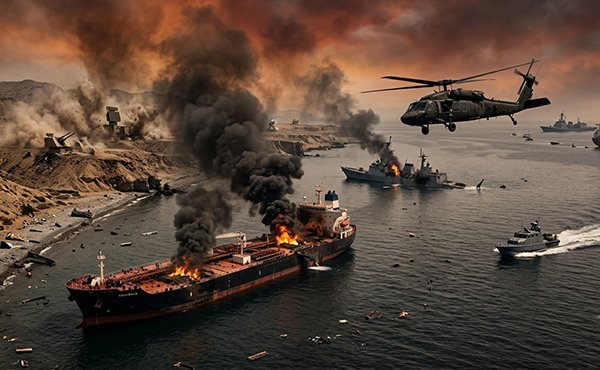
The United Arab Emirates confirmed a major escalation in Omani waters within the Strait of Hormuz. According to the UAE Ministry of Defence, Iranian cruise missiles targeted two commercial oil tankers: the Mombasa and the Al Bahiyah. The precision strike inflicted significant material damage and sparked intense fires on board both vessels.
Emergency response teams managed to bring the blazes under control, but the human cost was immediate. The attack killed an Indian national crew member on the Mombasa, while eight other mariners sustained serious injuries. Condemning the act as a “brazen” and “serious violation of international law,” Abu Dhabi declared it reserves its full right to respond to protect its territory, citizens, and residents.
Iran War Trump Grim Threats Actualized
As smoke cleared from the burning tankers, Washington moved swiftly to execute a military response. Addressing reporters in the Oval Office, President Donald Trump revealed that Tehran had attempted to reopen negotiations immediately after an apparent breakthrough agreement had been reached. However, Trump rejected the diplomatic overture, stating that Iran abruptly pulled back to demand further concessions.
In direct response to the breakdown, the administration initialized a massive wave of aerial and naval strikes. Trump stated plainly that the military would be hitting Iranian assets “very heavy tonight,” a vow that quickly manifested into reality. True to the Iran War Trump Grim Threats, U.S. Central Command (CENTCOM) launched a third consecutive night of heavy bombardments targeting Iranian offensive capabilities along the coastline.
Explosions Shake Iranian Port Cities
Local media outlets inside Iran confirmed that the American strikes hit hard. Massive explosions rattled the southern port cities of Jam and Bandar Abbas, alongside additional detonations reported on Kish Island. The strikes targeted Islamic Revolutionary Guard Corps (IRGC) naval installations, radar hubs, and coastal missile batteries used to disrupt maritime traffic.
Tehran’s state broadcaster, IRIB, quickly broadcasted retaliatory declarations. Iranian military officials claimed they executed counterstrikes against what they termed a “hostile vessel of the American enemy” as well as localized U.S. military assets stationed in Kuwait. Simultaneously, Iran’s military high command issued a stark warning to Washington, declaring that any attempt by the U.S. Navy to “interfere” with or monopolize the management of the Strait of Hormuz would be met with overwhelming force.
The escalating rhetoric directly responds to the Iran War Trump Grim Threats to position the United States as the permanent “guardian” of the critical waterway.
Reimposing the Total Maritime Blockade
The geopolitical fallout is rapidly cascading into a global economic and logistical crisis. CENTCOM officially announced that U.S. naval forces will formally enforce a strict, reimposed maritime blockade on all Iranian ports starting at 20:00 GMT on Thursday. The blockade aims to entirely halt Iranian oil exports and intercept inbound cargo vessels suspected of carrying dual-use military hardware.
| Blockade Parameters | Details & Timelines |
| Enforcement Body | U.S. Central Command (CENTCOM) |
| Effective Date & Time | Thursday at 20:00 GMT |
| Operational Mandate | Complete interception, diversion, and capture of unauthorized vessels |
| Primary Target | Inbound and outbound shipping across the entire Iranian coastline |
As the Iran War Trump Grim Threats materialize into a locked-down Gulf, local nations are bracing for immediate retaliatory crossfire. In Bahrain, home to the U.S. Navy’s Fifth Fleet, emergency air raid sirens blared across metropolitan areas. The Bahraini Interior Ministry issued urgent public safety alerts, instructing civilians to remain calm and immediately seek shelter in designated safe locations.
Consular Closures and Shifting Diplomatic Fault Lines
The threat matrix has caused severe diplomatic disruptions. Citing an unstable regional security situation, the U.S. Embassy in Abu Dhabi and the U.S. Consulate in Dubai suspended all standard consular appointments through Wednesday. Diplomatic missions instructed personnel and the public to avoid embassy grounds until the immediate threat of missile or drone strikes subsides.
Amid the chaotic backdrop of the Iran War Trump Grim Threats, secondary diplomatic crises are intensifying across the wider Middle East. In Cairo, the newly appointed Secretary-General of the Arab League, Nabil Fahmy, held his maiden press conference and immediately shifted focus to the ongoing instability in Palestine. Fahmy strongly condemned Israeli military operations in Gaza and the West Bank, calling them an ongoing genocide that requires a unified, resolute Arab stance.
Fahmy specifically highlighted the preservation of Jerusalem’s Arab identity against unilateral attempts to alter its status. The statement comes directly after Israel allegedly blocked the Arab League chief from visiting Ramallah in the occupied West Bank last week.
Israeli Political Friction Compounds the Crisis
The regional eruption has also exposed severe political rifts inside Israel. Right-wing Finance Minister Bezalel Smotrich publicly voiced deep anxieties regarding a potential return to the framework of the historic Oslo Accords. The original accords marked the first mutual recognition between Israeli and Palestinian leadership. Smotrich, a staunch proponent of expanding settlements, fears that the shifting global focus driven by the Iran War Trump Grim Threats could create international pressure to revive historical peace frameworks.
Global Markets Braced for Friction
With the U.S. military moving to systematically degrade Iran’s defensive capabilities and enforce a total commercial embargo, energy markets are preparing for record-breaking volatility. Under the shadow of the Iran War Trump Grim Threats, global oil prices have spiked as shipping companies begin routing mega-tankers completely away from the Persian Gulf.
The underlying truth of the current standoff remains clear: the short-lived diplomatic framework has dissolved entirely. As military forces mobilize and blockades take effect, the Iran War Trump Grim Threats have locked both Washington and Tehran into a dangerous cycle of kinetic escalation with no clear off-ramp in sight.
Whether the pressure of the renewed blockade forces Iran back to the negotiating table or ignites a broader regional conflagration depends heavily on how the next forty-eight hours unfold. For now, the global economy can only watch as the Iran War Trump Grim Threats reshape the geopolitical landscape of the Middle East in real time.
The strategic cost of keeping the world’s most volatile energy chokepoint open has just gone up exponentially. As the international community prepares for a long, drawn-out blockade, the reality of the Iran War Trump Grim Threats continues to dominate headlines worldwide.