
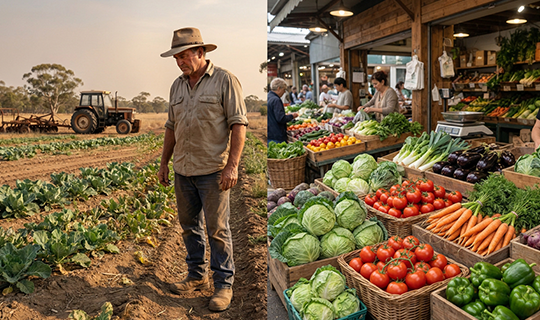
Australia sleepwalks into a devastating food crisis as 3 brutal costs crush farmers
Australia’s reputation as an agricultural powerhouse is facing its most severe threat in generations. While everyday families struggle with soaring checkout bills, a quiet exodus is taking place across the nation’s farmlands. According to a landmark industry sentiment survey released by national peak body AUSVEG, a staggering 85% of Australian vegetable growers are actively considering walking away from their farms. This alarming trend indicates that Australia sleepwalks into a catastrophic food security crisis unless immediate structural interventions are made.
The crisis hits at the very core of domestic self-sufficiency. Local growers currently supply approximately 98% of the fresh vegetables consumed by Australians—amounting to roughly 10,000 tonnes of fresh produce delivered to markets every single day. If these growers exit the industry, the nation risks becoming heavily reliant on imported perishables, leaving household nutrition and food supply chains vulnerable to global market shocks. Experts warn that as Australia sleepwalks through this mounting emergency, the window to save family-run agricultural operations is rapidly closing.
3 Brutal Costs Crushing Australia’s Farmers
At the heart of the crisis are three relentless cost pressures that have systematically eroded the viability of farming. As Australia sleepwalks past these warning signs, vegetable growers find themselves caught in a financial vise, squeezed by overheads they cannot pass on to major retail buyers.
1. Skyrocketing Fuel and Energy Tariffs
Global energy market volatility, exacerbated by escalating conflicts in the Middle East, has sent farm operational costs into overdrive. Farmers rely heavily on diesel for tractors, heavy machinery, and long-haul refrigerated transport, while electricity is vital for cold storage and irrigation pumps. With fuel and electricity prices reaching record highs, basic farm running costs have ballooned beyond sustainable limits.
2. Prohibitive Labor Costs and Workforce Shortages
Agricultural labor has become both increasingly scarce and prohibitively expensive. Compliance burdens, seasonal worker program changes, and minimum wage increases have pushed labor costs to the highest levels in the industry’s history. For labor-intensive vegetable crops—where harvesting, sorting, and packing are primarily done by hand—payroll alone now accounts for the lion’s share of operating budgets.
3. Spiraling Input Expenses (Fertilizer, Seed, and Water)
The price of critical agricultural inputs has experienced unprecedented surges. Synthetic fertilizers, specialized seeds, pest control materials, and water access rights have driven production costs upward. When these three brutal burdens combine, they form a financial barrier that individual farming families simply cannot survive.
The Bleak Reality Behind the Numbers
The latest AUSVEG data paints a grim picture of financial exhaustion across the agricultural sector. Of the hundreds of commercial vegetable growers surveyed:
-
88% stated they are in a worse financial position than they were just 12 months ago.
-
Nearly 70% reported that their net profit margins have plunged by at least 20% over the last five years.
-
85% are considering exiting vegetable production entirely, citing unviable returns and an inability to reinvest.
AUSVEG Chief Executive Michael Coote emphasized that these findings must serve as a critical wake-up call for federal policymakers and supply chain regulators. “As more and more growers look to leave the industry, we are facing a point of no return when it comes to Australia’s vegetable supply,” Coote warned. The reality that Australia sleepwalks into reliance on international food supplies is no longer a distant theoretical risk—it is happening on farms right now.
The Supermarket Disconnect: Farmers Squeezed While Prices Soar
For Australian consumers, the crisis is experienced through sticker shock at the checkout. Household budget tracker Canstar reports that supermarket grocery prices have jumped 8.5% over the past year. Yet, despite shoppers paying more for fresh produce, farmers are receiving little of that increase, with returns failing to cover the rising cost of production.
Politicians have clashed over the appropriate response. Trade Minister Don Farrell pointed to negotiations surrounding a free trade agreement with the European Union as a mechanism to introduce downward pressure on retail goods. However, Nationals Senator Matt Canavan fiercely rejected that approach, echoing farm group sentiments that called the policy response “pathetic, embarrassing, and a kick in the guts.” Canavan cautioned that Australia sleepwalks toward food insecurity by ignoring the fundamental domestic cost pressures destroying family farms.
Why “Sleepwalking” Could Lead to a Point of No Return
Food production cannot simply be switched back on once a farm goes under. When a multi-generational grower sells up, valuable agricultural knowledge is lost, packing infrastructure degrades, and prime agricultural land is often permanently subdivided or converted to non-food uses.
Critics argue that federal leaders and major retailers are largely indifferent while Australia sleepwalks into a structural deficit, ignoring the reality that fresh, affordable produce requires thriving local growers. If the current trajectory continues, Australia faces a future where fresh vegetables become luxury items rather than staple foods.
Industry bodies are demanding immediate interventions, including:
-
Mandatory Supermarket Codes of Conduct: Enforcing fair pricing practices so growers receive a sustainable share of retail prices.
-
Targeted Energy and Fuel Relief: Providing dedicated offsets for primary producers exposed to global fuel shocks.
-
Labor Compliance Simplification: Streamlining seasonal agricultural worker programs to lower administrative costs.
-
Disaster and Input Grants: Assisting farms to invest in technology that lowers water and fertilizer usage. Australia sleepwalks into a devastating food crisis as 3 brutal costs crush farmers
Conclusion: A Turning Point for Australian Food Security
The numbers leave no room for ambiguity. Australia cannot afford to lose the producers who provide 98% of its fresh vegetables. If Australia sleepwalks past this crisis, the resulting dependency on global supply chains will inevitably drive costs even higher while leaving the nation vulnerable to international trade shocks.
To prevent Australia sleepwalks from turning into a full-scale food emergency, policy leaders, supermarket chains, and consumers must recognize that cheap food cannot come at the expense of farm survival. Supporting local growers is not just an economic issue—it is the foundation of national security. Australia sleepwalks into a devastating food crisis as 3 brutal costs crush farmers