
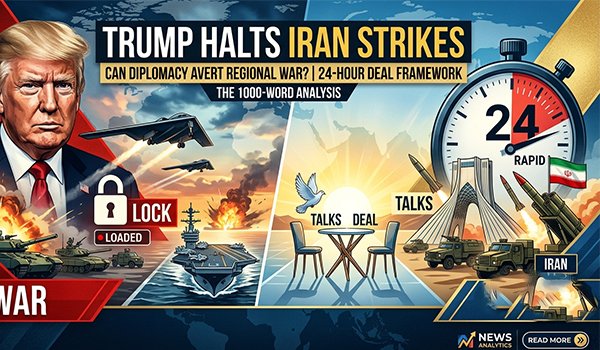
Trump Halts Iran Strikes in 24 Hours Bold Deal Needed for Rapid Peace
Trump Halts Iran Strikes: Brinkmanship, Diplomacy, and the High-Stakes Gamble in the Middle East
The Middle East stood on the precipice of a massive military confrontation this weekend before a dramatic announcement altered the trajectory of the ongoing crisis. In a series of high-profile statements, the White House signaled a sudden shift in military posture. When Trump Halts Iran Strikes, the global diplomatic landscape shifts dramatically overnight, raising urgent questions about whether a lasting peace agreement is truly within reach or if this is simply a temporary pause in a volatile conflict.
The Sudden Pause on Military Action
The pivot came directly from President Donald Trump via a post on Truth Social, where he revealed that planned military action against Iranian infrastructure had been paused. According to the administration, the decision came after urgent appeals from Iran and key regional allies in the Middle East who requested time to negotiate.
The announcement followed days of intense speculation that US and Israeli forces were preparing one of the most severe bombing campaigns to date targeting Iranian energy infrastructure. However, as news spread that Trump Halts Iran Strikes, conditional on a deal being struck “rapidly,” world leaders and financial markets scrambled to assess the credibility of the proposed peace framework.
“The USA is locked and loaded and ready to go… Despite this, we have just been asked by Iran, and other Middle Eastern Countries, to hold off any attack in that the perimeters of a deal has been agreed to.” — President Donald Trump
What the “Perimeters of a Deal” Look Like
According to US statements, the framework for halting direct aggression rests on two non-negotiable demands:
-
Reopening the Strait of Hormuz: Immediate and complete unblocking of the vital maritime bottleneck to restore commercial shipping and stabilize energy markets.
-
Ending Iran’s Nuclear Program: Verifiable commitments to halt nuclear enrichment activities and remove threats to regional security.
Many foreign policy analysts wondered why Trump Halts Iran Strikes at the eleventh hour when military preparations were already finalized. The administration maintains that granting diplomacy a narrow window serves global stability and gives Tehran an exit ramp before catastrophic destruction occurs.
Tehran’s Skepticism and High Military Alert
Despite Washington’s optimistic framing of a potential deal, the response from Tehran has been starkly different. Official and semi-official news outlets in Iran quickly disputed the claim that they had begged for a pause. Iran’s Mehr news agency went so far as to label the statement “nothing but a new lie,” insisting that Iranian forces remain at peak readiness.
Iranian leadership emphasized that whether Trump Halts Iran Strikes or escalates them, their military views every threat as real and credible. Iran’s acting Defence Minister, Majid Ibn al-Reza, made it clear that Tehran would neither be caught off guard nor remain passive amid what it views as psychological warfare.
┌─────────────────────────────────────────────────────────┐
│              STAKEHOLDER PERSPECTIVES                   │
├───────────────────────────┬─────────────────────────────┤
│ Washington's View         │ Tehran's View               │
├───────────────────────────┼─────────────────────────────┤
│ • Pause contingent on deal│ • Denies requesting a pause │
│ • "Locked and loaded"     │ • High military readiness   │
│ • Wants open waterways    │ • Rejects coercion/threats  │
└───────────────────────────┴─────────────────────────────┘
The Role of Regional Allies: Saudi Diplomacy at Work
Behind the scenes, intense diplomatic pressure from Gulf nations played a pivotal role in changing Washington’s timeline. Reports indicate that Saudi Crown Prince Mohammed bin Salman held an urgent phone call with President Trump. The Crown Prince emphasized the imperative of dialogue and the grave danger of drawing the broader region into an all-out war.
Gulf allies share a deep concern: while the US mainland is protected by distance, countries like Saudi Arabia, Bahrain, Jordan, and the UAE sit well within reach of Iranian missile stockpiles. Critical infrastructure—such as oil refineries and vital water desalination plants—would be primary targets in a full-scale exchange. It is largely due to these regional security concerns that Trump Halts Iran Strikes, opening a momentary corridor for high-stakes diplomacy.
Domestic Pressures and Economic Realities
Beyond international diplomacy, domestic factors inside the United States heavily influence these strategic decisions. The ongoing conflict and blockades have triggered severe fluctuations in global oil prices, creating economic ripples across the globe.
+-------------------------------------------------------------+
| KEY FACTOR: US Public Sentiment on Iran Conflict             |
+-------------------------------------------------------------+
| Disapprove of War: ~60%                                    |
| Approve/Undecided: ~40%                                     |
| (Source: Pew Research Center Data)                          |
+-------------------------------------------------------------+
As public disapproval climbs, political analysts observe that Trump Halts Iran Strikes partly to manage domestic blowback ahead of crucial midterm elections. American voters are increasingly sensitive to gas price surges and prolonged foreign entanglements, giving the White House strong incentives to achieve a fast resolution rather than an extended war of attrition.
The “Madman Theory” vs. Strategic Friction
This dynamic is not entirely unfamiliar to observers of current American foreign policy. Throughout his term, Trump has frequently deployed maximum pressure and apocalyptic warnings—such as declaring that “a whole civilization will die tonight”—only to follow up with sudden offers to negotiate.
Supporters view this strategy as a textbook application of the “Madman Theory,” arguing that unpredictable, aggressive threats force adversaries to the bargaining table. Critics, however, point out that past face-to-face talks have often collapsed under the weight of incompatible red lines. The fundamental question remains: as Trump Halts Iran Strikes, can coercive diplomacy yield a binding, verifiable treaty this time around, or will negotiations stall once again?
Economic Volatility and Global Shipping Risks
The maritime environment in the Strait of Hormuz remains one of the most delicate aspects of the standoff. With significant portions of global oil traffic passing through this corridor, any disruption directly impacts global supply chains.
When Trump Halts Iran Strikes, energy traders temporarily breathe a sigh of relief, but volatility remains high as long as military forces remain stationed across the Persian Gulf.
What Happens Next?
The coming days will test whether this temporary pause translates into a durable diplomatic breakthrough. Negotiators face an incredibly tight timeline to reconcile deeply entrenched differences over nuclear development, maritime routes, and regional security architecture.
Ultimately, as Trump Halts Iran Strikes, the world waits to see whether “rapid” negotiations can prevent an even larger regional war or if military options will return to the table.

Pingback: Iran and Oman Near Historic 2-Nation Breakthrough in Final