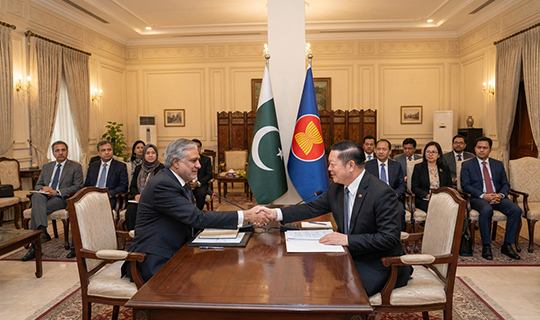
Pakistan and the Association of Southeast Asian Nations (ASEAN) have taken a decisive step forward in their diplomatic relationship, pledging to scale up cooperation across a range of transnational issues. During an official working visit to Islamabad, Deputy Prime Minister and Foreign Minister Ishaq Dar and ASEAN Secretary-General Dr. Kao Kim Hourn convened high-level, delegation-level talks at the Ministry of Foreign Affairs. Following their comprehensive discussions, DPM Dar ASEAN leader unite on a forward-looking roadmap to enhance strategic partnership, economic integration, and regional security.
Marking the first visit by an ASEAN secretary-general to Pakistan in over two decades, the engagement signifies a major milestone. Both sides expressed an urgent need to build beyond traditional diplomacy and translate historical goodwill into practical, modern cooperation. As DPM Dar ASEAN leader unite to address urgent bilateral priorities, the focal point of their joint agenda centers around combating four critical non-traditional security challenges that threaten regional prosperity.
The Four Non-Traditional Security Challenges
At a joint press stakeout following their talks, Deputy Prime Minister Dar highlighted that conventional military threats are no longer the only dangers facing developing economies. Today, DPM Dar ASEAN leader unite against non-traditional security challenges that directly impact hundreds of millions of livelihoods. These four critical pillars include:
-
Climate Change & Environmental Resilience: Both South Asia and Southeast Asia are among the world’s most vulnerable zones to extreme weather, rising sea levels, and catastrophic flooding.
-
Food Insecurity: Disrupted agricultural yields and fluctuating regional supply chains make cross-border agricultural collaboration paramount.
-
Disruptions to Energy Supplies: Geopolitical volatility has rendered energy grids vulnerable, prompting calls for renewable energy diversification.
-
Cyber Threats & Digital Infrastructure Vulnerabilities: Rapid digital expansion has exposed networks to transnational cybercrime and infrastructure vulnerabilities.
“Our ability to respond to these challenges together is vital to the security of our people and the sustainability of our development,” Dar emphasized. When DPM Dar ASEAN leader unite on these four frontiers, they create a collaborative framework designed to pool resources, share early-warning intelligence, and build resilient infrastructure.
Expanding Economic, Digital, and Academic Integration
While non-traditional security dominated the security briefing, economic ties emerged as the operational engine of the dialogue. The leaders agreed that the current trade volume between Pakistan and the ten-member ASEAN bloc remains far below its true potential. To bridge this gap, DPM Dar ASEAN leader unite to revitalize business-to-business links, building upon previous ASEAN-Pakistan business conferences to open up new market access, facilitate customs procedures, and remove trade barriers.
Key Pillars of the Enhanced Cooperation Framework:
-
Trade and Market Connectivity: Linking Pakistani enterprises with Southeast Asian supply chains, with an emphasis on textiles, agriculture, pharmaceuticals, and manufacturing.
-
Technology & Artificial Intelligence: Fostering academic and technological partnerships between universities and research institutions to drive joint research in AI and digital transformation.
-
Renewable Energy Collaboration: Dr. Kao Kim Hourn highlighted significant untapped potential in renewable energy investments, encouraging joint initiatives in solar, wind, and sustainable power grids.
-
Youth & Cultural Exchanges: Promoting people-to-people connectivity, academic scholarships, and tourism to solidify societal ties.
Regional Stability, Sea Lanes, and Geopolitical Priorities
The discussions also touched upon broader regional and global peace. Dar underscored the importance of ensuring secure sea lines of communication and uninterrupted maritime supply chains, which are crucial for Pakistan’s maritime trade as well as Southeast Asia’s maritime lifelines. In an era marked by shifting geopolitical alliances, DPM Dar ASEAN leader unite in reaffirming the central role of international law, diplomacy, and adherence to the United Nations Charter to resolve complex disputes.
Additionally, DPM Dar briefed the ASEAN delegation on South Asia’s security dynamics, emphasizing Pakistan’s stance on a just and peaceful settlement of the Jammu and Kashmir dispute in accordance with relevant UN Security Council resolutions. He expressed deep concern over India’s unilateral decision to hold the Indus Waters Treaty in abeyance—warning that such moves threaten the water, food, and energy security of Pakistan—and highlighted ongoing concerns regarding the use of Afghan territory for cross-border terrorist attacks.
On global humanitarian issues, Dar raised serious concerns regarding the expansion of illegal settlements in the West Bank, calling for unrestricted humanitarian aid to Gaza and advocating for an independent Palestinian state. Hourn also recognized Pakistan’s constructive role in international mediation, acknowledging its diplomatic efforts in facilitating dialogue and de-escalation between regional powers, including the signing of the Islamabad Memorandum of Understanding in June.
Looking Ahead: A New Era of ASEAN-Pakistan Partnership
As DPM Dar ASEAN leader unite to implement these agreements, the diplomatic community will watch closely to see if working groups can translate joint declarations into tangible trade agreements, joint cyber-defense exercises, and coordinated climate responses. In a multipolar world fraught with uncertainty, DPM Dar ASEAN leader unite to show that regional blocks and sovereign nations can find common ground to safeguard human security.
With the White House, regional capitals, and ASEAN headquarters focusing heavily on Indo-Pacific stability, this Islamabad meeting proves that proactive diplomacy remains the best defense against emerging global crises. When DPM Dar ASEAN leader unite to address non-traditional threats, they build a resilient foundation that will benefit generations to come across both South and Southeast Asia.