US Hits Iran Nuclear Site 7 Shocking Fallout After Kuwait Plant Attack
The Middle East is navigating an incredibly volatile chapter, characterized by a fragile balance of high-stakes diplomacy and sudden military escalations. From the halls of the US State Department to the tents of displaced families in Gaza, the regional landscape has been fundamentally reshaped.
Here is a comprehensive look at the diplomatic maneuvers, ongoing conflicts, and dangerous tit-for-tat escalations defining the region today.
1. The Washington-Beirut Connection: A New Trilateral Framework
In a major diplomatic development, US Secretary of State Marco Rubio met with Lebanese President Joseph Aoun in Washington, DC. The primary focus of their discussion was the implementation of a US-backed Trilateral Framework designed to restore stability along the volatile Lebanon-Israel border.
According to an official statement from the US State Department, Secretary Rubio commended the “courage” and “determined effort” of the Lebanese government under President Aoun’s leadership. The US explicitly praised Lebanon’s stated goals to reclaim its national sovereignty and disarm the militant group Hezbollah.
This diplomatic push comes at a critical time. Security dynamics across the Middle East transformed heavily after the US Hits Iran Nuclear Site incident, forcing neighboring countries to rapidly recalibrate their foreign policies. For Lebanon, the US-mediated negotiations—which recently concluded a round of talks in Rome—are focused on three core pillars:
-
Strengthening the active ceasefire.
-
Securing a full Israeli withdrawal from southern Lebanon.
-
Restoring long-term security and economic stability across the country.
President Aoun’s visit to Washington concludes a series of high-level engagements, setting the stage for a crucial meeting with US President Donald Trump. This marks the first official visit by a Lebanese president to Washington since 2009, highlighting the urgency of the current crisis.
2. Ceasefire Strained: Tragic Realities in Khan Younis
While diplomats talk peace in Washington, the reality on the ground remains devastatingly fluid. In southern Gaza, an Israeli air strike targeted a cluster of tents sheltering displaced families in the al-Mawasi area of Khan Younis. According to reports from the Wafa news agency, the strike killed at least one Palestinian and left ten others wounded.
What makes this strike particularly concerning to international observers is that it occurred despite Israel and Hamas previously agreeing to a ceasefire framework in October. The truce has proven incredibly fragile. Since its implementation, near-daily attacks have claimed the lives of more than 1,100 Palestinians, while four Israeli soldiers have also been killed in ongoing hostilities.
Many analysts trace this breakdown in security back to the regional chain reaction set off when the US Hits Iran Nuclear Site operation took place. The resulting geopolitical chaos has made it difficult for local ceasefires to hold, as proxy networks and state actors remain on high alert.
3. The Shadow War Heat Up: Iran Claims It Shot Down a US Drone
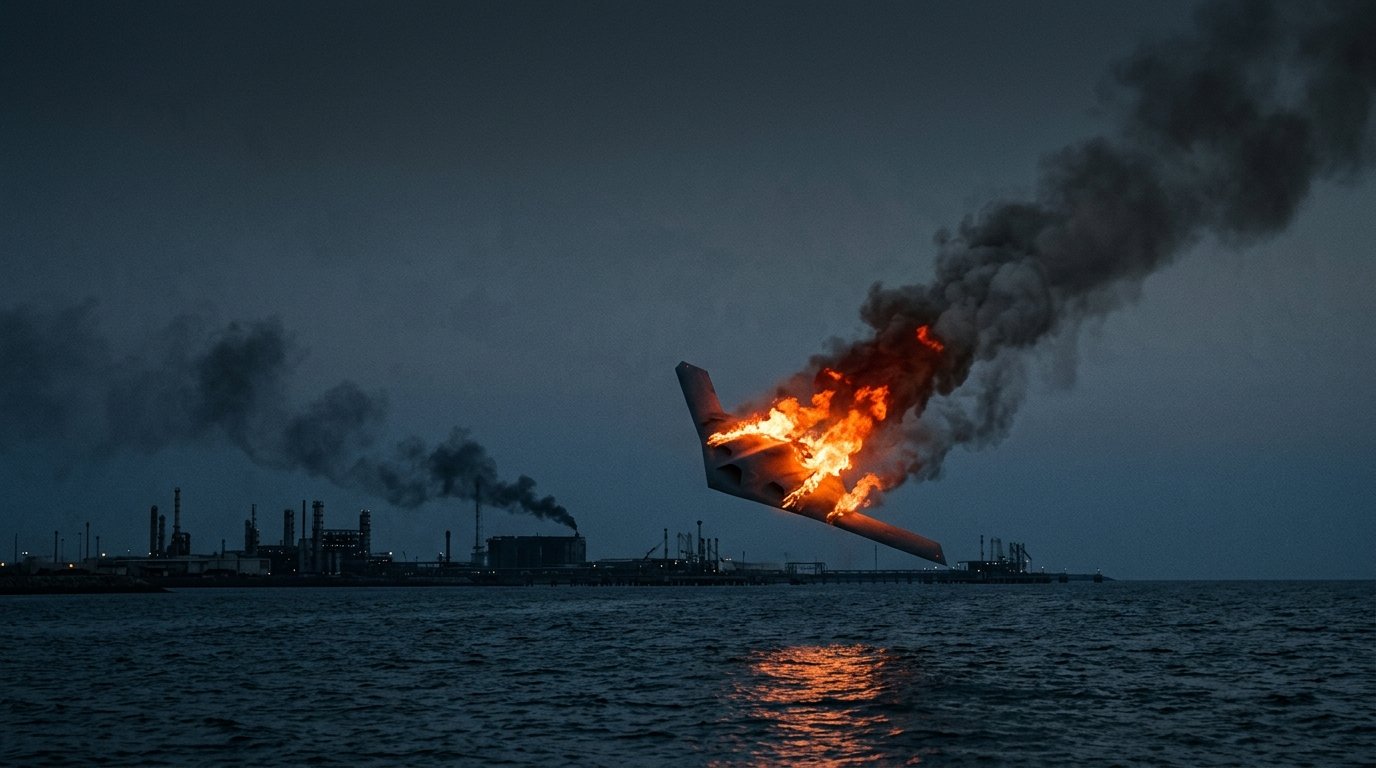
The direct confrontation between Washington and Tehran continues to manifest in dangerous airspace encounters. The Iranian military recently announced that its navy’s air defense systems successfully intercepted and shot down an American LUCAS drone in southern Iran.
To corroborate the claim, Iran’s state-run IRNA news agency published photographs showing what appears to be the severely damaged fuselage of the uncrewed aircraft.
What is the LUCAS System?
The Low-cost Uncrewed Combat Attack System (LUCAS) represents a newer class of affordable, tactical combat drones deployed by US forces.
The US military began utilizing these specialized uncrewed systems in the region earlier this year. Tensions in the shared airspace reached a boiling point after the initial reports surfaced that the US Hits Iran Nuclear Site, leading to a dramatic increase in surveillance, electronic warfare, and direct kinetic interceptions over the Persian Gulf.
4. Gulf Instability: Lebanon Condemns Strikes on Kuwait and Jordan
The ripples of the US-Iran confrontation are spreading far beyond their immediate borders, threatening traditional zones of neutrality in the Gulf. Lebanese Prime Minister Nawaf Salam issued a strong, public condemnation of ongoing Iranian military strikes targeting Kuwait and Jordan.
In official phone calls with Kuwaiti Prime Minister Ahmad Abdullah Al-Ahmad Al-Sabah and Jordanian Prime Minister Jaafar Hassan, Salam made Lebanon’s position entirely clear. He stated that these repeated aerial attacks constitute a “blatant violation of the security and territorial integrity” of both nations and present a “direct threat to the security of the Arab region.” US Hits Iran Nuclear Site 7 Shocking Fallout After Kuwait Plant Attack
The Presidency of the Council of Ministers in Beirut emphasized that Lebanon maintains a steadfast stance alongside its Arab neighbors in confronting any actions that undermine sovereign borders. Regional security experts note that these unprecedented multi-front missile and drone paths expanded rapidly after the US Hits Iran Nuclear Site timeline began, dragging previously stable nations into the crossfire.
5. Is Tehran Overplaying Its Hand?
Geopolitical experts are raising alarm bells regarding Iran’s current military strategy. Mehran Kamrava, a professor at Georgetown University in Qatar, notes that while Iranian forces appear to be adhering to a strict “principle of proportionality”—deliberately targeting foreign facilities similar to those struck inside its own borders—the long-term risks are immense. US Hits Iran Nuclear Site 7 Shocking Fallout After Kuwait Plant Attack
Ever since the historic day the US Hits Iran Nuclear Site, Tehran has engaged in aggressive posturing across the Gulf Cooperation Council (GCC) region. However, Kamrava warns that “Tehran has repeatedly overplayed its hand throughout history.” US Hits Iran Nuclear Site 7 Shocking Fallout After Kuwait Plant Attack
| Regional Risk Factor | Potential Impact |
| Strait of Hormuz Vulnerability | Excessive military friction could render the vital transit choke point redundant. |
| Energy Route Diversion | Major Gulf nations are already investing heavily in alternative pipelines to bypass Iranian waters entirely. |
| Economic Isolation | Continued escalation risks permanent economic decoupling from Western and regional trade networks. |
The narrative surrounding how the US Hits Iran Nuclear Site continues to dictate future oil routes, and Iran’s aggressive responses may inadvertently accelerate its own economic and geographic isolation.
6. The Uphill Battle for Regional Mediators
In an effort to prevent a total regional collapse, a flurry of back-channel diplomacy is underway. The Iraqi Prime Minister, Ali al-Zaidi, and Turkish Foreign Minister, Hakan Fidan, recently held independent, high-level meetings with the Emir of Qatar, Sheikh Tamim bin Hamad Al Thani. US Hits Iran Nuclear Site 7 Shocking Fallout After Kuwait Plant Attack
The discussions quickly pivoted toward exploring realistic ways to resurrect dialogue, de-escalate ongoing military actions, and coordinate joint diplomatic efforts. Because both Turkey and Iraq share physical borders and maintain strong economic and political ties with Iran, these nations are uniquely positioned to exert political pressure on Tehran to halt its regional attacks. US Hits Iran Nuclear Site 7 Shocking Fallout After Kuwait Plant Attack
However, the path forward is incredibly steep. International mediators face an uphill battle to restore order now that the US Hits Iran Nuclear Site reality has shifted borders, altered security doctrines, and hardened political rhetoric. With both Washington and Tehran actively pulling away from the negotiating table, any attempt to broker a lasting peace will require monumental diplomatic leverage