1000 Lawyers Firmly Boycott Courts Over Governor’s Cruel Rule Direc
Constitutional Crisis in K-P: Why Lawyers Firmly Boycott Courts Over Governor’s Rule
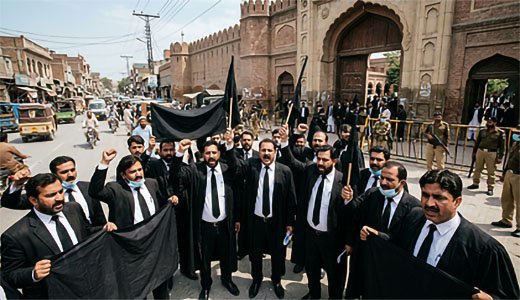
Courthouses across Khyber-Pakhtunkhwa (K-P) stood virtually empty on Monday as the region’s legal fraternity staged a comprehensive, province-wide strike. Following a unanimous call by the K-P Bar Council, legal professionals abstained from all judicial proceedings to express strong opposition to the federal government’s sudden imposition of governor’s rule and a state of emergency in the province.
This dramatic escalation in the ongoing political and constitutional standoff has brought routine judicial business to a grinding halt. From the district courts in rural precincts to the Peshawar High Court, hearing schedules have been shattered, leaving thousands of litigants in limbo. The core issue behind this movement is fundamental: the legal community views the federal executive’s intervention as an unconstitutional power grab that undermines democratic governance and the rule of law.
A Direct Challenge to Constitutional Order
The decision by the federal executive branch to declare a state of emergency and enforce governor’s rule in Khyber-Pakhtunkhwa has drawn intense condemnation across the political and legal spectrum. According to statements released by leadership at the K-P Bar Council, the federal government’s actions bypass clear statutory mandates and constitutional safeguards designed to protect provincial autonomy.
In response to what they characterize as an arbitrary federal overreach, lawyers firmly boycott courts across every district in Khyber-Pakhtunkhwa. Bar leaders emphasize that their refusal to appear before judges is not merely a labor dispute or a temporary grievance, but a principled stance against the erosion of constitutional norms.
The Bar Council declared that the notifications issued by federal authorities fail to satisfy the rigorous criteria required to suspend provincial self-governance. By taking a stand, the legal community aims to send an unmistakable message to Islamabad: executive actions that violate the constitution will encounter relentless resistance from those sworn to uphold the law.
Widespread Impact on the Judicial System
The strike’s impact was immediate and absolute. On Monday, as judges took their benches, courtroom podiums remained deserted. As lawyers firmly boycott courts, critical criminal bail applications, civil property suits, and routine administrative hearings were postponed indefinitely.
-
Empty Rosters: Court registers across Peshawar, Mardan, Abbottabad, Swat, and surrounding districts showed near-zero attendance from licensed advocates.
-
Litigant Disruption: Citizens traveling long distances for scheduled appearances found closed doors and empty halls, demonstrating the real-world friction caused by sudden executive interventions.
-
Bar Association Unity: District bar associations uniformly aligned with the central council’s directive, refusing to conduct even urgent matters.
Legal experts note that while court shutdowns create an immediate backlog, the broader implications for the rule of law are far more significant. When lawyers firmly boycott courts, it serves as an early warning system for the public that democratic checks and balances are under severe strain.
Legality Tested: Petitions Filed at the Peshawar High Court
While advocate ranks maintained their strike on the ground, the battle simultaneously expanded into the legal arena. Multiple constitutional petitions have been formally submitted before the Peshawar High Court (PHC), challenging the constitutional validity of the governor’s rule and emergency declarations.
The petitioners—comprising senior advocates, civil rights activists, and public representatives—have asked the High Court to issue a writ of mandamus and declare the federal notifications null and void. The petitions contend that:
-
The conditions required to declare a emergency under constitutional provisions were not met.
-
The federal government failed to demonstrate that provincial constitutional machinery had completely broken down.
-
Relevant parliamentary resolutions passed to justify the move lack legal standing and merit immediate judicial annulment.
As lawyers firmly boycott courts in protest, these filed petitions demand urgent judicial intervention to restore the constitutional status quo and preserve provincial sovereignty.
Key Demands of the K-P Legal Fraternity
The K-P Bar Council has outlined clear conditions for ending their campaign. Central to their demands is an immediate review and withdrawal of the emergency notifications by the federal government.
| Demand Category | Specific Objective | Expected Outcome |
| Constitutional Compliance | Full revocation of Governor’s Rule | Restoration of elected provincial executive powers |
| Emergency Withdrawal | Immediate annulment of emergency notifications | Re-establishment of fundamental rights protections |
| Judicial Integrity | Respect for court jurisdiction & autonomy | Preservation of checks and balances against executive overreach |
| Political Dialogue | Resolution of federal-provincial disputes through debate | Long-term constitutional stability in K-P |
Bar leaders contend that federal-provincial disagreements must be resolved through constitutional mechanisms and parliamentary debate, rather than executive mandates. Until the federal government demonstrates a willingness to reverse its decisions, lawyers firmly boycott courts to maintain pressure on decision-makers in Islamabad.
Historical Context and Provincial Autonomy
This current confrontation is part of a longer historical context involving federal-provincial relations in Pakistan. The constitutional framework grants clear autonomy to federating units, strictly limiting federal intervention to exceptional circumstances where governance has entirely collapsed.
When federal authorities bypass these boundaries, the legal community traditionally steps forward as a primary defender of civil rights and constitutional order. In this case, as lawyers firmly boycott courts, they draw upon a legacy of legal activism aimed at curbing executive overreach.
The Bar Council’s rhetoric stresses that allowing governor’s rule to stand unchecked sets a dangerous precedent for all provinces. If a federal cabinet can dissolve or bypass provincial authority without meeting high legal standards, the principle of provincial autonomy becomes meaningless.
What Lies Ahead for Khyber-Pakhtunkhwa?
The coming days will be critical in determining whether this constitutional standoff escalates or resolves through dialogue. With proceedings stalled as lawyers firmly boycott courts, pressure is mounting on both the federal government and the judiciary to deliver a swift, legally sound resolution. 1000 Lawyers Firmly Boycott Courts Over Governor’s Cruel Rule Direc
The Peshawar High Court’s upcoming preliminary hearings on the submitted petitions will be closely watched across the country. A judicial ruling that scrutinizes the federal government’s actions could provide a pathway out of the crisis. Conversely, prolonged delay or continued executive inaction risks deepening the judicial deadlock and causing further administrative instability throughout Khyber-Pakhtunkhwa.
For now, the legal community remains firm in its stance. As lawyers firmly boycott courts for a second consecutive session, their message remains clear: the Constitution must prevail over executive expediency, and provincial autonomy must be protected at all costs. 1000 Lawyers Firmly Boycott Courts Over Governor’s Cruel Rule Direc
Key Takeaways & Contextual
-
Read the original news coverage on the K-P Bar Council Strike against Governor Rule to get live updates. 1000 Lawyers Firmly Boycott Courts Over Governor’s Cruel Rule Direc