
FO Slams False 1 Claim CDF Munir Did Not Visit Iran as US Envoy
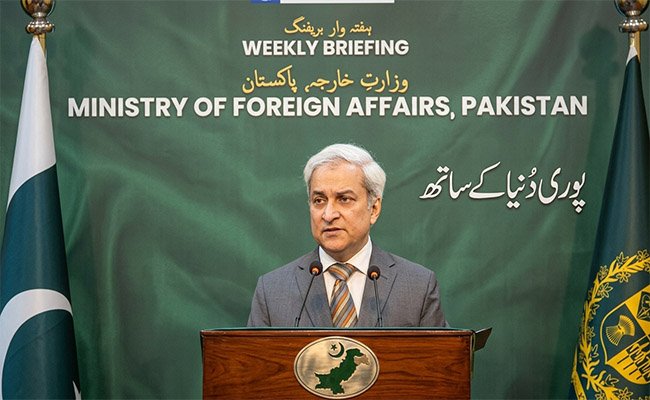
The Foreign Office (FO) of Pakistan has officially dismissed reports suggesting that Chief of Defence Forces (CDF) and Chief of Army Staff (COAS) Field Marshal Asim Munir visited Iran as an envoy for the United States. Speaking at a weekly press briefing in Islamabad, FO Spokesperson Tahir Andrabi clarified that the high-level diplomatic visit to Tehran was undertaken purely within the framework of Pakistan’s role as an independent mediator.
The official response came after speculation arose regarding the nature of the high-level trip to Tehran, during which Interior Minister Mohsin Naqvi accompanied the military leadership. The FO emphasized that Islamabad remains committed to reducing regional tensions through direct, neutral diplomatic channels.
Clarifying the Scope of the Tehran Visit
Addressing media inquiries, FO Spokesperson Tahir Andrabi stated that the discussions held during the trip focused primarily on regional de-escalation, breaking the ongoing military standoff, and exploring negotiated paths toward long-term stability. The trip was part of Islamabad’s ongoing efforts to prevent further escalation in the Middle East and Gulf regions. FO Slams False 1 Claim CDF Munir Did Not Visit Iran as US Envoy
During the press briefing, the spokesperson firmly clarified the position of the government regarding international media speculation:
“Claims by certain quarters that the COAS and CDF visited Iran as envoy of President Trump or the US are misleading and factually incorrect, as his visit was undertaken purely in the context and backdrop of Pakistan’s role as a mediator.”
The clarification underscores that Pakistan’s diplomatic engagements are self-directed and aimed at bridging differences between Washington and Tehran. According to the FO, the Iranian leadership expressed appreciation for Pakistan’s constructive role in facilitating peace talks. FO Slams False 1 Claim CDF Munir Did Not Visit Iran as US Envoy
Strategic Context and Regional Diplomacy
The visit by the military and political leadership comes amid a complex web of regional security challenges. Pakistan has consistently maintained open channels of communication with neighboring countries, advocating for peaceful solutions to international disputes. FO Slams False 1 Claim CDF Munir Did Not Visit Iran as US Envoy
In recent months, diplomatic engagement has extended across multiple regional partners. Over the past two weeks, Deputy Prime Minister and Foreign Minister Ishaq Dar held multiple discussions with Turkiye’s Foreign Minister Hakan Fidan to coordinate regional peace initiatives. FO Slams False 1 Claim CDF Munir Did Not Visit Iran as US Envoy
Islamabad’s diplomatic posture is rooted in balancing international obligations with regional stability. When asked about recent announcements regarding expanded US sanctions on trade with Iran, the FO spokesperson noted that Pakistan adheres to international law and respects its bilateral trade commitments with Tehran.
Historical Framework and Maritime Security
Pakistan’s mediation efforts previously helped establish a framework agreement between Washington and Tehran. A key milestone was the Pakistan-mediated Memorandum of Understanding (MoU) signed in mid-June. That agreement outlined provisions for maintaining security and reopening the Strait of Hormuz, leaving technical administration details to Tehran and Muscat in accordance with international law.
Although fundamental differences between the US and Iran led to a slowdown in implementation, recent diplomatic developments have brought core issues back to the table. Omani Foreign Minister Badr Albusaidi recently visited Tehran to discuss operational frameworks, including temporary shipping corridors and mine-clearing initiatives in the waterway.
The Iranian government continues to view the original Pakistan-mediated MoU as a viable foundation for negotiations, provided all participating parties fulfill their commitments through concrete actions.
Border Security and Relations with Afghanistan
Beyond the Gulf standoff, the Foreign Office addressed press queries concerning relations with Afghanistan. Responding to statements by Afghan Interim Interior Minister Sirajuddin Haqqani regarding a proposed security mechanism, the FO reiterated Pakistan’s openness to structured state-level dialogue.
However, the spokesperson emphasized that formal security mechanisms require actionable commitments rather than verbal assurances. The FO highlighted key expectations for bilateral progress:
-
Counterterrorism Measures: Ensuring Afghan territory is not utilized by hostile groups, including the Tehreek-i-Taliban Pakistan (TTP) and the Baloch Liberation Army (BLA), to launch attacks against Pakistan.
-
Compliance with International Commitments: Adhering to established agreements under the Doha framework regarding regional security. FO Slams False 1 Claim CDF Munir Did Not Visit Iran as US Envoy
-
Border Management: Implementing verifiable, institutionalized measures along shared border corridors to control cross-border movement. FO Slams False 1 Claim CDF Munir Did Not Visit Iran as US Envoy
Islamabad maintains that long-term stability along its western border depends on transparent cooperation and concrete actions to dismantle militant sanctuaries. FO Slams False 1 Claim CDF Munir Did Not Visit Iran as US Envoy
Diplomatic Outlook
Pakistan’s foreign policy approach continues to emphasize de-escalation, conflict resolution, and compliance with international law. By maintaining neutral communication channels with key regional and international actors, Islamabad aims to support sustainable solutions to complex geopolitical standoffs. FO Slams False 1 Claim CDF Munir Did Not Visit Iran as US Envoy
As diplomatic efforts proceed, official sources stress that accurate reporting remains essential to understanding Pakistan’s role as an independent facilitator in international diplomacy. FO Slams False 1 Claim CDF Munir Did Not Visit Iran as US Envoy


Pingback: Horrific Nepal Floods Leave 35 Australians Missing: Families