
PM Hails Pakistan Solar Revolution at COP31 with 3 Major Gains
PM Hails Pakistan Solar Revolution at COP31 with 22GW Power Boost
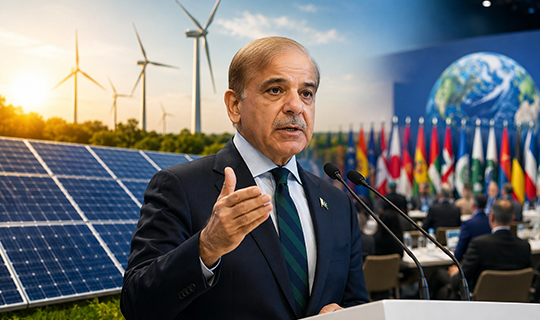
Prime Minister Shehbaz Sharif has highlighted Pakistan’s remarkable shift towards renewable energy, revealing that the country has added nearly 22 gigawatts of rooftop solar capacity in just two years. Addressing world leaders at the COP31 climate summit in Antalya, Turkiye, he described the development as a major transformation driven largely by ordinary citizens seeking affordable electricity and a cleaner environment.
PM Hails Pakistan Solar Revolution as an important example of how public participation can accelerate the transition towards sustainable energy. Speaking at a high-level dialogue on clean energy transition, the prime minister said Pakistan was already experiencing an extraordinary change in its energy sector, with households and businesses increasingly turning towards solar power.
The COP31 summit has brought together representatives from nearly 200 countries to discuss international cooperation, climate change and the transition towards a low-carbon global economy. The discussions are taking place at a time when greenhouse gas emissions remain a major concern and countries face growing economic and political challenges.
PM Hails Pakistan Solar Revolution at Global Climate Summit
Addressing the high-level dialogue titled ’35 by 35: Powering the Future’, Prime Minister Shehbaz Sharif explained that Pakistan’s solar expansion had demonstrated the willingness of citizens to adopt cleaner and more affordable energy solutions.
He said nearly 22GW of rooftop solar capacity had been added across Pakistan within two years, describing the development as a quiet revolution led by ordinary people.
According to the prime minister, citizens are increasingly choosing solar energy because it offers an opportunity to reduce electricity expenses while providing a more predictable and environmentally friendly source of power.
PM Hails Pakistan Solar Revolution while emphasising that the country’s experience could provide useful lessons for other developing nations looking to expand renewable energy.
The prime minister also expressed Pakistan’s full support for the ’35-by-35 Global Electrification Pledge’. Under this initiative, participating countries aim to increase electricity’s share of total final energy consumption to approximately 35 per cent by 2035.
The commitment is intended to support global climate objectives by encouraging greater electrification and reducing dependence on high-emission energy sources.
Pakistan Expands Its Clean Energy Infrastructure
During his address, Shehbaz Sharif highlighted several other initiatives that demonstrate Pakistan’s commitment to developing a more sustainable energy system.
He referred to the recent dome placement ceremony at Chashma Nuclear Power Plant Unit 5, describing it as an important development for the country’s energy infrastructure.
The Chashma-5 nuclear power project is expected to add 1,200 megawatts of electricity to Pakistan’s national energy mix.
The prime minister said nuclear power would contribute to the availability of reliable, low-carbon electricity and support the country’s efforts to diversify its energy sources.
Pakistan has been working to strengthen its energy infrastructure through different technologies, including solar, nuclear and other renewable energy projects.
PM Hails Pakistan Solar Revolution as part of a broader national effort to increase clean electricity generation, improve energy security and reduce the environmental impact of conventional power production.
The government believes that combining renewable energy expansion with reliable electricity generation will be important for meeting future economic and industrial requirements.
Pakistan Targets 30 Per Cent Electric Vehicles by 2030
Another important area highlighted by the prime minister at COP31 was Pakistan’s transition towards electric transportation.
Shehbaz Sharif said the country’s newly drafted automobile policy supports the target of ensuring that 30 per cent of new vehicles sold in Pakistan are electric by 2030.
He explained that the government plans to encourage electric vehicle adoption through financial incentives and lower tariffs, making electric transportation more accessible to consumers. PM Hails Pakistan Solar Revolution at COP31 with 3 Major Gains
The prime minister also announced that future government buses and motorcycles would be electric, reflecting the administration’s intention to gradually reduce the use of conventional fuel-powered vehicles.
He further revealed that, for the first time, electric motorcycles accounted for more than one in every 10 motorcycles sold in Pakistan during the current year. PM Hails Pakistan Solar Revolution at COP31 with 3 Major Gains
This development indicates growing consumer interest in alternative transportation, particularly as rising fuel expenses encourage people to explore more affordable options. PM Hails Pakistan Solar Revolution at COP31 with 3 Major Gains
The shift towards electric vehicles could also help reduce urban air pollution and lower the country’s dependence on imported petroleum products. PM Hails Pakistan Solar Revolution at COP31 with 3 Major Gains
PM Warns Climate Goals Need $188 Billion in Investment
Despite highlighting significant progress in renewable energy, Prime Minister Shehbaz Sharif warned that Pakistan’s clean energy ambitions would require substantial financial support.
He said the momentum behind the country’s energy transformation was real and accelerating, but cautioned that progress could not be sustained without adequate financing.
According to the prime minister, Pakistan requires approximately $138 billion by 2035 to support low-carbon electricity generation and related energy infrastructure.
He also estimated that an additional $50 billion would be needed to replace coal-based electricity generation with solar power.
These financial requirements highlight the challenges developing countries face when attempting to transition towards cleaner energy while maintaining economic stability and meeting growing electricity demand.
PM Hails Pakistan Solar Revolution by pointing to the country’s achievements, but the prime minister stressed that international financial cooperation would be essential to maintain the pace of progress.
He called for concessional financing, affordable technology and greater international investment to help developing countries meet their climate commitments.
Shehbaz Sharif argued that the global ’35 by 35′ electricity target could only become achievable if financial resources reached developing economies at the same pace as their climate ambitions.
Shehbaz Sharif Calls for International Cooperation
In his address, the prime minister urged world leaders to work together to ensure that the transition towards clean energy did not create additional economic difficulties for ordinary people.
He emphasised that countries must find ways to develop their economies, provide affordable electricity and protect the environment at the same time.
He said the world should aim to power economies without increasing poverty and provide electricity to homes without causing further damage to the planet.
The prime minister thanked Turkish President Recep Tayyip Erdogan for hosting the important climate dialogue and bringing international leaders together to discuss sustainable energy solutions.
Earlier, President Erdogan and United Nations Secretary-General Antonio Guterres welcomed Shehbaz Sharif upon his arrival at the summit venue. PM Hails Pakistan Solar Revolution at COP31 with 3 Major Gains
According to the Prime Minister’s Office, Shehbaz Sharif was also scheduled to address the Antalya Leaders’ Summit, where he would present Pakistan’s climate priorities and call for stronger international cooperation to address the effects of climate change.
A dedicated Pakistan Pavilion was also established at the COP31 venue, where 54 events were planned around different climate-related themes. PM Hails Pakistan Solar Revolution at COP31 with 3 Major Gains
PM Hails Pakistan Solar Revolution as a message that developing countries can contribute to global climate objectives when domestic initiatives are supported by international partnerships and financial assistance.
PM Shehbaz Meets Iranian President and Other World Leaders
Apart from participating in climate discussions, Prime Minister Shehbaz Sharif also held several important diplomatic meetings with international leaders on the sidelines of COP31.
One of the key meetings took place with Iranian President Masoud Pezeshkian and his delegation.
According to the Prime Minister’s Office, the discussions covered bilateral relations, opportunities to strengthen cooperation between Pakistan and Iran, regional developments and matters concerning peace and stability.
In a message shared on social media platform X, Shehbaz Sharif described his meeting with the Iranian president as a positive engagement and reaffirmed the longstanding relationship between the neighbouring countries.
He also expressed concern over the prolonged conflict in the region, stressing that dialogue, restraint, de-escalation and sustained diplomatic efforts remained the most effective ways to achieve lasting peace.
The prime minister further referred to the understandings reached under the Islamabad Memorandum of Understanding, saying Pakistan would continue playing a constructive role in promoting regional stability.
Shehbaz Sharif also met Kuwait’s Prime Minister Ahmad Al-Abdullah Al-Ahmad Al-Sabah.
During their meeting, both leaders reviewed longstanding relations between Pakistan and Kuwait and discussed ways to strengthen cooperation in trade, investment, energy, development and people-to-people exchanges.
They also welcomed the recent ratification of the Pakistan-Kuwait defence agreement, expressing hope that it would further strengthen cooperation between the two countries.
Pakistan Seeks a Sustainable Energy Future
Pakistan’s participation in COP31 reflects its growing focus on renewable energy, climate resilience and international cooperation.
The rapid expansion of rooftop solar installations, development of nuclear energy infrastructure and plans to promote electric vehicles represent important elements of the country’s changing energy strategy.
However, financing remains a major challenge, particularly as Pakistan needs significant investment to modernise its electricity system and reduce its dependence on coal.
PM Hails Pakistan Solar Revolution as Prime Minister Shehbaz Sharif uses the international platform to highlight the country’s achievements and call for greater support from the global community.
The prime minister’s message at COP31 was clear: developing countries should not have to choose between economic growth and environmental protection. PM Hails Pakistan Solar Revolution at COP31 with 3 Major Gains
With sufficient investment, affordable technology and stronger international partnerships, Pakistan hopes to accelerate its transition towards cleaner energy while supporting its economic development and improving the lives of its citizens. PM Hails Pakistan Solar Revolution at COP31 with 3 Major Gains