Powerful Marka-e-Haq Warning Full-Spectrum Response to Aggression
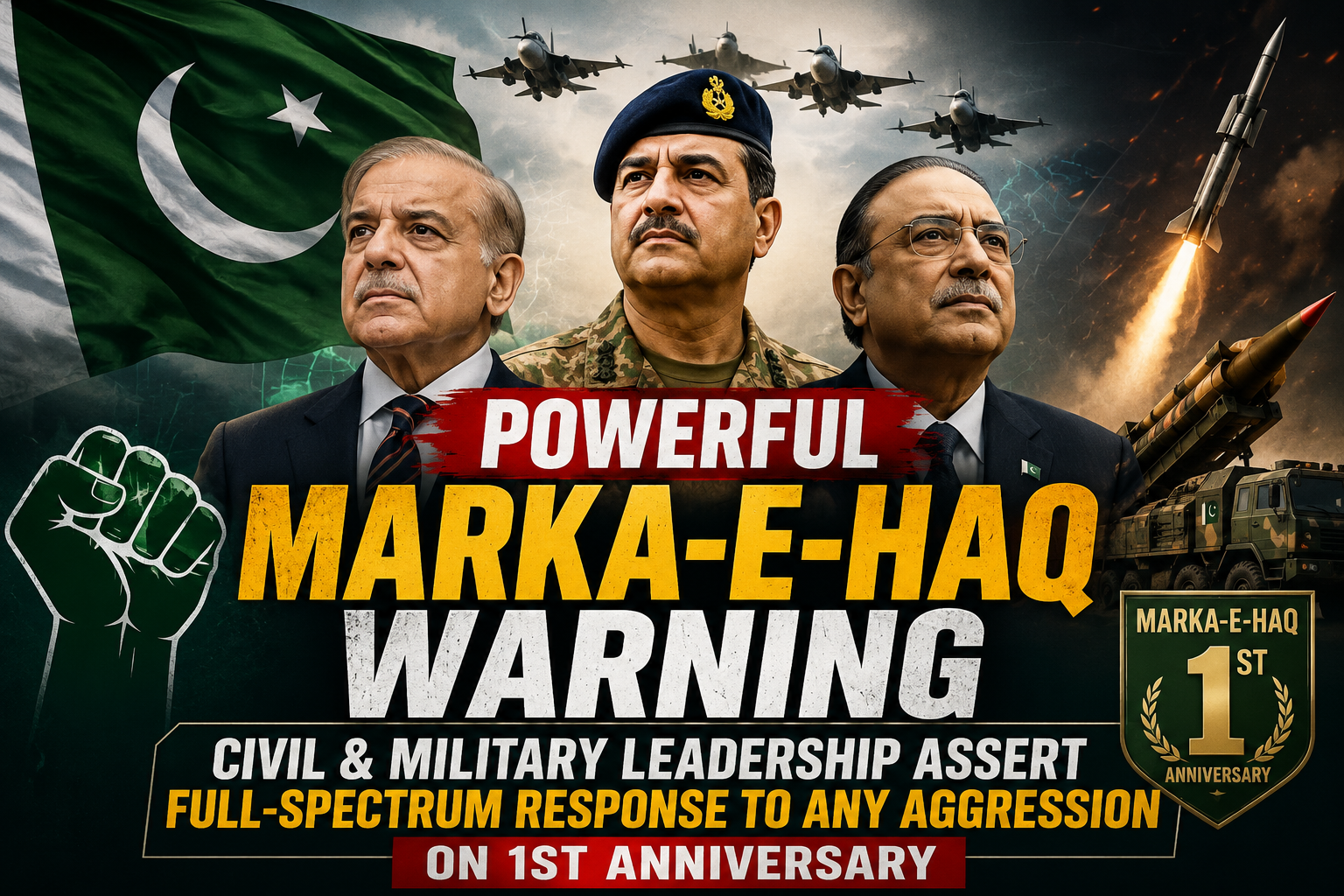
Powerful Marka-e-Haq Warning: Pakistan Renews Full-Spectrum Response Against Any Aggression
Pakistan’s civil and military leadership marked the first anniversary of Marka-e-Haq with strong statements of unity, national pride, and renewed determination to defend the country against every form of aggression. The day was observed as a reminder of the 2025 conflict with India, which ended on May 10 after Pakistan launched Operation Bunyanum Marsoos in response to rising tensions following the Pahalgam attack.
The anniversary was dominated by a Powerful Marka-e-Haq Warning from both political and military leaders, who made it clear that Pakistan would respond immediately and decisively to any future threat against its sovereignty. The message reflected the country’s growing confidence in its defence capabilities and its determination to maintain regional stability while protecting national interests.
Prime Minister Shehbaz Sharif paid tribute to the martyrs, soldiers, and citizens who stood united during the conflict. He described Marka-e-Haq as a historic moment that demonstrated Pakistan’s courage, resilience, and military coordination across land, sea, air, and cyber warfare domains. According to the prime minister, the success of the operation proved that Pakistan remains a peace-loving nation but will never compromise on its security and dignity.
The Powerful Marka-e-Haq Warning delivered during the anniversary celebrations highlighted that Pakistan’s armed forces are fully prepared to answer any aggression with a “full-spectrum response.” Officials emphasized that the country’s defence strategy is no longer limited to conventional warfare but now includes cyber security, intelligence operations, and strategic deterrence.
The prime minister also praised Chief of Defence Forces and Chief of Army Staff Field Marshal Asim Munir for his leadership during the conflict. He acknowledged the role of the Pakistan Air Force and Pakistan Navy, saying the coordination between all branches of the armed forces created a strong and unified defence system that surprised the enemy and strengthened Pakistan’s global image.
Many analysts believe this Powerful Marka-e-Haq Warning sends a message not only to regional rivals but also to the international community that Pakistan is capable of defending itself while still supporting peace and diplomacy. Government officials repeatedly stated that Pakistan did not seek war but was fully capable of protecting its territorial integrity if challenged.
President Asif Ali Zardari also joined the nation in commemorating the first anniversary of Marka-e-Haq. In his statement, he praised the professionalism of the armed forces and said the military’s disciplined response had earned respect around the world. He noted that Pakistan showed restraint despite provocation, proving that strength and responsibility can exist together.
The president’s remarks reinforced the Powerful Marka-e-Haq Warning issued by the leadership. He stressed that Pakistan’s defence capability should never be underestimated and warned that any hostile action against the country would receive a measured yet forceful response.
Apart from military matters, leaders also focused heavily on the Kashmir dispute. Prime Minister Shehbaz Sharif said no story of Pakistan could ever be complete without Kashmir. He repeated Pakistan’s long-standing position that the issue should be resolved according to United Nations resolutions and the wishes of the Kashmiri people.
This part of the speech added another layer to the Powerful Marka-e-Haq Warning, as Pakistani leaders linked regional peace directly to the resolution of Kashmir. Officials argued that lasting stability in South Asia would remain impossible until the dispute is settled fairly.
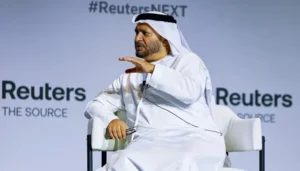
The anniversary also became an opportunity for Pakistan to highlight its growing diplomatic role internationally. The prime minister pointed to Pakistan’s mediation efforts during the US-Iran tensions, saying the country had emerged as a responsible state that contributes to global peace instead of conflict. According to him, Pakistan’s balanced foreign policy has improved its international standing over the past year.
Political experts believe the Powerful Marka-e-Haq Warning is not only military in nature but also diplomatic. Pakistan appears determined to present itself as both a strong regional power and a responsible global actor capable of supporting peace initiatives.
Another major topic discussed during the anniversary was terrorism and regional security. Prime Minister Sharif reaffirmed Pakistan’s commitment to eliminating terrorist groups and protecting the country from extremism. He stated that the government and armed forces would continue operations against militants until the threat is completely removed.
President Zardari also raised concerns about cross-border terrorism originating from Afghanistan. He urged Afghan authorities to ensure their territory is not used for attacks against Pakistan or neighboring countries. His comments reflected growing regional security concerns and added further significance to the Powerful Marka-e-Haq Warning being emphasized throughout the anniversary events.
Water security was another issue highlighted strongly by the president. He criticized India’s attempts to suspend the Indus Waters Treaty and described such actions as “water aggression.” According to him, water is directly connected to the survival of millions of Pakistanis and cannot become a political weapon.
This statement strengthened the broader Powerful Marka-e-Haq Warning, showing that Pakistan views threats beyond traditional military attacks as serious national security matters. Leaders suggested that economic pressure, cyber attacks, and water disputes are now part of modern regional conflicts.
Across Pakistan, social media users, analysts, and political supporters discussed the anniversary extensively. Many praised the armed forces and expressed pride in the country’s ability to defend itself during difficult times. Television channels aired special programs about the conflict, while newspapers highlighted the sacrifices made by soldiers and civilians during Marka-e-Haq.
The Powerful Marka-e-Haq Warning became one of the most discussed political phrases online as people debated the future of regional relations and Pakistan’s growing strategic confidence. Supporters argued that the message was necessary to maintain deterrence, while critics called for stronger diplomatic engagement to avoid future escalation.
Despite different opinions, one thing became clear during the anniversary: Pakistan’s leadership wants to project unity, strength, and readiness. Civilian and military officials stood together to show that national defence remains a shared responsibility supported by both the state and the public.
As the region continues to face political tensions, security challenges, and diplomatic uncertainty, the message coming from Islamabad remains firm. The Powerful Marka-e-Haq Warning delivered on the first anniversary of the conflict reflects Pakistan’s determination to defend its sovereignty while continuing to advocate for peace, dialogue, and regional stability.