Trump Weighs 2 Harsh Iran Options Economic Collapse or Brutal Strike
Trump Weighs 2 Harsh Iran Options: Economic Collapse or Military Escalation
The geopolitical landscape in the Middle East has reached a critical juncture. In a candid interview released on Monday, U.S. President Donald Trump described Iranian leaders as “devious negotiators” while detailing his current strategic choices. The rhetoric comes at a time when military actions, naval security concerns, and international diplomatic maneuvers are converging. As global observers watch closely, Trump Weighs 2 Harsh Iran Options to determine the direction of American foreign policy in the region.
Whether the U.S. relies on financial pressure or shifts toward direct, high-intensity conflict, the consequences will reverberate globally. Understanding how Trump Weighs 2 Harsh Iran Options provides vital insight into the future of international security, energy markets, and diplomatic alliances.
1. Option One: Financial Stranglehold and Economic Isolation
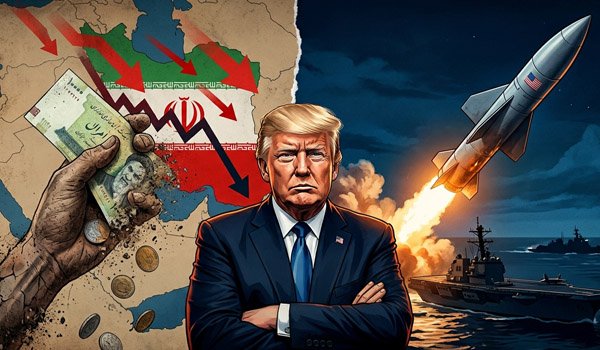
The first strategy outlined by the administration centers on prolonged economic pressure—a concept described simply as letting Tehran “bop along” while its financial foundations continue to deteriorate. According to recent statements, the U.S. maintains substantial control over frozen Iranian assets, positioning Washington as a primary force holding the keys to Tehran’s liquidity.
“Economically, they are a mess. They can’t borrow money. We control their money… I’m their banker.”
— Donald Trump, interview with Real America’s Voice
When analyzing how Trump Weighs 2 Harsh Iran Options, this financial route represents a non-kinetic yet devastating approach. Sanctions and asset freezes have severely limited Iran’s access to global banking systems, weakening its foreign reserves and crippling its domestic economy.
Key Aspects of the Economic Strategy:
-
Asset Control: Total restriction on billions of dollars in foreign Iranian funds.
-
Capital Restrictions: Severe constraints on Iran’s ability to borrow from international lenders.
-
Inflation & Market Strain: Continuous pressure on domestic currency values and purchasing power.
Observers point out that when Trump Weighs 2 Harsh Iran Options, the economic approach minimizes immediate U.S. military casualties while keeping maximum pressure on Tehran’s leadership to come to terms.
2. Option Two: “Hit Them Really, Really Hard”
The second strategy stands in stark contrast to passive economic constriction. It is the threat of direct, high-impact military strikes against key targets. Since conflicts flared earlier in the year, military posturing has oscillated between diplomatic signaling and threats of massive escalation.
+-------------------------------------------------------------------+
|                   TRUMP'S TWO-TRACK IRAN STRATEGY                  |
+-----------------------------------+-------------------------------+
| Strategy A: Economic Exhaustion   | Strategy B: Direct Strike     |
+-----------------------------------+-------------------------------+
| • Freeze foreign assets           | • High-intensity military     |
| • Limit international borrowing   | • Targeted infrastructure     |
| • Leverage financial sanctions    | • Decisive escalation power   |
+-----------------------------------+-------------------------------+
Military analysts emphasize that as Trump Weighs 2 Harsh Iran Options, the option for a direct strike signals to regional adversaries that the U.S. retains full operational readiness. A hard kinetic response would target command centers, defensive infrastructure, or supply routes, dramatically altering the tactical landscape overnight.
3. Diplomatic Signals and Regional Reaction
While public statements highlight extreme measures, diplomatic negotiations continue behind the scenes. Middle Eastern allies and key international stakeholders are actively attempting to broker stability, particularly regarding vital maritime corridors like the Strait of Hormuz.
-
Pakistan’s Assessment: Officials in Islamabad noted that Washington and Tehran may be closer to “some sort” of structured agreement than public rhetoric suggests.
-
Qatar’s Mediation: Qatari diplomats confirmed advanced talks regarding maritime security and transit through the Strait of Hormuz.
-
Shipping Security: Despite ongoing diplomatic dialogues, reports of attacks on commercial shipping in regional waters persist.
The contrast between public threats and active negotiations demonstrates the complex backdrop as Trump Weighs 2 Harsh Iran Options. Diplomatic channels remain active even as military readiness is publicly emphasized.
For a broader look at regional security policies, consult the Reuters World News Coverage on international diplomacy.
4. Munitions Stockpiles and U.S. Military Readiness
A central discussion surrounding any military action is defense readiness and ammunition availability. Reports have highlighted heavy usage of precision-guided long-range missiles over recent operations, raising questions about military reserves.
In response to concerns regarding inventory, U.S. leadership assured that production lines are operating at peak capacity:
“We’re fine with munitions… we’re building them like crazy.”
Defense Production Overview
-
Accelerated Manufacturing: Ramping up production for high-precision guided munitions.
-
Resource Allocation: Balancing overseas military assistance with domestic readiness.
-
Strategic Stockpiles: Ensuring adequate supply for immediate regional defense commitments.
Evaluating defense industrial output is critical while Trump Weighs 2 Harsh Iran Options. Maintaining robust defense supplies ensures that if a kinetic option is chosen, logistical capabilities can fully support operational objectives.
5. Strategic Implications for Global Security
The decision between financial containment and direct military intervention carries far-reaching consequences for global energy supplies, trade routes, and international relations.
Energy & Shipping Impact
The Strait of Hormuz remains one of the world’s most critical oil transit chokepoints. Any escalation toward the “hit them hard” strategy risks immediate disruption to crude oil shipping, driving up global energy prices.
Diplomatic Balance
Simultaneously, relying solely on economic sanctions requires sustained cooperation from international partners to prevent sanction evasion. As Trump Weighs 2 Harsh Iran Options, maintaining alignment with international allies remains a vital component of either pathway.
Conclusion: What Lies Ahead?
The dynamic situation between the U.S. and Iran underscores a pivotal moment in modern diplomacy and defense strategy. Whether Washington pursues complete economic isolation or transitions to direct kinetic action, the outcome will redefine regional stability for years to come.
Ultimately, as Trump Weighs 2 Harsh Iran Options, global markets, regional governments, and defense strategists will remain on high alert for the next decisive move.