
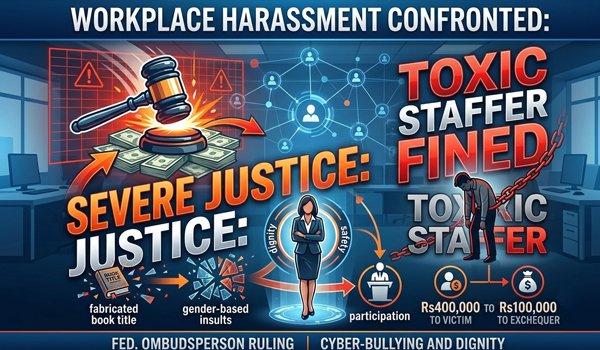
Severe Justice Toxic Staffer Fined Rs500,000 For Workplace Harassment
A Landmark Judgment for Workplace Dignity: Federal Ombudsperson Confronts Cyber-Bullying and Gender Discrimination
The modern corporate landscape, while fostering connectivity, has also opened up new, insidious channels for professional misconduct. In an era where digital footprints are permanent, the boundaries of professional conduct must extend well beyond the physical office. In a decisive ruling that serves as a stern warning to professionals nationwide, the Federal Ombudsperson for Protection against Harassment of Women at the Workplace has delivered a monumental verdict. The regulatory body intervened in a high-profile case of digital bullying, proving that digital safe spaces are non-negotiable. Through the application of Severe Justice Toxic Staffer Fined regulatory measures, the authority has sent a resounding message: online campaigns of gender-based harassment will face aggressive legal consequences.
At its core, this ruling highlights a crucial shift in how quasi-judicial bodies view corporate misbehavior. When professional rivalries spill over into malicious cyber-campaigns, the resulting damage is not merely personal—it actively disrupts the fundamental right to work in peace. By executing the Severe Justice Toxic Staffer Fined framework of accountability, the Ombudsperson has established that cyber-intimidation is a punishable, discriminatory offense under the Protection against Harassment of Women at the Workplace Act.
Inside the Campaign: A Toxic Workplace Rivalry Gone Too Far
The details of the case reveal a shocking lack of professional empathy and boundaries. According to the official order issued by the Ombudsperson, the accused individual launched a highly targeted, persistent online smear campaign against a female colleague. This was not a temporary lapse in judgment; rather, it was a calculated effort to humiliate and isolate the victim within her professional circle.
The perpetrator went to extreme lengths, which included:
-
Fabricating False Credentials: The accused went so far as to invent a completely fictitious book title, complete with fake authorship details and manufactured publishing credits, specifically engineered to ridicule and delegitimize the female colleague’s professional standing.
-
Targeting Deep Personal Vulnerabilities: The smear campaign repeatedly targeted the complainant’s inability to bear children.
-
Weaponizing Transgender Identity: The harasser made demeaning and derogatory references that linked the complainant to the transgender community, weaponizing marginalized identities as a tool for personal mockery.
When a professional environment deteriorates to this level, systemic intervention is required. By invoking Severe Justice Toxic Staffer Fined protocols, the state ensured that the victim was not left to navigate this toxic landscape alone. This case illustrates how traditional, offline rivalries can evolve into highly damaging cyber-campaigns if left unchecked.
Defining the Legal Boundaries of Harassment
A crucial aspect of this landmark ruling lies in its legal definitions. During the proceedings, the defense attempted to navigate loopholes in the regulatory framework. However, the Ombudsperson’s judgment made some highly necessary legal distinctions clear:
                  [ Regulatory Boundary Matrix ]
                                │
       ┌────────────────────────┴────────────────────────┐
       ▼                                                 ▼
[ Non-Harassment Under Act ]                    [ Actionable Harassment ]
- Standalone ethnic references                  - Targeted gender-based slurs
- General linguistic differences                - Demeanor-stripping insults
- Standard peer disagreements                   - Malicious online campaigns
The ruling specified that while generic ethnic or linguistic references, on their own, might not always meet the statutory definition of workplace harassment, the deliberate use of gender-based and highly demeaning language targeting an identifiable colleague constitutes clear discriminatory conduct. This clarification ensures that employees cannot hide behind the excuse of casual banter or off-duty personal opinions.
Because the perpetrator purposely crossed these clear lines, the application of Severe Justice Toxic Staffer Fined regulations was not only appropriate but legally vital. The law protects the fundamental right of every individual to operate in an environment of safety and respect.
The Broader Social Implications of Demeaning Language
This landmark ruling goes beyond merely punishing a rogue employee; it addresses deep-seated societal issues. The Ombudsperson explicitly noted that utilizing terms associated with transgender identity as insults is highly damaging on multiple fronts. First, it directly demeans the targeted individual. Second, and perhaps more insidiously, it reinforces harmful prejudices against an already vulnerable, historically marginalized community.
Furthermore, the judgment noted that targeted campaign-style harassment severely damages a victim’s confidence, personal autonomy, and dignity. When women in leadership or highly visible corporate positions are subjected to such attacks, it creates a chilling effect across the entire organizational structure.
This toxic cycle discourages broader female participation in decision-making and leadership roles. By utilizing Severe Justice Toxic Staffer Fined disciplinary measures, the state actively works to prevent this hostile regression and protect progress in corporate diversity.
Breaking Down the Financial Penalties and Compensation
To guarantee that justice was both punitive and corrective, the Ombudsperson imposed a total fine of Rs500,000 on the perpetrator. What makes this financial penalty notable is how the distribution of the funds is structured to prioritize victim rehabilitation:
| Recipient of Penalty | Designated Amount (PKR) | Primary Purpose |
| The Complainant | Rs400,000 | Compensation for severe psychological harm and loss of dignity |
| National Exchequer | Rs100,000 | Legal fine deposited directly into the state treasury |
This financial distribution proves that the Severe Justice Toxic Staffer Fined protocol is designed to provide genuine relief to those who suffer the consequences of hostile work environments. Paying 80% of the fine directly to the victim acknowledges the severe mental toll of cyber-intimidation.
Why Modern Organizations Must Act Swiftly
This ruling serves as an urgent wake-up call for Human Resource departments and corporate leadership. Passive anti-harassment policies are no longer sufficient in the digital age. Companies must establish clear, enforceable guidelines regarding online behavior, social media engagement, and peer-to-peer interactions outside the physical office.
Implementing proactive measures can save an organization from severe public relations fallout and legal liabilities:
-
Implement Robust Cyber-Safety Policies: Company handbooks must clearly state that digital harassment, even on personal social media accounts, is subject to immediate disciplinary actions.
-
Host Annual Inclusivity Trainings: Educate staff on the impact of gender-biased language, microaggressions, and the importance of respecting marginalized communities.
-
Establish Independent Complaint Channels: Ensure that victims have a secure, confidential pathway to report toxic behavior without fear of professional retaliation.
If an organization fails to police itself, external authorities will step in. The Severe Justice Toxic Staffer Fined standard shows that regulatory bodies will not hesitate to impose significant financial and reputational penalties on offenders.
The Path Forward: Cultivating Inclusive Workplaces
As we move forward, the corporate sector must view this judgment not as an isolated incident, but as a turning point. True professional progress cannot occur without safety and mutual respect. The Federal Ombudsperson’s proactive stance shows that the legal system is evolving to meet the challenges of the digital era.
By championing the Severe Justice Toxic Staffer Fined approach to cyber-harassment, the legal system is actively paving the way for a more equitable future. Ultimately, eliminating toxic behavior from the workplace is not just about compliance—it is about building an environment where every professional can thrive with their dignity intact.
Deepen Your Understanding
To better understand your rights and the evolving frameworks of workplace safety and professional conduct, explore our comprehensive guides:
-
Navating Digital Safety: Read our expert analysis on Online Gender-Based Harassment Laws to understand your rights in virtual workspaces. Severe Justice Toxic Staffer Fined Rs500,000 For Workplace Harassment
-
Defining the Legal Safeguards: Learn more about the provisions under the Protection Against Harassment of Women Act to understand the legal duties of employers. Severe Justice Toxic Staffer Fined Rs500,000 For Workplace Harassment
-
Corporate Accountability in Focus: Read our deep dive into the Severe Justice Toxic Staffer Fined case study to understand how modern regulatory bodies are stamping out cyber-bullying. Severe Justice Toxic Staffer Fined Rs500,000 For Workplace Harassment



Pingback: Good Samaritan Tasered After Disarming Man 7 Shocking Detail