Trump Plans Steep $103K H-1B Visa Fee Plan After Harsh Court Defeat
The debate surrounding specialized employment immigration has reached another critical turning point as the executive branch attempts to reshape foreign labor policy. In a sweeping regulatory move, the Trump Plans Steep $103,265 fee proposal for H-1B visas to significantly alter how American technology firms and corporate institutions recruit foreign talent.
This bold initiative represents a dramatic shift from historical administrative standards, seeking to introduce unprecedented financial hurdles for companies sponsoring non-immigrant specialty workers.
The Evolution of the High-Stakes H-1B Fee Strategy
The administration’s determination to reform specialized employment channels is not new. Back in September 2025, executive action was initiated to mandate a massive $100,000 supplemental application charge. For years, basic H-1B petition filing expenses remained near the $3,000 baseline. Consequently, the Trump Plans Steep financial adjustments were designed to curb program usage and shift hiring preferences toward the domestic workforce.
However, the initial executive order met fierce resistance from state officials and business advocacy groups. A coalition of 20 state attorneys general challenged the policy’s constitutionality, setting up a high-stakes courtroom confrontation over executive overreach.
Judicial Rejection and the Executive Power Boundary
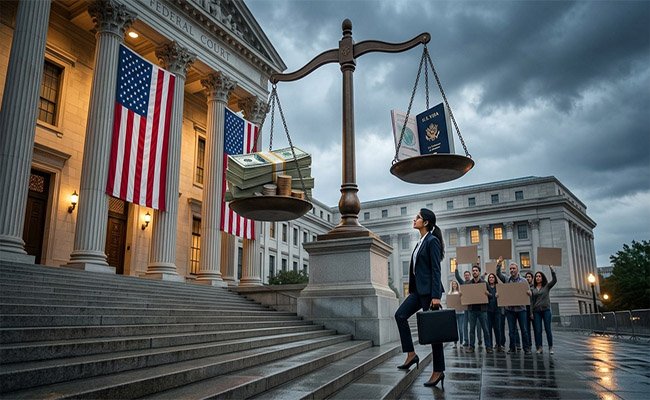
The administration experienced a notable legal setback when Boston-based U.S. District Judge Leo Sorokin issued a decisive ruling striking down the presidential proclamation. The court determined that the executive branch lacked constitutional authorization to levy such exorbitant exactions.
+-----------------------------------------------------------------------------------+
|                           H-1B FEE LITIGATION & RULEMAKING                         |
+-----------------------------------------------------------------------------------+
| September 2025: Executive Proclamation introduces $100,000 supplemental fee.      |
| June 2026: District Court Judge Leo Sorokin strikes down fee as an illegal tax.   |
| August 2026: Formal regulatory proposal introduced featuring $103,265 charge.     |
+-----------------------------------------------------------------------------------+
Judge Sorokin explicitly stated that the $100,000 payment functioned as an unconstitutional tax rather than a routine administrative fee. Under Article I of the U.S. Constitution, the power to lay and collect taxes belongs exclusively to Congress. Because the INA (Immigration and Nationality Act) never granted the White House broad taxation powers, the court vacated the fee structure in its entirety.
The Transition to Notice-and-Comment Rulemaking
Refusing to abandon its strategic objective, the administration pivoted from executive proclamations to formal agency rulemaking. By introducing the Trump Plans Steep $103,265 fee via standard administrative procedures, the Department of Homeland Security aims to satisfy procedural requirements while asserting cost-recovery necessity.
Under this new proposed regulation, federal agencies argue that the expanded fees directly fund the broader operational costs of managing immigration enforcement and processing systems. Public stakeholders now have a mandatory 30-day notice-and-comment window to submit formal feedback, though lengthy administrative reviews and subsequent court challenges are guaranteed.
Economic Realities and Corporate Sponsorship Dynamics
The standard H-1B program operates under a strict statutory cap of 65,000 regular visas per fiscal year, along with an additional 20,000 allocation reserved for advanced degree holders from U.S. universities. While tech industry leaders depend on specialized talent pools, the Trump Plans Steep $103,265 price tag forces corporate executives to re-evaluate global recruitment budgets.
| Entity / Official | Position on H-1B Fee Escalation | Primary Stated Rationale |
| Trump Administration | Supports $103,265 mandatory fee | Recovers operational costs and incentivizes hiring American workers. |
| Vice President JD Vance | Strongly endorses high fees | Asserts corporations must prioritize training and employing domestic labor. |
| U.S. District Court | Struck down previous $100K fee | Ruled the charge constituted an unconstitutional tax lacking Congressional approval. |
| Industry Economists | Opposes prohibitive cost increases | Argues specialty visas boost global competitiveness and fuel net job creation. |
Prominent economists argue that high-skilled specialty visas complement the domestic workforce rather than displace it. Companies utilizing foreign specialized expertise frequently expand operations, generating additional downstream employment opportunities across local economic sectors.
Administrative Justifications and Domestic Labor Arguments
In contrast, administration representatives insist that the current structure has allowed large corporations to bypass domestic entry-level workers. Supporting the policy push online, Vice President JD Vance emphasized that companies needing specialized skills should invest resources into training local personnel.
Through this lens, the Trump Plans Steep regulatory overhaul acts as a direct financial incentive for companies to elevate domestic wages. The administration maintains that by placing a substantial premium on foreign talent sponsorship, corporations will naturally look inward to build sustainable domestic talent pipelines. Trump Plans Steep $103K H-1B Visa Fee Plan After Harsh Court Defeat
Corporate Strategy in an Era of Regulatory Uncertainty
For human resource departments, immigration counsel, and global talent acquisition managers, navigating these policy swings requires agile scenario planning. Because the Trump Plans Steep $103,265 requirement faces an intense public comment period and impending court injunctions, businesses must carefully evaluate alternative immigration pathways.
Many enterprise organizations are re-evaluating internal wage tiers and exploring non-cap options, such as L-1 intra-company transfers or remote offshore development hubs, to safeguard projects against abrupt cost spikes. As the regulatory process unfolds, legal analysts warn that another legal showdown in the federal court system remains inevitable. Trump Plans Steep $103K H-1B Visa Fee Plan After Harsh Court Defeat
What the Proposed Timeline Means for Applicants
As the 30-day public notice period progresses, prospective H-1B applicants and sponsoring entities must track agency announcements closely. The Trump Plans Steep $103,265 fee proposal cannot take immediate effect until federal agencies publish a final rule addressing public feedback. Trump Plans Steep $103K H-1B Visa Fee Plan After Harsh Court Defeat.
If federal courts issue temporary stays or preliminary injunctions, the implementation timeline could extend well into future filing cycles. However, the administration’s persistent focus confirms that high-skilled immigration will remain a primary battleground in ongoing federal policy debates.
Ultimately, the outcome of this regulatory effort will establish critical precedents regarding executive fee-setting authority and corporate visa sponsorship economics for years to come.
To monitor official regulatory updates and administrative rule proposals, review announcements directly on the USCIS Official Portal or examine legal filings via the U.S. Courts Public Access Page. For broader reporting on federal workforce statistics and economic impact analyses, inspect comprehensive data from the U.S. Department of Labor and legal commentary on The Japan Times Business Desk.