
Table of Contents
TogglePakistan $800M Weekly Oil Bill Shocks Nation 3x Amid Mideast War
Pakistan $800M Weekly Oil Bill Surges Amid Middle East Conflict
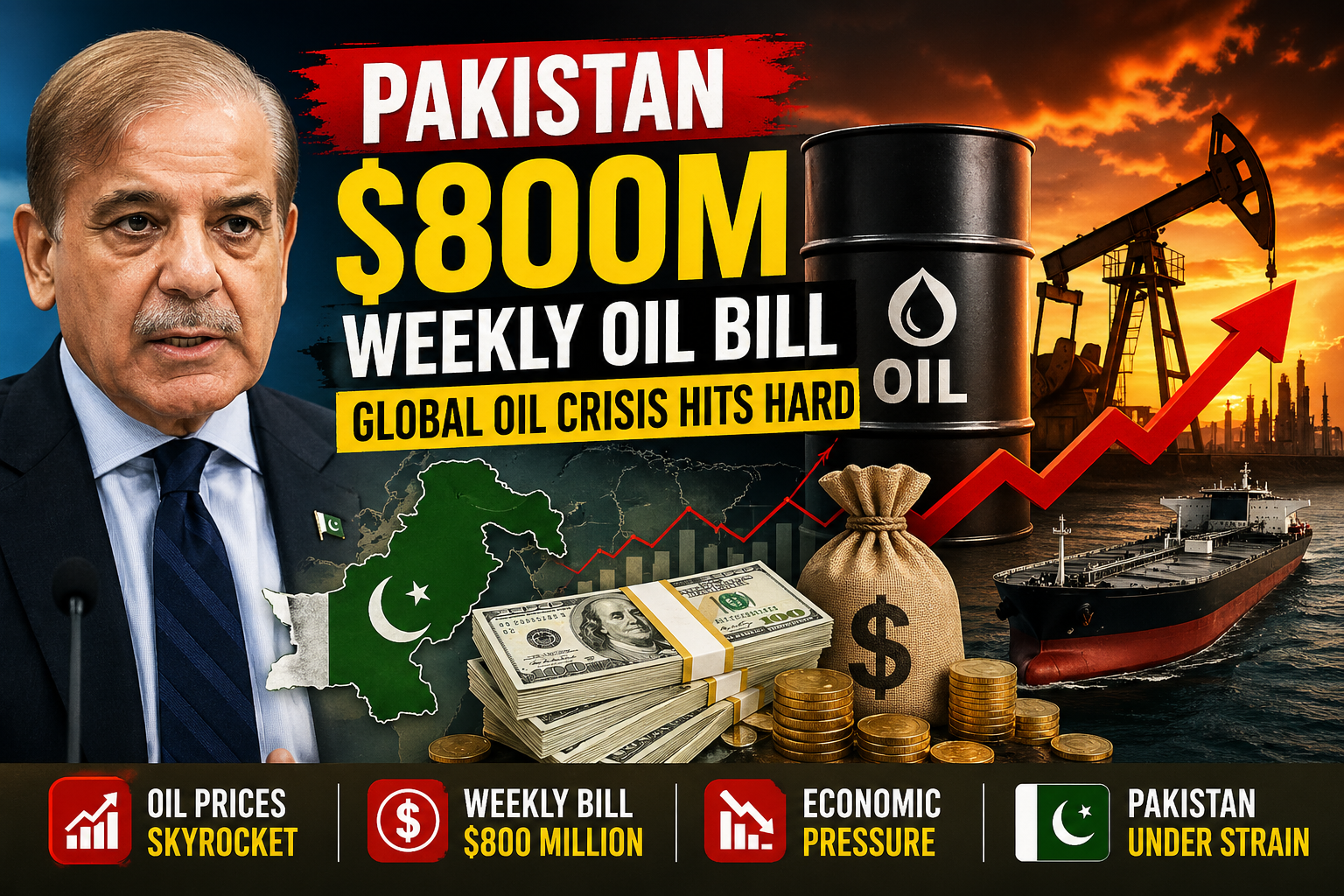
Pakistan is currently facing a serious economic challenge as rising global oil prices continue to put pressure on the country’s finances. Prime Minister Shehbaz Sharif recently revealed that Pakistan’s weekly oil expenditure has jumped dramatically, reaching an alarming figure of $800 million. This sharp increase highlights the growing impact of the ongoing Middle East conflict on the country’s economy.
The Pakistan $800M Weekly Oil Bill has become a major concern for policymakers, businesses, and citizens alike. Just a few months ago, before tensions escalated in the Middle East, the country was spending nearly $300 million per week on oil imports. Now, that figure has more than doubled, creating a significant burden on national resources.
Why Oil Prices Are Rising
The surge in Pakistan’s oil bill is directly linked to disruptions in global supply chains. The Strait of Hormuz, one of the world’s most critical oil shipping routes, has been severely affected due to geopolitical tensions. Since late February, when military actions intensified in the region, oil shipments have slowed down, causing global fuel prices to spike.
As a result, countries like Pakistan, which rely heavily on imported fuel, are facing the consequences. The Pakistan $800M Weekly Oil Bill is not just a number—it reflects the broader vulnerability of the economy to external shocks.
Government Response to the Crisis
During a federal cabinet meeting, Prime Minister Shehbaz Sharif acknowledged the severity of the situation but also assured that the government is actively managing the crisis. He praised Petroleum Minister Ali Pervaiz Malik for his efforts in stabilizing the fuel supply despite difficult circumstances.
According to the prime minister, the situation is now “satisfactory” compared to earlier weeks when uncertainty was at its peak. However, the Pakistan $800M Weekly Oil Bill remains a pressing issue that requires continuous monitoring and strategic planning.
The government has also initiated consultations with provincial authorities to explore the possibility of extending fuel subsidies. This step aims to provide relief to the public, especially as inflation continues to affect daily life.
Impact on Pakistan’s Economy
The rising oil bill is having a ripple effect across the economy. Increased fuel costs lead to higher transportation expenses, which in turn drive up the prices of essential goods. This creates inflationary pressure, making it harder for ordinary citizens to manage their expenses.
The Pakistan $800M Weekly Oil Bill is also putting strain on foreign exchange reserves. Although the prime minister stated that reserves remain stable for now, continued high spending on oil imports could pose long-term challenges.
Before the conflict, Pakistan was showing signs of economic improvement. Macroeconomic indicators were stabilizing, and the country was gradually recovering from previous financial difficulties. However, the current situation has disrupted that progress.
Fuel Consumption Trends
Interestingly, the prime minister noted that fuel consumption has slightly decreased in recent weeks. This could be due to higher prices forcing people and industries to cut back on usage. While this reduction may offer some temporary relief, it is not enough to offset the massive increase in costs.
Even with lower consumption, the Pakistan $800M Weekly Oil Bill continues to rise because of global price hikes. This highlights how deeply interconnected Pakistan’s economy is with international markets.
International Support and Financial Stability
Despite these challenges, Pakistan has received support from friendly nations. The government recently repaid a $3.45 billion deposit to the United Arab Emirates, demonstrating its commitment to financial obligations.
Additionally, Saudi Arabia has provided significant assistance by transferring a $3 billion deposit and extending an existing $5 billion facility for another three years. These measures have helped maintain financial stability at a time when the Pakistan $800M Weekly Oil Bill is putting pressure on national reserves.
Diplomatic Efforts and Regional Stability
The government is not only focusing on economic measures but also actively participating in diplomatic efforts to restore peace in the region. Prime Minister Shehbaz highlighted Pakistan’s role in facilitating dialogue and promoting stability.
High-level meetings, including the Islamabad Talks, have been part of these efforts. Pakistani leadership, including senior military and diplomatic officials, has been engaged in discussions aimed at reducing tensions.
The prime minister also mentioned ongoing communication with international stakeholders, emphasizing that peace in the region is essential to bring down global oil prices. Without stability, the Pakistan $800M Weekly Oil Bill is unlikely to decrease anytime soon.
Visits by Iranian Officials
Iran’s Foreign Minister recently made multiple visits to Pakistan, meeting top leadership to discuss the evolving situation. These engagements reflect Pakistan’s active role in regional diplomacy.
Such efforts are crucial because any improvement in the geopolitical environment could lead to stabilization in oil markets. Until then, the Pakistan $800M Weekly Oil Bill will remain a key challenge for the country.
What Lies Ahead
Looking forward, Pakistan needs to adopt both short-term and long-term strategies to deal with the crisis. In the short term, managing fuel prices, providing subsidies, and controlling consumption are essential steps.
In the long term, the country must reduce its dependence on imported oil by investing in alternative energy sources such as solar, wind, and hydropower. This shift could help protect the economy from future external shocks.
The Pakistan $800M Weekly Oil Bill serves as a wake-up call, highlighting the urgent need for energy diversification and economic resilience.
Final Thoughts
Pakistan is navigating a complex situation where global events are directly impacting domestic stability. While the government has taken several steps to manage the crisis, the road ahead remains challenging.
The Pakistan $800M Weekly Oil Bill is more than just a statistic—it represents the broader economic pressures facing the country. However, with careful planning, international cooperation, and a focus on sustainable solutions, Pakistan can overcome these challenges.

Pingback: Iran War Crisis Trump Warns Tehran 3 Times, Ghalibaf Mocks
Pingback: Zardari Strategic Victory 3 Major China Deals Finalized