
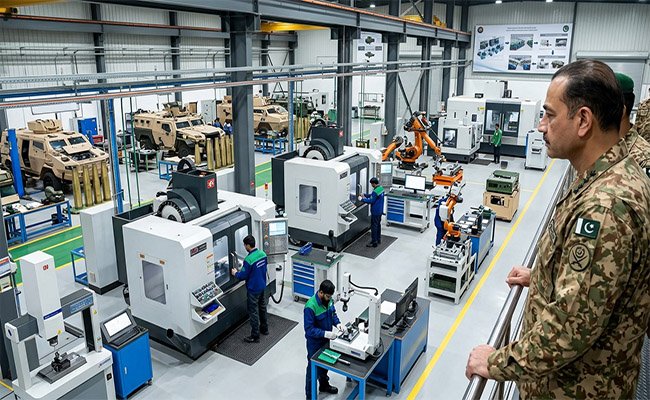
COAS Munir inspects 1 top POF plant driving bold defense upgrades
COAS Munir inspects POF Wah to Boost Pakistan’s Defense Industry
In a major move toward national self-reliance, the Chief of Defence Forces (CDF) and Chief of Army Staff (COAS), Field Marshal Syed Asim Munir, visited the Pakistan Ordnance Factory (POF) in Wah on Saturday. As COAS Munir inspects the facility, the visit focused heavily on evaluating indigenous manufacturing capabilities, expanding export potential, and reinforcing the bedrock of the country’s defense industrial base.
Strategic Overview of the High-Level Military Visit
During his comprehensive tour of Pakistan’s largest defense industrial complex, COAS Munir inspects key operational divisions while receiving detailed briefings from senior officials. The media wing of the military, Inter-Services Public Relations (ISPR), confirmed that the visit was centered on driving innovation and reducing reliance on foreign hardware.
According to official updates shared by ISPR News, the military leadership remains firmly dedicated to modernizing armed forces gear through local talent and engineering. When COAS Munir inspects these installations, it sends a clear signal to both domestic stakeholders and foreign partners about Pakistan’s evolving strategic priorities.
Witnessing Advanced Field Tests and Weaponry Trials
A highlight of the visit occurred on the testing grounds, where COAS Munir inspects the latest trials of locally designed arms and tactical ammunition. Engineers and weapon designers at POF presented several cutting-edge small arms, heavy weaponry, and specialized munitions built specifically for high-intensity operational demands.
The live demonstrations proved that domestic arms production has achieved a high level of precision and reliability. As COAS Munir inspects these live-fire trials, he commended the technical teams for maintaining global standards while drastically cutting procurement expenditures through self-sufficiency.
Legislative Progress: The DIPRA Ordinance and Corporatization
The operational evaluation went far beyond weapons testing. A major agenda item during the visit was analyzing the administrative progress made under the Defense Industrial Production and Regulatory Authority (DIPRA) Ordinance.
As COAS Munir inspects the administrative rollout, leadership presented an overview of the ongoing corporatization process. Restructuring POF into a streamlined, corporate-style framework allows the organization to cut through bureaucratic delays, scale export contracts, and form strategic joint ventures worldwide. Readers interested in national industrial policies can learn more via the official Ministry of Defence Production portal.
Installation of Two New High-Tech Production Plants
Looking toward immediate expansion, officials briefed the military chief on upcoming infrastructure developments. Modernization efforts are moving forward rapidly with the installation of two brand-new, state-of-the-art industrial plants within the Wah complex.
These modern manufacturing units are scheduled to begin commercial operations by the end of the current year. When COAS Munir inspects the construction sites for these dual facilities, he noted that their completion will multiply daily output volume, optimize production lines, and open new avenues for international defense exports.
Advancing Self-Reliance and Export Capabilities
For decades, military procurement in developing nations has suffered from heavy foreign dependency. However, when COAS Munir inspects industrial installations like POF, the strategy shifts toward maximum indigenization.
Enhancing export potential remains a key pillar of this strategy. By scaling up production of battle-tested arms and ammunition, Pakistan aims to serve friendly nations looking for affordable, high-grade defense hardware. To monitor broader defense industry news and regional updates, explore continuous coverage on DAWN News.
Technological Innovation in National Defense
Technological advancement is no longer optional in modern warfare. During his inspection, the army chief emphasized that artificial intelligence, automation, and modern material sciences must be integrated into everyday manufacturing workflows.
As COAS Munir inspects research and development labs, he reaffirmed that technological innovation must go hand-in-hand with raw production capacity. Upgrading equipment to match contemporary battlefields ensures that troops receive equipment tailored to their exact tactical needs.
Supporting Pakistan’s Strategic Industrial Base
The broader implication of this visit reaches deep into the national economy. Defense industrialization acts as a massive driver for domestic job creation, technical training, and heavy engineering growth.
When COAS Munir inspects the facilities, he reinforces the strong synergy between military readiness and economic stability. Developing specialized industrial infrastructure at home keeps capital within the country while providing thousands of skilled workers with valuable engineering careers.
Key Takeaways from the Official Inspection
To summarize the core outcomes of the military leadership’s visit to Pakistan Ordnance Factory:
-
Production Review: Comprehensive evaluation of manufacturing output and operational capacity across all Wah plants.
-
Weaponry Trials: Live testing of indigenous small arms, artillery rounds, and advanced ammunition.
-
DIPRA Ordinance: Assessment of structural corporatization to enable faster commercial and export workflows.
-
Plant Expansion: Setup of two new industrial plants going operational by year-end.
-
Export Strategy: Boosting international sales of local military technology to earn foreign exchange.
Final Perspective on Defense Modernization
The visit of Field Marshal Asim Munir to POF Wah highlights a clear vision for Pakistan’s military complex. As COAS Munir inspects the defense footprint across the country, the commitment to self-reliance, local manufacturing, and structural modernization remains steadfast. By building up indigenous capacities today, Pakistan guarantees both its national sovereignty and defense industrial independence for the future.