Grim News 1 Resilient Khan Stronghold Crushed Under Emergency Rule
Khyber Pakhtunkhwa Under Emergency Rule: Political Drama Unfolds
Pakistan’s political landscape has been rocked once again by a dramatic decision from the top levels of federal authority. President Asif Ali Zardari signed a constitutional order placing the northwestern province of Khyber Pakhtunkhwa under emergency rule, effectively suspending its regional government.
For millions of citizens, this province is not just another administrative region; it serves as a Resilient Khan Stronghold where former Prime Minister Imran Khan and his party, the Pakistan Tehreek-e-Insaf (PTI), maintain deep political roots.
The imposition of governor’s rule marks a major escalation between the coalition government in Islamabad and opposition forces rallying across the country. As thousands of supporters continue demanding Khan’s immediate release from prison, the federal government’s action raises serious questions about constitutional stability, public trust, and the future of democratic governance in Pakistan.
What Prompted Emergency Rule in the Resilient Khan Stronghold?
The formal request to declare an emergency came directly from Prime Minister Shehbaz Sharif, citing grave security concerns and severe political instability. According to official statements, central authorities claim that provincial leaders failed to adequately address rising militant threats and local security risks in the area.
However, political observers view the central government’s intervention in this Resilient Khan Stronghold as a calculated attempt to neutralize PTI’s organizational hub. By utilizing Articles 232 and 234 of Pakistan’s Constitution, the federal government effectively stripped the provincial assembly and regional executive offices of their authority.
Key Drivers Behind the Federal Decision:
-
Escalating Political Demonstrations: Continuous marches and rallies originating from the Resilient Khan Stronghold toward Islamabad.
-
Security Concerns: Rising militant activities and claims that local authorities were underperforming in counterterrorism efforts.
-
Constitutional Overreach Controversies: Opponents argue the constitutional articles are being weaponized for political leverage.
Mass Demonstrations and the Demand for Imran Khan’s Release
Despite being incarcerated since August 2023, Imran Khan remains a formidable force in Pakistani politics. His arrest on various charges—ranging from corruption to state secret violations—has failed to weaken his political footprint. Supporters consistently rally around his message, maintaining that the legal challenges against him are politically motivated plots designed to prevent his return to power.
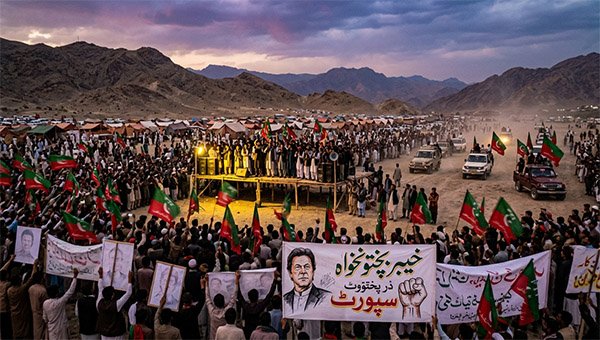
Recently, thousands of demonstrators began marching from the Resilient Khan Stronghold toward the federal capital, aiming to mobilize hundreds of thousands along the way. The movement’s primary objective is clear: secure access to medical care and push for the complete release of their party leader. The central government’s sudden imposition of emergency rule was aimed directly at curtailing this growing momentum before protesters could fully converge on Islamabad.
Allegations of Election Rigging and Security Challenges
The tension between PTI supporters and the ruling coalition has been building since the February 2024 general elections. Opposition leaders insist that the election results were heavily rigged to favor the ruling coalition—a claim the federal government vigorously denies.
Adding another layer of complexity to the region’s dynamic, the federal government accuses PTI officials in the Resilient Khan Stronghold of showing leniency toward extremist groups like the Tehrik-e-Taliban Pakistan (TTP). PTI leaders firmly reject these allegations, arguing that the central government is misusing state machinery and counterterrorism narratives to suppress political dissent.
| Aspect | Federal Government View | PTI / Local Supporters View |
| Emergency Rule Cause | Failure to curb militancy & regional insecurity | Political maneuver to crush dissent |
| 2024 Election Legitimacy | Valid, democratic process | Fraudulent and heavily manipulated |
| Role of Local Leadership | Uncooperative with central authorities | Defending constitutional rights in a Resilient Khan Stronghold |
Constitutional Implications and What Lies Ahead
The suspension of regional governance is a high-stakes move that risks widening the rift between the population and central authorities. The public in this Resilient Khan Stronghold has historically demonstrated a high degree of political activism and resistance to federal overreach.
Stripping an elected regional government of its powers could further alienate citizens and trigger broader civil unrest. Political analysts caution that relying on emergency powers rather than political dialogue may exacerbate stability issues across the country.
As protests persist and legal challenges against emergency rule mount, Pakistan enters a highly volatile phase. How the leadership in Islamabad balances national security imperatives with democratic norms will determine whether stability can be restored to this Resilient Khan Stronghold or if the country faces a prolonged constitutional crisis.