US Envoy Huckabee Faces Powerful Backlash in Arab World After 1 Claim!
US Envoy Huckabee Faces Powerful: Arab World Erupts Over Controversial Israel Remarks
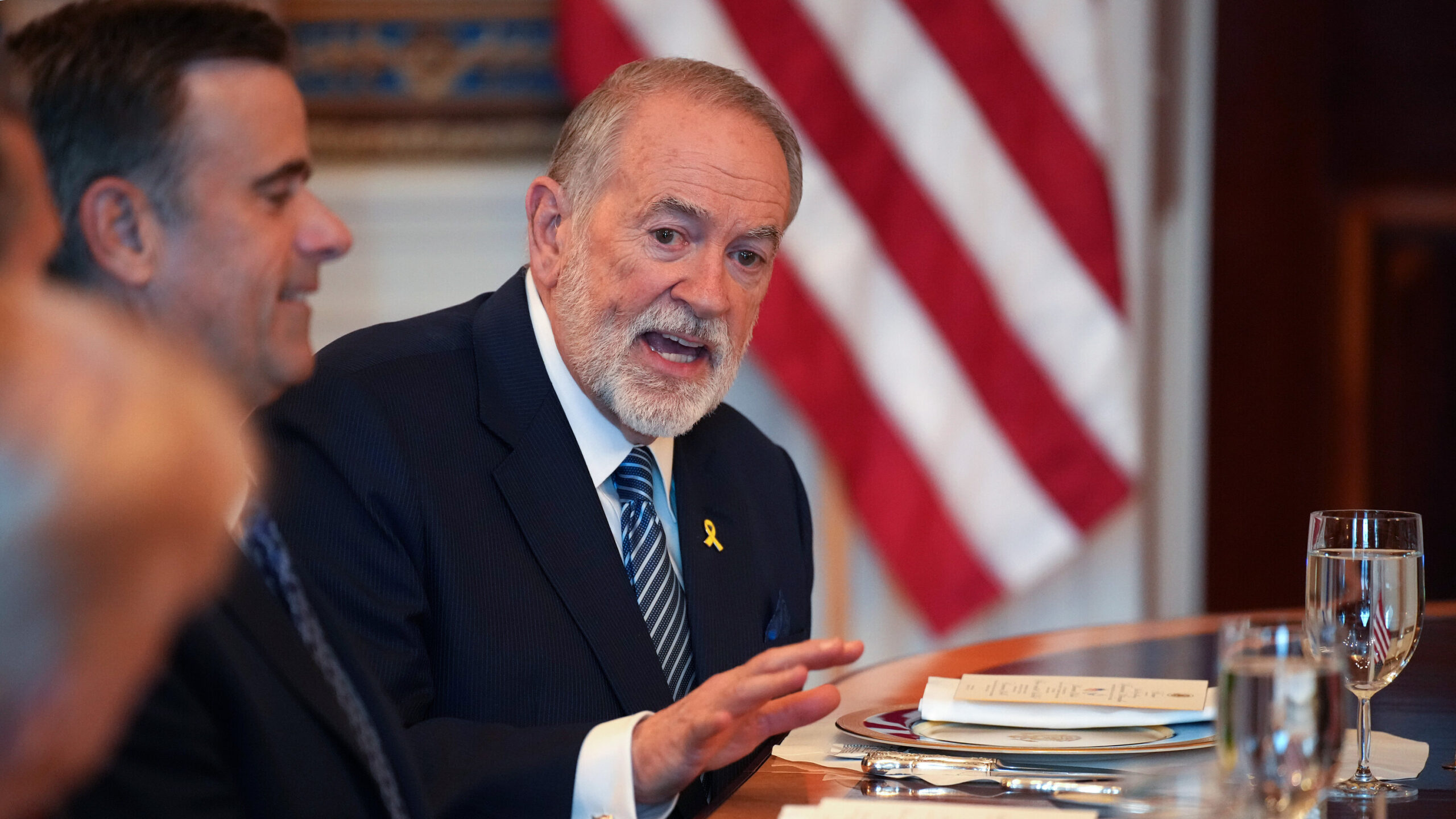
The Middle East woke up to a storm of reactions after remarks made by Mike Huckabee triggered outrage across several Arab nations. The controversy began when the American diplomat, speaking on the podcast of far-right commentator Tucker Carlson, suggested that Israel had a biblical right to vast stretches of Middle Eastern land. What followed was an uproar that once again exposed how sensitive regional boundaries and historical interpretations remain.
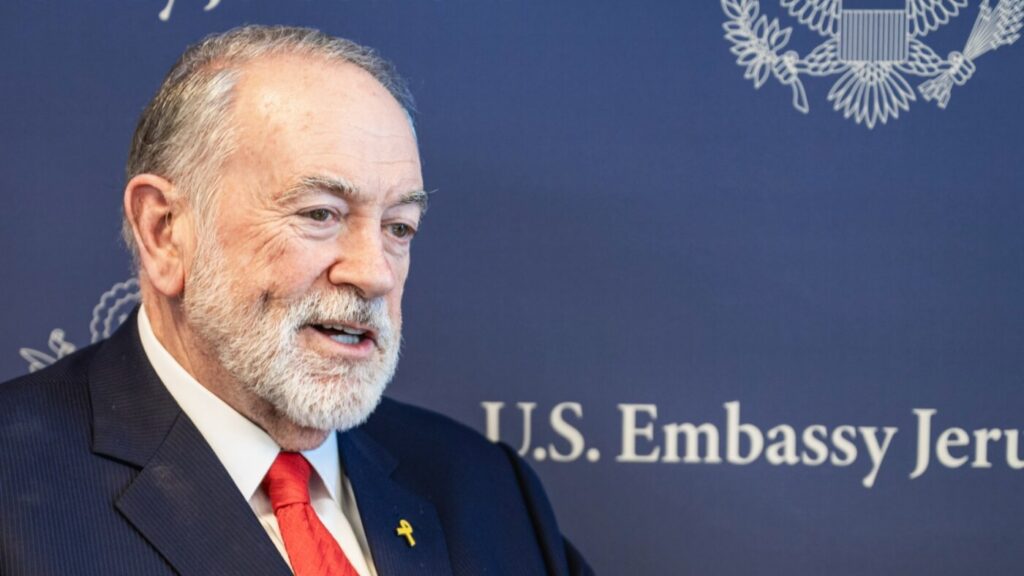
In the interview, Carlson asked Huckabee about a biblical verse that some believe grants Israel the land spanning from the Nile in Egypt to the Euphrates in Syria and Iraq. Responding casually, Huckabee said, “It would be fine if they took it all.” Even though he later tried to frame it as “hyperbolic,” the words spread instantly, prompting headlines and diplomatic statements across the Arab world. And so the first wave of global reactions began, making US Envoy Huckabee Faces Powerful criticism unavoidable.
A Single Remark, A Regional Firestorm
The remark may have seemed like a throwaway line to Huckabee, but it touched one of the rawest nerves in Middle Eastern politics. Borders, identity, displacement, sovereignty — all of these issues sit directly under the surface. Once his words started circulating online, ministries across Arab capitals issued formal condemnations.
Saudi Arabia called the statement “reckless” and “irresponsible.”
Jordan described it as “an assault on the sovereignty of regional states.”
Kuwait said it was a “flagrant violation of international law.”
Oman warned that such language “threatened the prospects for peace.”
Every one of these responses showed that US Envoy Huckabee Faces Powerful repercussions for framing biblical interpretations as political justification.
Egypt, Palestine, and Wider Voices Respond
The reaction from Egypt was firm. Cairo’s foreign ministry reiterated that Israel “has no sovereignty over the occupied Palestinian territory or any other Arab lands.” They stressed that international legality and long-standing agreements cannot be dismissed through personal religious interpretation.
The response from the Palestinian Authority was just as sharp. They highlighted that Huckabee’s comments even contradicted former U.S. President Donald Trump’s stance, despite Huckabee often being seen as a supporter of Trump-era policies. According to Palestinian officials, US Envoy Huckabee Faces Powerful backlash because his statement touched not just political issues but core elements of identity and land.
Silence, Clarifications — But No Direct Retraction
Interestingly, Huckabee later posted clarifications on other parts of his interview, but he avoided addressing the specific biblical-land comment. The silence left critics even more frustrated. Some argued that if he could clarify other topics, he could also clarify — or retract — the line that sparked the diplomatic tension.
In Israel, however, the reaction was mixed. The Speaker of the Israeli Parliament, Amir Ohana, praised Huckabee for his overall pro-Israel stance in the interview. The contrasting responses from different sides only highlighted why US Envoy Huckabee Faces Powerful regional reactions — because every word an American diplomat speaks carries weight far beyond a podcast episode.
Tucker Carlson, Antisemitism Accusations, and the Bigger Context
This controversy unfolded at a time when Tucker Carlson was already at the center of several public debates.
That context shaped the way Huckabee’s comments were received. For many in the region, the problem was not just one line but the environment in which it was said. Adding religious claims about land ownership only made the situation more volatile. No wonder US Envoy Huckabee Faces Powerful reactions — because the issue expanded beyond geopolitics into issues of extremism, fairness, and historical ethics.
The Arab World’s Sensitivity to Boundary Narratives
Arab states have always been highly sensitive to suggestions that justify territorial expansion through religious interpretation. This isn’t new. Any commentary that appears to support annexation or redraw maps sparks immediate political alarm.
For decades, the region has struggled with conflict, displacement, wars, and broken agreements. Even minor rhetoric can open old wounds. That is exactly why US Envoy Huckabee Faces Powerful criticism. Many Arab nations saw the remark as an endorsement of an outdated, expansionist ideology that threatens both peace and stability.
Why Huckabee’s Words Hit Hard
Several factors made his comment especially damaging:
He holds an official diplomatic position.
Even personal remarks carry diplomatic implications.
The Middle East is already experiencing heightened tensions.
Conflicts in Gaza, disputes over West Bank settlements, and shifting alliances add pressure.
Religious justification for land ownership is one of the most sensitive narratives in the region.
Bringing biblical texts into modern political disputes risks inflaming tensions.
The U.S. is viewed as a key mediator.
When a U.S. official appears biased, trust erodes quickly.
Because of these reasons, US Envoy Huckabee Faces Powerful consequences not only diplomatically but also symbolically.
How This Could Affect U.S.–Arab Relations
The long-term impact of the controversy remains uncertain, but several possibilities exist:
Arab nations may demand an official clarification from Washington.
The U.S. embassy in Israel may face additional scrutiny.
Regional trust in American neutrality may weaken.
Extremist groups could use the comment as propaganda.
Diplomats know that even single sentences can shape narratives for years. That is why many observers believe US Envoy Huckabee Faces Powerful diplomatic hurdles ahead.
Could This Incident Trigger Policy Changes?
It’s unlikely to cause major shifts in U.S. foreign policy on its own. But it may:
Increase caution in future ambassadorial appointments
Encourage Arab nations to push harder for public U.S. assurances
Influence media coverage of U.S. involvement in the region
Even if Huckabee didn’t intend to make a political statement, the consequences are real — and they highlight how fragile the regional environment is