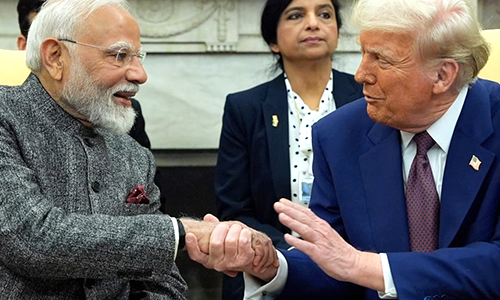
Trump and Modi in strong warm call but 2025 may end without an accord.
The Trade Chasm: Why Trump and Modi in strong warm Phone Calls Still Can’t Bridge the Gap
The year 2025 is drawing to a close, yet the much-anticipated US-India trade deal, a cornerstone of their purported “Comprehensive Global Strategic Partnership,” remains stubbornly out of reach.

In a climate where Washington consistently calls on India to be a pivotal strategic counterbalance to China in the Indo-Pacific, the economic reality is a stark and painful contrast: New Delhi is being treated, in many ways, less like a partner and more like an economic adversary.
The latest snapshot of this complex, strained relationship arrived with the high-level phone call between US President Donald Trump and Indian Prime Minister Narendra Modi on a recent Thursday. While the conversation aimed to inject momentum into the faltering ties, the outcome was predictable—lots of diplomatic warmth, zero trade breakthrough.
The Diplomatic Duality: Warmth vs. Silence
Prime Minister Modi, ever the master of diplomatic messaging, quickly took to social media to describe his exchange with President Trump as “very warm and engaging.” He highlighted a review of “progress in our bilateral relations” and discussions on “regional and international developments.” This one-sided communication highlights where the power asymmetry lies and who is controlling the narrative—and the trade taps.
The fact that this high-level call came just days after Modi hosted Russian President Vladimir Putin adds another layer to the complexity. India’s commitment to its long-standing strategic autonomy, particularly its continued imports of discounted Russian oil and defence equipment, is clearly the primary irritant poisoning the well of trade relations. Trump and Modi in strong warm call but 2025 may end without an accord.
The Tariff Tyranny: A 50% Staggering Burden
The missed deadline at the end of 2025 marks the painful culmination of months of grinding negotiations and escalating tensions. For Washington, this isn’t just a trade dispute; it’s a leverage play designed to coerce a change in India’s energy policy.
While the strategic community in Washington views India as the indispensable democratic counterweight to Beijing, Trump himself appears focused solely on the immediate, transactional benefits of trade rapprochement with China.
White House Press Secretary Karoline Leavitt’s statement that the President believes a “good working relationship” with Beijing is “a good thing for our country” speaks volumes. It suggests that, in the Trump and Modi in strong warm dynamic, the geopolitical urgency of the Indo-Pacific takes a backseat to America First economics.
The Strategic Autonomy Test
India is now at a critical juncture, facing a severe test of its long-standing commitment to strategic autonomy.
While the Indian Commerce Minister Piyush Goyal stated defiantly that India would not “bow down” to the United States and would instead focus on attracting new markets (evidenced by ongoing free trade talks with the European Union), the economic pain is real.
Both leaders continue to meet and talk—the latest conversation confirming that despite the friction caused by the tariffs, the two nations remain committed to working together for “global peace, stability and prosperity.” Trump and Modi in strong warm call but 2025 may end without an accord.
The key takeaway is this: until President Trump softens his “America First” stance on trade and separates it from the strategic imperative to counter China, the trade deal will remain elusive. The continued, almost contradictory, high-level engagement between the two leaders keeps the door ajar, but the punishing tariffs are currently locking the trade vault.
The future of the US-India strategic partnership depends less on the frequency of Trump and Modi in strong warm phone calls and more on whether economic realism can finally trump nationalist protectionism. The current situation demands a political will in Washington to offer the same level of trade concessions that are rhetorically offered in the security domain



Pingback: Terror Attack in Australia Nation on High Alert After 2025
Pingback: Climate Minister Warns of Dangerous Global 2025