RSF Brutal Slaughter Hundreds Vanish After City Falls 2025
Sūḍān’s Agony: Witnessing the Genocide in El Fasher as the World Watches
The news coming out of El Fasher, Sudan, is not just a report; it’s a scream echoing from the heart of Africa. It’s a tragedy that unfolds with chilling predictability, yet still manages to shock the human conscience to its core.
The city, the last bastion of the Sudanese military (SAF) in Darfur, has fallen to the paramilitary Rapid Support Forces (RSF). And what has followed is a grim, systematic brutality that confirms the worst fears of activists and human rights groups.
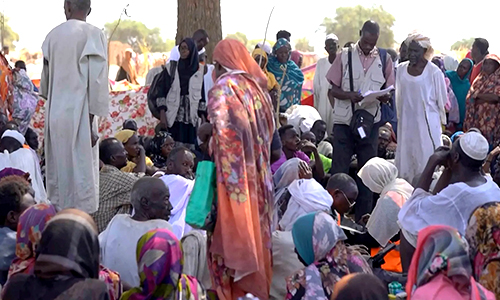
We are once again witnessing what can only be described as a slow-motion genocide, driven by a history of ethnic hatred. The accounts of the RSF Brutal Slaughter Hundreds of men are not mere statistics; they are testimonies to an organized campaign of terror.
The Survivor’s Scar: Alkheir Ismail’s Story
Imagine the scene: fighters, some on camels, others in trucks, rounding up men—not soldiers, but civilians—near a reservoir. Alkheir Ismail was one of them. He was simply trying to bring food to his trapped relatives. He recounts being taken with “a couple of hundred” unarmed men, subjected to racial slurs, and then, the gunfire began.
His survival is a twist of fate almost too cruel to bear. One of the captors recognized him from his school days and whispered a lifeline: “Don’t kill him.” Ismail was spared, but not his friends, not everyone else.
He was forced to flee, leaving behind the chilling sound of slaughter, the undeniable evidence of the RSF Brutal Slaughter Hundreds of men purely based on their perceived ethnicity. His voice, captured by a local journalist, carries the weight of all those lost lives—a voice the world must not silence.
Separated and Silenced: The Pattern of Terror
Ismail’s account is not an isolated incident. Reuters spoke to four such witnesses and six aid workers in the nearby town of Tawila. The pattern is tragically consistent: as people flee, they are apprehended. Men are systematically separated from women and children and removed. Then, gunshots.
Mary Brace, a protection adviser at Nonviolent Peaceforce, an NGO, noted that those arriving in Tawila “are women, children and older men generally.” Where are the younger men? The fear is that they were intercepted, detained, or executed.
This methodical separation and disappearance are war crimes; they are the tactics of ethnic cleansing. Activists warned for months that the fall of El Fasher would invite revenge killings, and the RSF, whose origins trace back to the infamous Janjaweed militias, is fulfilling that horrific prophecy.
The UN human rights office has since shared accounts, estimating that hundreds of civilians and unarmed fighters may have been executed. This is the tragic reality behind the phrase RSF Brutal Slaughter Hundreds.
Echoes of Genocide: Darfur’s Dark History Repeats
For those familiar with the history of Darfur in the early 2000s, this feels like an agonizing loop. The enmity between the largely Arab RSF fighters and the non-Arab ethnic groups, like the Zaghawa and Fur, is deeply ingrained.
Alex de Waal, a genocide expert, tragically observed that the reported RSF acts in El Fasher look “very similar to what they did in Geneina and elsewhere.” The US has already determined that the RSF committed genocide in Geneina. The latest evidence of the RSF Brutal Slaughter Hundreds only adds horrifying weight to those earlier conclusions.
The capture of El Fasher is a major strategic victory for the RSF, but it comes at an unspeakable human cost. It has cemented the geographical division of Sudan, giving the RSF control over the entire Darfur region.
Denials and Detentions: The RSF Response
In the face of mounting evidence—verified videos showing men in RSF uniforms shooting unarmed captives, and satellite imagery consistent with mass graves—the RSF leadership offers denials. A high-level RSF commander dismissed the accounts as “media exaggeration” and propaganda by the enemy. They claim their actions are merely “interrogation” of soldiers and fighters disguised as civilians.
RSF head Mohamed Hamdan Dagalo (Hemedti) even made a speech calling on his fighters to protect civilians and ordering the release of detainees, seemingly acknowledging the widespread reports of detentions. But such pronouncements ring hollow against the backdrop of verified footage and harrowing witness accounts like Ismail’s. The attempt to deflect responsibility and minimize the scope of the RSF Brutal Slaughter Hundreds is an insult to the victims and a cynical exercise in whitewashing war crimes.
The Humanitarian Catastrophe: Where Are the Missing?
The tragedy extends far beyond the executions. The sheer scale of the displacement is staggering. Around 260,000 people were in El Fasher before the attack, yet only 62,000 have been definitively accounted for elsewhere. Tens of thousands are missing.
Aid workers describe a situation where the RSF appears to be deliberately controlling the narrative, providing limited, highly publicised aid in towns like Garney, possibly to attract foreign aid into areas they control.
They are literally using human suffering as a bargaining chip. The journey to safety is perilous, marked by beatings, insults, and theft, as Tahani Hassan, a former hospital cleaner, described after fleeing with her family. The deliberate ethnic targeting and the systematic separation of men reinforce the devastating impact of the RSF Brutal Slaughter Hundreds on the social fabric of Darfur. The world must not let the RSF Brutal Slaughter Hundreds be ignored.
Accountability and the World’s Silence
The ultimate crime here is not just the violence but the international community’s inertia. Warnings were sounded for months that El Fasher would fall, yet no coordinated, decisive action was taken to protect the trapped population. The conflict in Sudan has been called the world’s largest humanitarian crisis, yet funding and diplomatic pressure remain woefully inadequate.
The systematic killings—the RSF Brutal Slaughter Hundreds—constitute war crimes, and potentially crimes against humanity. They are under investigation by the International Criminal Court.
Yet, as the sun sets on Darfur, the question remains: who is supplying the RSF with the weapons and financial support they need to carry out this terror? Accusations against certain foreign powers, though denied, continue to circulate, painting a picture of geopolitical self-interest overriding human life.
We must amplify the voices of survivors like Alkheir Ismail and Tahani Hassan. We must demand an end to the impunity. The RSF Brutal Slaughter Hundreds is a stain on our collective conscience.
The world must recognize that the fall of El Fasher is a critical point of no return. Unless immediate and sustained pressure is brought to bear, the chilling pattern of the RSF Brutal Slaughter Hundreds will only continue, deepening Sudan’s misery into an irreparable regional tragedy.