Pakistan New Zealand Clash Ends in Dramatic Setback as 1 Super Eights Opener Halts
Damp Start to the Super Eights: Why the Pakistan New Zealand Clash Ends in Frustration
Cricket is a sport that often demands patience, but few things test the soul of a fan quite like a tropical downpour in Sri Lanka. However, nature had other plans. Instead of a display of power hitting and tactical bowling, the Pakistan New Zealand Clash Ends before it could even begin, leaving both teams and thousands of drenched supporters staring at a waterlogged outfield and a shared points table.
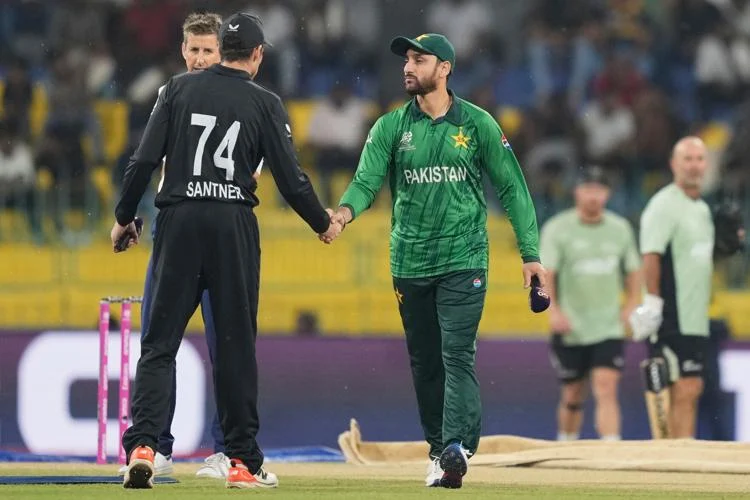
For Pakistan, the Super Eights represented a fresh start after a rollercoaster group stage. For New Zealand, it was a chance to prove their consistency on the big stage. Yet, as the persistent rain turned the square into a series of blue-covered islands, the reality set in: the Pakistan New Zealand Clash Ends not with a roar, but with a handshake in the dugout.
The Toss, the Hope, and the Downpour
The evening began with a deceptive sense of optimism. The floodlights were humming, and the stands were beginning to fill with the vibrant green of Pakistan and the steady black of the Kiwis. He even announced a tactical change, bringing in the explosive Fakhar Zaman to bolster the top order.
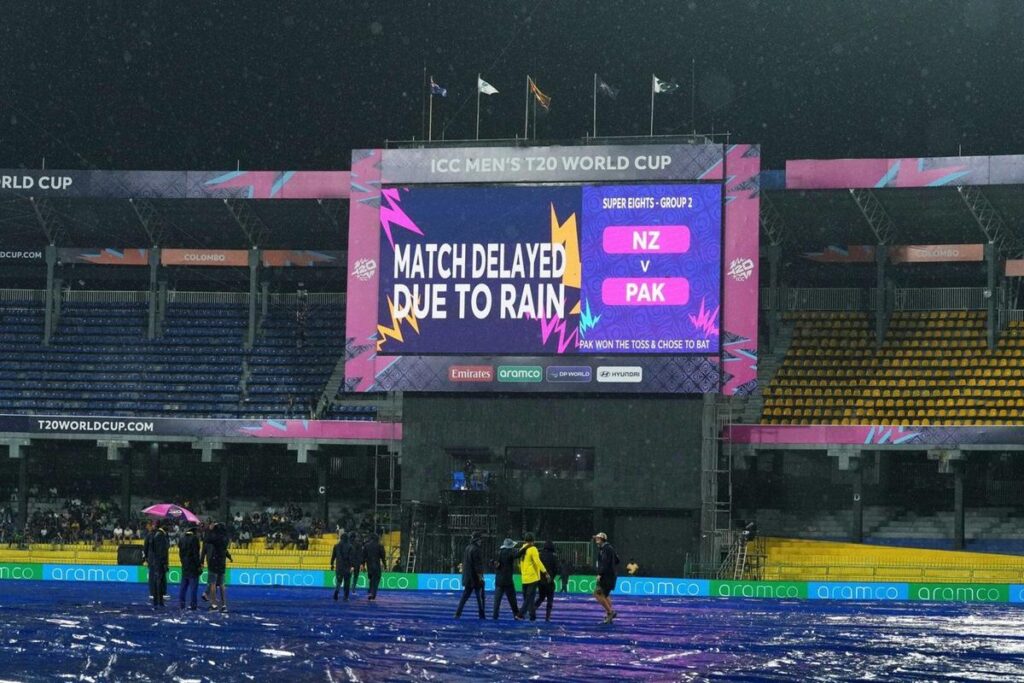
However, as the post-toss interviews were being wrapped up, the first few drops fell. What initially looked like a passing shower quickly escalated into a relentless Colombo drizzle. Within minutes, the 60-plus ground staff—legendary for their speed in Sri Lanka—were sprinting across the grass with massive tarpaulins. It was a heartbreaking sight for the fans, marking the moment the Pakistan New Zealand Clash Ends its competitive life and enters a long wait against the clock.
Ground Staff vs. The Elements
The R Premadasa Stadium is famous for its world-class drainage, but even the best engineering has its limits when the clouds refuse to move. For nearly three hours, the groundsmen performed a silent, heroic dance, constantly adjusting covers and trying to sweep away puddles that formed in the runoff areas.
When the official announcement finally echoed through the PA system, the Pakistan New Zealand Clash Ends officially as an abandonment, a “No Result” that leaves a bitter taste for everyone involved.
The Math of the Super Eights
In a tournament format as unforgiving as the Super Eights, a single point can be a blessing or a curse. Group 2 is a “Group of Death,” featuring not just these two giants but also the formidable defending champions England and the co-hosts Sri Lanka. By splitting the points, both teams now find themselves in a precarious position. Because the Pakistan New Zealand Clash Ends without a ball bowled, neither team was able to gain a Net Run Rate (NRR) advantage, which often acts as the tie-breaker in these short bursts of matches.
Pakistan’s road to the semi-finals now requires them to be almost perfect. They must travel to Pallekele to face England, a match that has now become a virtual “must-win.” If they stumble there, their final game against Sri Lanka might not even matter. Similarly, for Mitchell Santner’s New Zealand side, the pressure has ramped up. They remain in Colombo to face the Lankans, knowing that another washout or a narrow loss could effectively end their World Cup dreams before they’ve even had a chance to bat.
Tactical “What-Ifs”: The Fakhar Factor
One of the most discussed points among the shivering fans in the stands was the return of Fakhar Zaman. Pakistan had decided to drop Khawaja Nafay to make room for the veteran left-hander, a clear signal that they intended to play an aggressive brand of cricket. On the other side, New Zealand had welcomed back Mitchell Santner after his brief illness, alongside Ish Sodhi and Lockie Ferguson.
The tragedy of the rain is that we never got to see these tactical gambles play out. Would Fakhar have dismantled the Kiwis’ spin-heavy attack? Would Ferguson’s extra pace have troubled Saim Ayub on a sticky Colombo deck? Because the Pakistan New Zealand Clash Ends prematurely, these questions remain confined to the realm of “cricket fan theories” rather than on-field evidence.
The Plight of the Fans
We often talk about the players and the points, but the real victims of a washout are the fans. Many had traveled from across the globe, booking flights and hotels months in advance just to see this specific fixture. To see the Pakistan New Zealand Clash Ends in such a damp fashion is a reminder of cricket’s unique vulnerability to the weather. Unlike football or rugby, which can be played in a deluge, cricket requires a dry surface for safety and the integrity of the ball.
The “look Rank Math SEO” of the crowd was one of somber resignation.
Looking Ahead: Group 2 Complexity
With one point each, the focus shifts to the other teams in the group. India and South Africa are set to clash in Ahmedabad, and their result will set the tone for Group 1, but for our Group 2 protagonists, all eyes are on the Sunday clash between Sri Lanka and England. If one of those teams secures a big win, Pakistan and New Zealand will find themselves trailing in the NRR race immediately.
The fact that the Pakistan New Zealand Clash Ends this way means that every boundary and every wicket in the remaining fixtures will carry double the weight. There is no longer any margin for error. The “safe” approach is gone; both teams will have to play high-risk, high-reward cricket in their next outings to make up for the lost opportunity in Colombo.
Conclusion: A Game Lost to the Clouds
In the grand scheme of the 2026 T20 World Cup, this match will be remembered as the “one that got away.” It serves as a reminder that in South Asia, the monsoon is as much a player as any cricketer on the field. While the Pakistan New Zealand Clash Ends with a boring “NR” (No Result) on the scorecard, the implications for the tournament are anything but boring.