North Korea Shocking 1 Missile Launch: Unidentified Projectile Fired Toward Sea
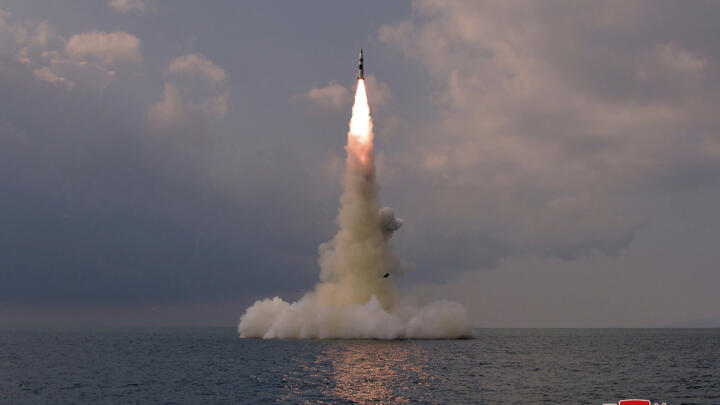
Midnight Fire: The Scale of the Launch
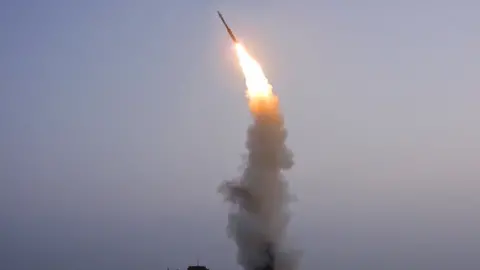
South Korea’s Joint Chiefs of Staff (JCS) and Japanese defense authorities confirmed the detection of the projectiles launched from the Sunan area near Pyongyang. The timing of this North Korea Shocking event is no coincidence. It aligns perfectly with the ongoing “Freedom Shield” exercises—a massive 11-day joint military drill between the United States and South Korea involving approximately 18,000 troops.
This North Korea Shocking surge in kinetic activity suggests that Kim Jong Un is no longer content with single-test demonstrations but is instead rehearsing for large-scale saturation strikes.
Kim Yo Jong’s Ominous Warning
The missile tests were preceded by a chilling rhetorical barrage from the North’s leadership. Kim Yo Jong, the influential sister of the North Korean leader, issued a statement earlier in the week criticizing the “reckless acts of outrageous international rogues.” She warned that the Freedom Shield drills would bring about “unimaginably terrible consequences.” This North Korea Shocking rhetoric highlights the regime’s view that these exercises are not defensive drills, as claimed by Washington and Seoul, but rather a “preemptive war rehearsal.”
The 11-day Freedom Shield exercise, scheduled to run until March 19, is primarily a computer-simulated command post exercise. However, it is accompanied by “Warrior Shield,” a field training program designed to test the allies’ joint operational capabilities. The United States is currently engaged in an escalating conflict with Iran, a situation that has reportedly led to the relocation of some U.S. military assets—including Patriot anti-missile systems—from the Korean Peninsula to the Middle East.
Critics and security experts worry that Kim Jong Un is using this “window of opportunity” to increase his leverage. With U.S. attention divided between the Middle East and the war in Ukraine, the North Korea Shocking persistence of these missile tests suggests that Pyongyang believes the U.S. “nuclear umbrella” over South Korea may be stretched thin. This perception of weakness, whether real or imagined, is a recipe for miscalculation on both sides.
The Russia-North Korea Alliance: A New Cold War
Beyond the immediate missile threat, the deepening ties between Pyongyang and Moscow have reached a fever pitch. Reports throughout early 2026 indicate that Kim has sent thousands of elite “Storm Corps” troops to Russia’s Kursk region to support the war effort in Ukraine. This North Korea Shocking level of direct combat participation marks a radical departure from the North’s traditional isolationist policy.
In exchange for manpower and millions of artillery shells, Russia is believed to be providing North Korea with advanced military technology, including submarine and satellite capabilities. This transactional relationship means that every North Korea Shocking missile launch is likely informed by data and technical assistance gathered from the battlefields of Europe. The “Axis of Resistance” mentioned in Middle Eastern contexts now has a clear counterpart in East Asia, as Pyongyang aligns itself firmly with the “New Cold War” bloc.
The Trump Factor and the Collapse of Diplomacy
Adding another layer of complexity is the political situation in Washington. As the Trump administration wages its war against Iran, there have been mixed signals regarding the Korean Peninsula. While the military continues its drills, there is talk of a potential meeting between Trump and Kim Jong Un to “reopen dialogue” that has been frozen since 2019.
However, the North Korea Shocking reality is that diplomacy currently feels like a distant memory. The collapse of the 2019 Hanoi summit left deep scars on the relationship, and Kim has since pivoted toward a “super-strong offensive” doctrine. The launch of ten missiles during a time when some are calling for talks is a clear message: Pyongyang will only return to the table on its own terms, and certainly not under the precondition of denuclearization.
Civil and Humanitarian Impact
The constant state of “Warrior Shield” and North Korea Shocking missile alerts has taken a toll on the civilian populations in both the North and the South. In Seoul, the government of President Lee Jae Myung is walking a tightrope between maintaining a strong defense posture and avoiding an accidental outbreak of war. Meanwhile, in the North, the redirection of resources toward these massive missile volleys continues to exacerbate the humanitarian crisis, though the regime remains undeterred.
Conclusion: Preparing for the Unthinkable
The events of March 14, 2026, serve as a stark reminder that the Korean Peninsula remains one of the most volatile regions on Earth. The North Korea Shocking launch of a missile swarm during a period of global conflict indicates that the old rules of engagement are no longer in play. As Operation Ghazab Lil Haq rages in the Middle East and the war in Ukraine persists, the “Freedom Shield” drills must now account for a North Korea that is more capable, more integrated with Russia, and more willing to risk total escalation than ever before.
The international community must now decide whether to continue the path of sanctions and drills or seek a radically new diplomatic framework before these “terrible consequences” become a reality.