
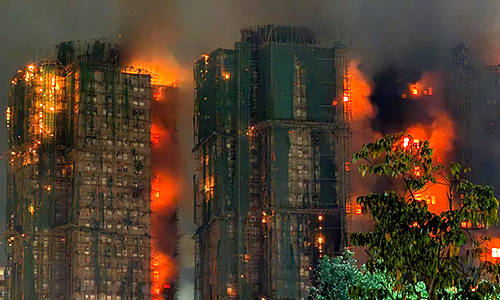
Hong Kong Tragedy Powerful Questions Rise After 40 Killed in Massive Fire
Hong Kong Tragedy: Residents Ask How a Deadly Blaze Spread So Fast
Wan had been relaxing at home, watching television like it was any ordinary afternoon in Hong Kong. For nearly half an hour, he had no idea a massive fire was racing toward his apartment building. The Hong Kong Tragedy began quietly for him — just a normal day, loud streets, and distant sirens he barely paid attention to. He assumed it was another routine disturbance in a busy city.
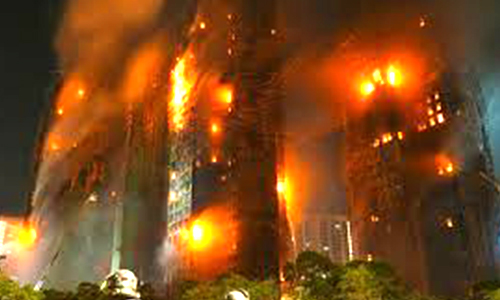
But the moment he heard people screaming for help, he walked over to his window. As soon as he slid it open, thick smoke rushed into view. “The instant I opened the window, I saw the smoke,” Wan told CNN. What he didn’t know at that time was that he was already 30 minutes into what would become the Hong Kong Tragedy that shocked the entire city.
How the Fire Spread So Fast
At around 2:45 p.m., an eyewitness first noticed flames rising from one of the eight residential towers at Wang Fuk Court, a large public housing complex. By the time Wan looked outside his eighth-floor apartment window at 3:15 p.m., firefighters were on the scene — but the fire was already out of control.
All the buildings in the complex were under renovation and wrapped in bamboo scaffolding, a traditional yet highly flammable construction material. As flames shot up the sides of the 31-storey towers, bamboo poles snapped and collapsed, acting like a ladder guiding the fire higher and wider. This rapid spread became one of the most horrifying parts of the Hong Kong Tragedy, leaving residents questioning how such a disaster was even possible in a city known for its strict safety standards.
Realizing the danger, Wan grabbed his two dogs and wallet, rushing into an emergency stairwell that reeked of gas. Minutes after he escaped, officials upgraded the blaze to a Level 4 alarm — and soon after, to the maximum Level 5.
Thousands Watched Their Homes Burn
As daylight faded, shocked residents returning from work and school watched the orange glow swallow building after building. More than 4,000 people lived in Wang Fuk Court, many of them elderly. The Hong Kong Tragedy moved so quickly that within hours, seven of the eight towers were engulfed in flames.
By nightfall, the worst fears were confirmed. Families filled community chat groups, desperately searching for loved ones. News channels broadcast images of the firestorm across the region. For a wealthy city with a strong history of building safety, the scale of destruction felt unreal.
This was not just a fire. It was the Hong Kong Tragedy that raised critical questions about construction materials, safety checks, and renovation standards.
Families Left With Nothing
After the fire was finally contained, emergency shelters filled with displaced residents. Wan and his wife sat on chairs inside a sports center converted into a temporary shelter, surrounded by volunteers handing out food and water.
“There’s no home to go back to,” he said softly. “We have nothing, not even clothes.”
His words echoed the heartbreak felt by hundreds of families. The Hong Kong Tragedy left many wondering whether it was a preventable disaster — one that should have been stopped long before flames appeared.
Warnings Were Raised a Year Earlier
A Facebook group used by Wang Fuk Court residents revealed something even more troubling: people had been warning about safety hazards for more than a year.
Shockingly, the last inspection was on November 20 — just days before the Hong Kong Tragedy — and the department had issued another written reminder to contractors to follow fire-prevention measures.
Hong Kong’s bamboo scaffolding code requires all scaffold netting to be fire-retardant. The catch? This code isn’t actually a law. This loophole is now one of the most heavily questioned parts of the Hong Kong Tragedy, as residents and officials debate whether stricter enforcement could have saved lives and prevented widespread destruction.



Pingback: Rising Tension Police Warn Melburnians of Big Protest 24