
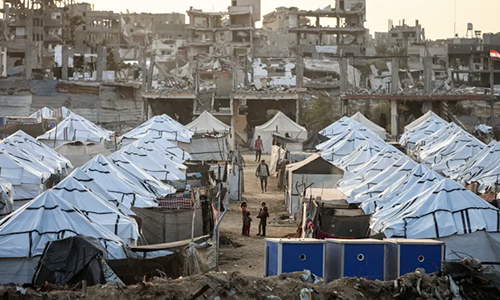
Gaza aid faces bleak shortfall as fierce storms hit and 1 urgent need rises
Gaza Aid Faces Bleak Shortfall as UNRWA Accuses Israel of Blocking Relief
The humanitarian crisis in Gaza has entered another painful chapter as Gaza aid faces bleak shortfall despite a ceasefire that supposedly guarantees the flow of relief. The United Nations Relief and Works Agency (UNRWA) has sharply criticised Israel for crippling its operations, blocking vital supplies, and leaving millions of Palestinians exposed to heavy rains, harsh winter conditions, and severe shortages of food, medicine, and shelter.
For more than two years, Palestinians have endured what UN officials repeatedly describe as an “ongoing genocidal war.” Now, as Gaza aid faces bleak shortfall once again, UNRWA Commissioner-General Philippe Lazzarini has warned the international community that the situation is dire and worsening.
Speaking to the UN General Assembly’s Fourth Committee, Lazzarini said safeguarding UNRWA’s mandate is not a matter of politics but of survival for millions of Palestinians. He reminded member states that international law — through the UN Commission of Inquiry and the International Court of Justice (ICJ) — obligates Israel to lift restrictions on the agency. But on the ground, those obligations go largely ignored, and Gaza aid faces bleak shortfall every passing week.
Funding Crisis: ‘We Run Week by Week’
Complicating the crisis is UNRWA’s financial collapse. Lazzarini revealed that the organisation is barely surviving month to month due to massive funding cuts, most notably from the United States.
“We run week by week, month by month,” he explained, noting that salaries for November are barely manageable and December remains uncertain. As Gaza aid faces bleak shortfall, UNRWA’s ability to function across the region — not just Gaza — is now at risk.
Israel has barred UNRWA from operating on its territory after making unverified allegations that some staff supported Hamas during the October 7, 2023 attack. Despite failing to produce proof, Israel continues to cite these accusations to justify preventing the delivery of aid. Following Israel’s claims, the United States suspended its financial support, worsening the crisis as Gaza aid faces bleak shortfall under increasing pressure.
UNRWA had to pull out its international staff from Gaza and the West Bank, further restricting operations. Still, 12,000 Palestinian staff members continue working relentlessly to keep the agency alive.
Vital Services Under Threat
In a region where Gaza aid faces bleak shortfall, UNRWA remains the backbone of civilian survival.
Lazzarini said the agency provides shelter to 75,000 displaced people across 100 facilities. Over the past two years, UNRWA delivered more than 15 million primary health consultations — averaging 14,000 every day.
Its partnership with UNICEF and the World Health Organization ensures critical vaccination campaigns for children, while its education services remain a lifeline for thousands of students robbed of normal schooling by war.
Without new funding, these essential services will collapse. “The delivery of critical services to millions of Palestinian refugees across the region will be compromised,” Lazzarini warned, underscoring once again that Gaza aid faces bleak shortfall and that the situation is becoming unbearable.
Ceasefire Violated: Expected 600 Trucks, Only 150 Entering
Under the US-brokered ceasefire that took effect on October 10, at least 600 trucks per day were supposed to enter Gaza. But as reports indicate, Gaza aid faces bleak shortfall as only around 150 trucks are allowed in daily.
Al Jazeera’s Hind Khoudary, reporting from Deir el-Balah, says the shortage is catastrophic. More than two million displaced Palestinians are left homeless, without tents, tarps, or basic supplies — despite the arrival of some aid trucks.
Families sheltering in makeshift camps fear the coming winter. The lack of warm clothing, medicine, and safe shelter is transforming the situation into what Khoudary calls a “terrifying nightmare.”
The UN has repeatedly warned that famine in northern Gaza — first declared in August — remains an active threat. Gaza aid faces bleak shortfall, especially for communities cut off by damaged roads and long delays at Israeli checkpoints.
Northern Crossing Reopens — But Still Not Enough
Earlier this week, Israel reopened the northern Zikim crossing after keeping it closed for two months. Its closure had choked off the main route for aid into northern Gaza, intensifying hunger and disease. Palestinian truck drivers, like Abdulkarim Abu Daqqa, welcomed the reopening, hoping it would continue long enough to ease the crisis.
He said that approximately 80 trucks were loaded and ready, but even that number barely dents the overwhelming need. The reopening does not change the grim fact that Gaza aid faces bleak shortfall on a scale far beyond what current aid levels can address.
A spokesperson for COGAT — the Israeli body overseeing civilian matters in the occupied territories — said the crossing would stay open permanently. But humanitarian agencies remain skeptical, noting repeated inconsistencies between announcements and actual ground conditions.
Political Repercussions: UNRWA Under Targeted Pressure
The crisis is also deeply political.
The US Secretary of State, Marco Rubio, stated that UNRWA would have no role in post-war Gaza, aligning with Israeli demands to dismantle the agency. Yet Lazzarini says UNRWA has expanded its services since the ceasefire began, insisting that its presence is indispensable — especially now, when Gaza aid faces bleak shortfall and communities are on the brink.
Former officials have warned that moves to sideline UNRWA are part of a larger strategy to redesign Gaza’s political landscape without considering the will or welfare of its people.
At the same time, Israel’s relentless restrictions on aid have triggered international criticism. Human rights groups argue that preventing food and medical supplies from reaching civilians violates international humanitarian law and could constitute collective punishment.
Humanitarian Outlook: A Harsh Winter Ahead
For families in Gaza, survival is becoming harder every day. Heavy rains have already begun, turning camps into muddy swamps. Residents lack blankets, heating, and waterproof shelters. The psychological toll is immense, especially for children who have spent two years under bombardment and displacement.
If the situation continues and Gaza aid faces bleak shortfall without significant corrective action, the coming winter could lead to widespread illness, outbreaks of infection, and even preventable deaths.
Humanitarian workers fear that the international community is becoming desensitised. Despite repeated warnings, global political divisions prevent decisive intervention.
Conclusion: A Crisis the World Cannot Ignore
As Gaza aid faces bleak shortfall — repeated, deepened, and prolonged — the humanitarian needs grow more urgent. UNRWA is sounding the alarm, Israel continues its restrictions, and millions of Palestinians remain trapped between political decisions and survival.
Unless immediate action is taken, Gaza will continue sinking deeper into a crisis the world already has the power — but not yet the will — to resolve.
Once again, the truth is unavoidable: Gaza aid faces bleak shortfall, and time is running out for those who depend on it most.



Pingback: Pakistan and Jordan Strong 5-Step Gaza Peace Plan