
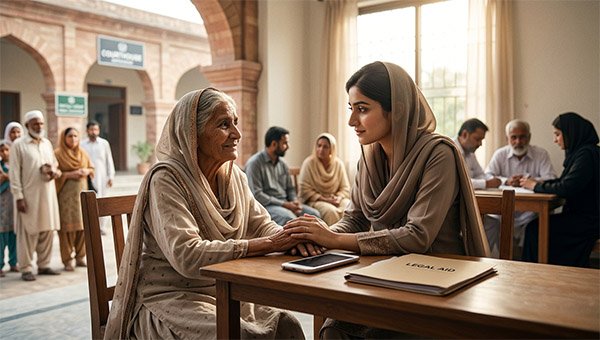
Supreme Justice 5 Fierce Breakthroughs Beyond Conventional Lines
Supreme Justice 5 Fierce Pillars of Equal Access and Legal Aid in Pakistan
Article 37(d) of the Constitution places a solemn responsibility upon the State to ensure inexpensive and expeditious justice for all citizens. Behind every pending case in our courtrooms lies a deeply human story: a family worried about the roof over its head, a widow striving to protect her lawful inheritance, a daily-wage worker seeking unpaid wages, or simply a vulnerable citizen who does not know where to turn.
While the heavy wooden doors of our courthouses may technically remain open to everyone, real justice often stays far beyond reach when the financial cost of seeking it exceeds what a person can possibly bear. For someone already struggling daily to make ends meet, the core question is not whether the law provides a remedy, but whether they can realistically afford to reach it.
For such marginalized individuals, litigation is never merely a sterile legal process. A single court visit can mean sacrificing a day’s vital income. A private lawyer’s retainer fee often directly competes with putting food on the table, paying school fees, or purchasing life-saving medicines.
Even knowing where to go, which forms to fill, and how to begin can become an insurmountable barrier. A constitutional right guaranteed by law holds very little meaning if a citizen lacks the financial means to claim it. This fundamental disconnect proves why Supreme Justice 5 Fierce reforms must move far beyond the conventional contours of traditional courtrooms and rigid legal procedures.
The Constitutional Mandate and State Responsibility
Article 37(d) of the Constitution places upon the State the responsibility to ensure inexpensive, expeditious justice. Behind this vital constitutional commitment lies the most basic principle of our social contract: citizens look to the State not merely to draft laws, but to actively protect fundamental rights and provide accessible remedies whenever those rights are violated. Justice cannot be deemed truly inclusive if the ability to seek a legal remedy depends entirely upon the ability to pay high legal fees.
Recent judicial and administrative initiatives seek to address this deep societal divide. For instance, the National Judicial Policy Making Committee announced an initiative under which financially distressed litigants may receive legal representation at State expense across the entire judicial hierarchy, ranging from local Magistrate Courts all the way up to the Supreme Court.
Concurrently, the Law and Justice Commission of Pakistan is working towards establishing a broader, more robust framework for free legal aid and advice. The core principle driving these efforts is refreshingly simple: crushing poverty should never determine whether a citizen’s voice is heard before a court of law. Supreme Justice 5 Fierce Breakthroughs Beyond Conventional Lines
Bridging the Information Gap Before the Courtroom
Access to justice actually begins long before a litigant ever speaks to a lawyer or enters a courtroom. Someone entirely unfamiliar with the judicial system may not know what legal remedies are available or where to seek professional help. To professionals already familiar with the system, these may seem like ordinary questions. However, for someone poor, vulnerable, or distressed, they become impenetrable walls standing directly between a right and its lawful remedy.
This is where initiatives aligned with Supreme Justice 5 Fierce principles step in to bridge the gap. The Supreme Court’s dedicated Call Centre has emerged as a vital lifeline in this regard. Experienced legal professionals, including a retired judge and a skilled legal consultant, have been actively engaged to provide professional legal advice directly over the telephone or through a personal visit to the Centre.
For a citizen unable to afford even an initial consultation fee, this means having somewhere to turn, someone who will listen compassionately, understand the core problem, and guide them toward the appropriate legal forum. Supreme Justice 5 Fierce Breakthroughs Beyond Conventional Lines
The Role of the Bar and Human Pathways
The legal fraternity and the Bar form another vital pillar of this inclusive approach. The Bar is increasingly being taken on board to provide pro bono legal representation to deserving litigants who simply cannot afford a private lawyer. For someone with a genuine, undeniable grievance but zero financial means to pursue it in court, such representation makes the absolute difference between giving up entirely and having a real opportunity to secure justice.
Together, these progressive measures create a much more humane pathway to justice: practical guidance at the very first point of contact and, where appropriate, free legal representation. Instead of expecting ordinary citizens to understand every complex door of the judicial system before asking for help, the system now begins helping them find the right one. That is the true essence of Supreme Justice 5 Fierce structural evolution.
Fulfilling Global Commitments and SDG 16
Comprehensive legal aid, public facilitation desks, telephone-based guidance, and free representation serve a common, noble purpose: removing artificial barriers that leave a person possessing a legal right with no practical way to claim it. Supreme Justice 5 Fierce Breakthroughs Beyond Conventional Lines
Furthermore, these systemic improvements give genuine, practical meaning to Sustainable Development Goal 16 (SDG 16), which calls for equal access to justice and strong, inclusive institutions, grounded in the broader promise that no citizen should ever be left behind because of poverty, geographical distance, or a lack of legal knowledge.
Achieving Supreme Justice 5 Fierce standards means that the real test will always lie in rigorous implementation. Free legal assistance requires transparent eligibility criteria, highly competent lawyers, clear referral mechanisms, and measurable quality standards. The quality of legal representation provided to the poor matters just as much as its mere availability. Justice for a destitute person must never degrade into poorer justice. Supreme Justice 5 Fierce Breakthroughs Beyond Conventional Lines
Ultimately, access to justice cannot be measured solely by counting courthouses, active judges, or resolved cases. Its truest measure lies in the lived experience of the person seeking help at their moment of greatest need: Was that individual genuinely heard? Was their human dignity preserved? Or did their inability to pay stand as an unbreakable wall between a citizen and a lawful remedy?
A courthouse may have its physical doors wide open, but justice becomes truly accessible only when poverty and lack of legal knowledge no longer decide who can walk through them. Perhaps that is the deeper meaning behind Supreme Justice 5 Fierce reform frameworks: a judicial system that listens when people feel unheard, helps them find the right door when they feel lost, and brings justice back within reach when it once seemed impossible.
For someone who thought there was nowhere else to turn, that transformative journey often begins with something as simple as a phone call. Supreme Justice 5 Fierce Breakthroughs Beyond Conventional Lines