CDF Munir Ghalibaf Meet 1 Great Push to Stop Regional Hostility
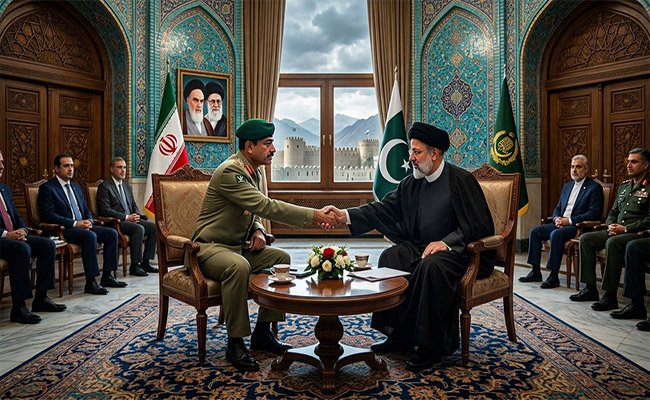
High-stakes diplomatic engagement unfolded in Tehran on Monday as Pakistan’s Chief of Defence Forces and Chief of Army Staff, Field Marshal Asim Munir, embarked on a high-profile official visit to the Iranian capital. Central to this visit was a strategic CDF Munir Ghalibaf Meet aimed at reviving stalled peace talks and mitigating escalating tensions in the Middle East.
The bilateral talks, which included top Iranian political, security, and diplomatic leadership, take place at a critical juncture for international security, regional economic stability, and energy trade routes.
Strategic Objectives Behind the Tehran Diplomatic Mission
According to official statements issued by the Inter-Services Public Relations (ISPR), Field Marshal Munir’s visit is part of Islamabad’s ongoing commitment to support regional peace, security, and diplomatic stability. Accompanied by Pakistan’s Interior Minister Mohsin Naqvi, the military chief led a high-powered delegation designed to bridge gaps between Tehran and Western powers.
The primary focal point of the mission centers around the CDF Munir Ghalibaf Meet, where both leaders discussed the operational status of the landmark Islamabad Memorandum of Understanding (MoU). The MoU, brokered by Pakistan in June 2026, served as a foundational 14-point framework aimed at bringing an end to the severe escalation between the United States, Israel, and Iran.
Pakistan’s diplomatic channels have continued working tirelessly to ensure that peace initiatives remain viable despite the complex geopolitical web surrounding the region.
Key Takeaways from the High-Level Deliberations
During the meeting, Iranian Parliament Speaker Mohammad Bagher Ghalibaf reiterated Tehran’s determination to honor its commitments under the diplomatic framework. However, he expressed strong skepticism regarding Washington’s willingness to implement its obligations.
| Official / Leader | Platform / Organization | Key Message |
| Field Marshal Asim Munir | Chief of Defence Forces, Pakistan | Reaffirmed Pakistan’s commitment to restoring regional peace and stabilizing trade routes. |
| Mohammad Bagher Ghalibaf | Speaker of Parliament, Iran | Stated Iran adheres to the Islamabad MoU but criticized US non-compliance for eroding trust. |
| Mohsen Rezaei | Secretary, Supreme National Security Council | Demanded practical action and behavior changes from Washington regarding agreement terms. |
| Esmaeil Baqaei | Foreign Ministry Spokesperson, Iran | Highlighted that Pakistan-Iran bilateral ties have reached one of their strongest historical stages. |
Ghalibaf noted during the CDF Munir Ghalibaf Meet that Washington’s failure to honor its commitments has hindered regional stability and eroded diplomatic trust. Reaffirming Pakistan’s neutral mediating role, Field Marshal Munir assured Iranian leaders that Pakistan will spare no effort to help bring lasting resolution to the Middle Eastern crisis.
Broad Diplomatic Outreach: Meetings with Pezeshkian and Rezaei
Beyond the central discussions with the parliamentary speaker, the Pakistani delegation engaged with several other high-level figures in Tehran. Photographs published by Iran’s ISNA news agency confirmed a formal session between Field Marshal Munir and Iranian President Masoud Pezeshkian.
In a separate session, Mohsen Rezaei, Secretary of Iran’s Supreme National Security Council, underscored the lack of confidence Tehran holds toward international agreements when terms are violated arbitrarily. Rezaei emphasized that for any deal to succeed, the United States must demonstrate tangible policy shifts rather than issuing coercive economic threats.
Meanwhile, Iranian Foreign Ministry Spokesperson Esmaeil Baqaei praised the visit, highlighting that Pakistan-Iran relations are experiencing unprecedented strength. Baqaei clarified that while the Pakistani delegation’s schedule ran concurrently with an official visit by Oman’s foreign minister, both engagements independently focused on broader Middle East security dynamics.
Geopolitical Context: The Conflict and Strategic Waterways
To fully grasp the significance of the CDF Munir Ghalibaf Meet, one must consider the historical backdrop of the 2026 regional crisis. Following intense military exchanges in early 2026, an initial April ceasefire temporarily halted major bombardment. However, control over the Strait of Hormuz quickly surfaced as a critical international flashpoint.
As one of the world’s vital maritime conduits for global energy transport, the closure of the Strait has triggered severe international economic reverberations. Iran has maintained firm control over the waterway, conditioning its full reopening on several key demands:
-
Complete lifting of naval blockades on Iranian ports.
-
Unfreezing of Iranian state financial assets abroad.
-
Revocation of unilateral economic and oil sanctions.
Pakistan’s role as a trusted mediator came into sharp focus during the June 2026 negotiations, which produced the Islamabad Memorandum of Understanding. The recent CDF Munir Ghalibaf Meet represents a renewed push to prevent that framework from collapsing under fresh geopolitical strain.
Escalating Pressure and the Road Ahead
The diplomatic effort in Tehran faces significant external headwinds. Washington’s declaration of renewed, strict economic pressure under “Operation Economic Outcast” has introduced fresh complications to the diplomatic landscape. US officials have signaled an intent to enforce historical sanctions, urging key global economies to isolate Iran further.
Despite these mounting obstacles, the outcomes of the CDF Munir Ghalibaf Meet demonstrate that channels for dialogue remain open. By hosting conversations between top Pakistani military officials and Iranian political leaders, both nations are attempting to safeguard regional security from further destabilization. CDF Munir Ghalibaf Meet 1 Great Push to Stop Regional Hostility
As Pakistan continues its good offices, international observers remain focused on whether these diplomatic interventions can prevent renewed confrontation, secure critical energy maritime lanes, and pave the way toward a comprehensive regional peace framework. CDF Munir Ghalibaf Meet 1 Great Push to Stop Regional Hostility