
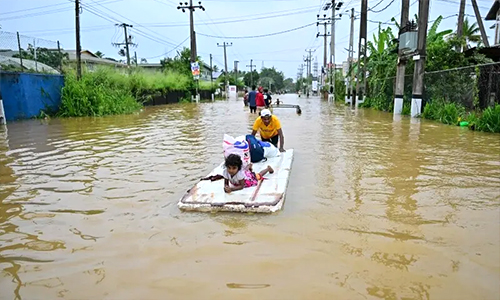
Sri Lanka Emergency Declared After 100 death Negative Floods and Mudslides
Sri Lanka is living through one of the darkest chapters in its recent history. Days of nonstop rain, floods, and deadly mudslides have torn through towns and villages, leaving behind destruction that people are still trying to understand. With Sri Lanka Emergency Declared, the country is now trying to gather itself and help thousands of families who have lost everything.

The official figures paint a grim picture. More than 330 people have died, and the number is expected to rise as rescue teams slowly reach cut-off areas. Over 200 people are still missing, while close to 20,000 homes have either collapsed or washed away. Around 108,000 people are spending their days and nights inside temporary shelters set up by the government.
The monsoon season is normal for Sri Lanka, but this time the rain came with an intensity no one was prepared for. Cyclone Ditwah skimmed past the eastern coast, adding more chaos to the already heavy rainfall. Soon after the storm passed, Sri Lanka Emergency Declared became unavoidable as entire districts started reporting landslides, collapsed bridges, and drowned neighborhoods.
President Anura Kumara Dissanayake called it the “most challenging natural disaster” the country has ever dealt with. He also said that the destruction is so widespread that it will take huge resources and a long time to rebuild. His statement came on the same day when Sri Lanka Emergency Declared was announced to speed up relief efforts.
Some of the worst scenes have emerged from Kandy and Badulla, where landslides wiped out entire clusters of homes. A woman from central Sri Lanka told the BBC that nearly “15 houses vanished under rocks and mud” in her village — and nobody survived. Stories like this have become painfully common ever since Sri Lanka Emergency Declared.
In Badulla’s Maspanna village, a resident named Saman Kumara spoke by phone to a local news site. He said, “We lost two people here… the rest of us are squeezed inside a temple and one house that somehow survived.” He added that the roads are blocked, food supplies are running out, and clean drinking water is almost gone. His voice described the fear many families now live with after Sri Lanka Emergency Declared.
Another heartbreaking incident occurred in Kurunegala, where 11 elderly residents died when their care home flooded. Police said rescue teams could not reach the building in time because the roads were underwater.
Survivors have also spoken about moments when they thought they would not make it. After a long rescue operation, one man told AFP how navy officers helped people onto a nearby building’s roof. “We were lucky… a part of the roof broke while we were standing on it. Three women fell but were pulled back up,” he said, still shaken.
Electricity and water supply remain a huge problem. Nearly one-third of the country has no power or running water. Engineers are trying to fix the lines, but damaged roads and unstable ground are slowing everything down. These delays were among the reasons Sri Lanka Emergency Declared was required — so the military and rescue teams could be deployed without bureaucratic hurdles.
The last time Sri Lanka saw flooding anywhere near this scale was in 2003, when more than 250 people died. But this time the destruction is more widespread, and many more families have been displaced. It has affected agriculture, transport, small businesses, and even schools. With Sri Lanka Emergency Declared, local authorities now have more control to move people, open emergency routes, and coordinate with international organizations.
Evacuation warnings remain in place for areas near the overflowing Kelani River. Authorities are urging people to leave immediately if they receive orders, because more ground movement is expected in the hilly regions. Since Sri Lanka Emergency Declared, rescue teams have been told to give top priority to villages located on unstable slopes.
The disaster has arrived at a time when Southeast Asia is also suffering. Indonesia, Malaysia, and Thailand are facing serious floods of their own, affecting millions of people. This entire region is going through unusually heavy weather this year.
🌐 Rank Math–Style Backlinks (Natural Placement)
People seeking verified updates and safety instructions can follow government information at Sri Lanka Disaster Updates and global support resources at International Relief Network. These sources continue to provide guidance throughout the Sri Lanka Emergency Declared situation.
A Long Road Ahead
Rebuilding will not be easy. Houses, roads, schools, and entire neighborhoods will need to be constructed again from the ground up.


Pingback: Pakistan Cricket Obsession A Passion Beyond Borders 2025