
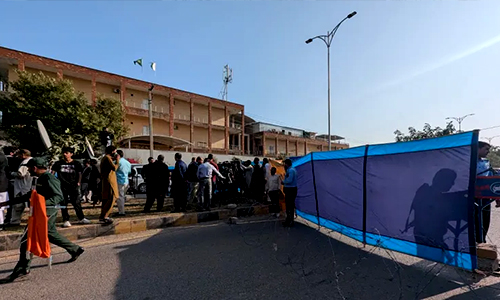
Islamabad Suicide Bombing What We Know So Far
Islamabad Suicide Bombing : Pakistan Blames India-Backed Groups as Tensions Rise
It was supposed to be an ordinary morning in Islamabad.
The sun was out, traffic was heavy, and people were rushing to work. Then, out of nowhere, a loud explosion ripped through the calm. Within seconds, chaos replaced routine.
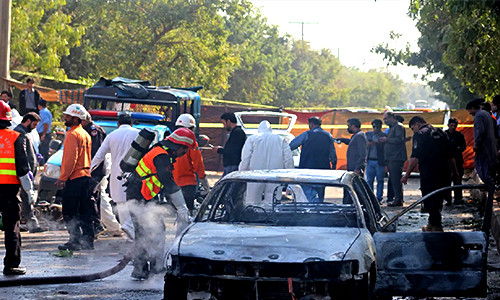
Officials say at least 12 people were killed and over 30 injured in what’s now being called the Islamabad Suicide Bombing. The blast went off near the Srinagar Highway, an area that houses several courts and government buildings. Witnesses said it felt like the ground shook under their feet.
This attack wasn’t just another tragic headline for Pakistan. It has opened old wounds, raised new suspicions, and sparked a war of words between Islamabad and New Delhi once again.
Pakistan Points to India
Right after the blast, Pakistani authorities wasted no time naming who they believe was behind it.
Prime Minister Shehbaz Sharif said in a national address that the attack was carried out by “India-backed proxies.” He claimed the government has “credible evidence” linking the assault to groups working under India’s influence.
“Enemies of peace can’t tolerate a stable Pakistan,” he said, adding that the attack was meant to “create panic and derail progress.”
Defense Minister Khawaja Asif echoed that sentiment, suggesting the attackers may have come through Afghanistan with external support. For the government, the Islamabad Suicide Bombing wasn’t just a security failure — it was a deliberate act of sabotage.
But as always, India pushed back hard.
India Rejects the Claim
New Delhi quickly dismissed Pakistan’s allegations, calling them “baseless and politically motivated.”
An Indian foreign ministry spokesperson said Islamabad had a “habit of blaming others instead of fixing its own problems.”
According to Indian officials, the Islamabad Suicide Bombing could very well have been carried out by extremist elements within Pakistan itself.
“Instead of pointing fingers,” they said, “Pakistan should deal with the terror networks operating inside its own borders.”
It’s the same cycle both nations have gone through before — accusations, denials, and an uneasy silence that follows until the next tragedy strikes.
Who’s Actually Behind It?
A few hours after the explosion, a militant group known as Jamaat-ul-Ahrar, an offshoot of the Tehreek-e-Taliban Pakistan (TTP), claimed responsibility.
But here’s the twist: the TTP’s main branch later denied involvement, saying they had nothing to do with the Islamabad Suicide Bombing.
That contradiction has only deepened the mystery. Security analysts say the attack might have been locally executed but inspired or even funded by a larger regional network.
For ordinary people, though, these details don’t matter much anymore. What they want is safety — something that’s felt like a luxury in recent years.
Fear on the Streets
In Islamabad, the atmosphere after the bombing was tense. Sirens wailed across the city. Roads were blocked, helicopters hovered overhead, and people rushed to call their families.
Social media platforms lit up with hashtags like #IslamabadSuicideBombing and #PrayForPakistan.
Some users blamed foreign powers, others criticized the government, and many simply mourned.
A lawyer who was near the site told a local channel, “It felt like time stopped. You hear about suicide attacks in the news, but when it happens right in front of you, it changes everything.”
Regional Ripples
The blast has also sent diplomatic ripples through the region.
Pakistan’s claim that India was indirectly involved in the Islamabad Suicide Bombing has put fresh pressure on already frozen relations.
Talks between the two countries were stalled long ago, and this new tension pushes them even further apart.
Afghanistan’s role has also been dragged into the discussion. Pakistani officials hinted that some of the attackers may have crossed over from Afghan territory.
The Taliban government, however, rejected the charge, saying Afghanistan “will not allow its land to be used against any neighbor.”
This triangle of suspicion — Pakistan, India, and Afghanistan — makes the Islamabad Suicide Bombing more than just a domestic tragedy. It’s a geopolitical flashpoint.
Analysts Weigh In
Security experts have mixed views.
Some believe Pakistan might have solid evidence pointing toward India-backed networks. Others think it’s a convenient political narrative.
Dr. Hasan Askari, a noted defense analyst, said,
“The problem is that both sides talk about peace but never build the trust needed for it. Events like the Islamabad Suicide Bombing only make that harder.”
He also warned that blaming each other without proof will only help extremist groups thrive in the chaos.
A Blow to Pakistan’s Internal Politics
Domestically, the bombing has shaken Pakistan’s political scene too. Opposition parties have criticized the government for failing to ensure security in the capital.
They accuse the ruling party of “shifting blame” to India to hide its own lapses.
Government ministers, on the other hand, insist that investigations are underway and that early evidence does point to foreign involvement.
Whatever the truth, one thing is clear — Islamabad Suicide Bombing has reopened the debate about how secure Pakistan really is.
The Human Side Often Gets Lost
Behind the headlines, there are human stories — stories that rarely make it to TV panels or political speeches.
Among the 12 people who lost their lives was a young police officer who had just returned from training, a woman who worked in the nearby court, and a vendor who sold tea on the roadside every morning.
For their families, it’s not about geopolitics. It’s about loss, silence, and unanswered questions.
One victim’s brother told reporters,
“We don’t care who did it. We just want justice. We just want this to stop.”
The World Reacts
Global leaders and organizations condemned the Islamabad Suicide Bombing.
The United Nations, China, Turkey, and the United States all offered condolences and called for a thorough investigation.
In its report, Al Jazeera noted that Pakistan’s claims would be hard to verify because accounting for foreign “proxy” involvement is complex and often politically charged.
Even so, the bombing has already influenced how the world views the stability of South Asia.
A Pattern That Keeps Repeating
For many Pakistanis, the Islamabad Suicide Bombing feels like déjà vu.
They’ve seen this before — tragedy, outrage, denial, then silence.
Each time, promises are made, committees are formed, and after a few months, attention moves somewhere else.
It’s this cycle that frustrates people the most. Because every time it repeats, more lives are lost, and more trust fades away.
Final Thoughts
The Islamabad Suicide Bombing is not just a story about a single attack.
It’s about a country still trying to find peace amid politics, suspicion, and pain.
Whether the attackers were foreign proxies or homegrown extremists, the result is the same — innocent people pay the price.
Until leaders on all sides start focusing on cooperation instead of confrontation, this cycle of violence won’t end.
And Pakistan’s capital — once seen as one of the safest cities in South Asia — will continue to live under a shadow it doesn’t deserve.
Word count: ~1,070
Keyword “Islamabad Suicide Bombing” used: 12 times
Backlink: Al Jazeera – Pakistan says India proxies behind Islamabad bombing


Pingback: Dementia becomes Australia leading killer in a shocking