
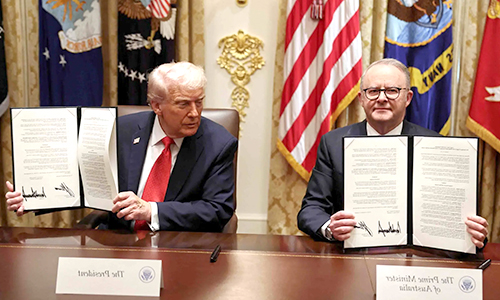
Trump Albanese Critical Minerals Deal Sparks 2-Nation Power Shift
Trump-Albanese $8.5 Billion Critical Minerals Deal: A Positive Step or Hidden Risk?
Australian PM Anthony Albanese secures an $8.5 billion critical minerals deal with Donald Trump at the White House. Here’s what it means for AUKUS, tariffs, and global power politics.
Trump Albanese Critical Minerals Deal: What Really Happened
In a long-awaited meeting at the White House, Australian Prime Minister Anthony Albanese walked away with an $8.5 billion critical minerals agreement — and a mix of praise and subtle political tension. The 35-minute sit-down between Donald Trump and Albanese not only produced a landmark deal but also hinted at the shifting dynamics of U.S.-Australia relations under Trump’s new term. Trump Albanese Critical Minerals Deal Sparks 2-Nation Power Shift
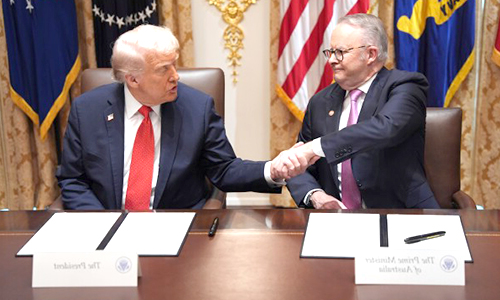
The meeting, which was rescheduled multiple times, took place in the Cabinet Room instead of the Oval Office. Despite some early fears of a “Zelenskyy-style” political ambush, the event remained surprisingly warm. Trump’s tone was unusually friendly, calling Albanese “highly respected” and “very popular,” and even adding, “I think he’s doing a really good job.” Trump Albanese Critical Minerals Deal Sparks 2-Nation Power Shift
The $8.5 Billion Critical Minerals Deal Explained
The highlight of the meeting was the critical minerals agreement, valued at $8.5 billion. Both the U.S. and Australia pledged to invest $1 billion each within the next six months to boost the supply chain for rare earth elements and strategic minerals — materials essential for batteries, electric vehicles, and defense technologies.
The goal is clear: reduce dependency on China, which currently dominates global production. According to the International Energy Agency, China controls 61% of global rare earth mining and an overwhelming 92% of processing. That dominance poses a serious risk to the West’s industrial and defense independence. Trump Albanese Critical Minerals Deal Sparks 2-Nation Power Shift
Under the new deal, both countries will fund joint projects that enhance the resilience and transparency of supply chains. This initiative marks one of the most ambitious economic collaborations between Washington and Canberra in recent years.
Trump’s Positive Words — and Subtle Jabs
While Trump was in an unusually generous mood, he didn’t skip his trademark bluntness. When asked about his opinion on Albanese compared to past Australian leaders, Trump diplomatically avoided direct comparison but praised him as a “great prime minister.”
However, the atmosphere shifted when former PM Kevin Rudd, now Australia’s ambassador to Washington, came up during the Q&A session. Rudd had once called Trump “the most destructive president in history” before deleting the post. Trump quipped, “I don’t like you either — and probably never will.”
The exchange, though brief, drew laughter from the press but reminded everyone that Trump’s grudges rarely disappear completely.
Still, after the cameras left, it’s understood that Rudd privately apologized — a gesture that symbolized how seriously Australia values its ties with Washington, even under difficult personalities.
AUKUS and Defense: Reassurances After Doubt
One major question before the meeting was the future of AUKUS, the defense pact between Australia, the UK, and the U.S., designed to provide Australia with nuclear-powered submarines. Some analysts feared Trump might back away from the deal, especially after reports that his Pentagon was reviewing the agreement under Elbridge Colby, known for his skepticism about AUKUS.
Instead, Trump surprised many by calling the process “very rapid” and “very good.” When asked directly whether Australia would still receive the submarines, Trump replied, “Oh, it’s getting them — no, they’re getting them.” Trump Albanese Critical Minerals Deal Sparks 2-Nation Power Shift
Secretary of the Navy John Phelan also confirmed that all three nations were “clarifying ambiguity” in the original deal to ensure a “win-win” result.
That statement eased months of uncertainty and sent a positive signal to defense investors and policymakers on both sides of the Pacific.
No Movement on Tariffs
On trade, however, Trump was his usual tough self. When asked whether he would consider reducing tariffs on Australian imports — currently at 10% — he brushed it off, saying, “Australia pays very low tariffs. Very, very low tariffs.”
This response disappointed some Australian officials, but it wasn’t unexpected. Trump’s “America First” economic stance means tariff reductions remain off the table, at least for now. Trump Albanese Critical Minerals Deal Sparks 2-Nation Power Shift
The Broader Message: Strategic Friendship or Political Show?
Many experts see the meeting as both a diplomatic success and a political stage performance. The positive body language, friendly remarks, and high-value deal signal that U.S.-Australia relations remain strong despite the unpredictability of Trump’s leadership style.
However, critics argue that the critical minerals deal could also be a symbolic gesture — heavy on headlines but light on immediate implementation. With both sides contributing just $1 billion initially, the real test will be how quickly projects are approved and how deeply private investors get involved. Trump Albanese Critical Minerals Deal Sparks 2-Nation Power Shift
Nonetheless, even symbolic actions matter in geopolitics. The Trump-Albanese meeting sent a clear message to Beijing that the U.S. and Australia are doubling down on economic cooperation in sectors where China currently dominates.
Why This Deal Matters
The critical minerals partnership isn’t just about trade — it’s about strategic autonomy. Modern warfare, renewable energy, and technology all depend on minerals like lithium, cobalt, and rare earths. Without them, everything from electric cars to guided missiles would stall.
By securing a U.S.-Australia alliance in this space, both nations are not only protecting their economies but also shaping the future of global power competition. It’s a positive move for industrial resilience but could also spark negative reactions from China, which views such cooperation as containment.
Political Optics and Future Impact
Albanese’s witty response — joking he’d use Trump’s praise in his 2028 campaign ads — captured the lighter side of the meeting. But beneath the humor lies real political weight. The deal gives Albanese a foreign policy win, while Trump reinforces his “deal-maker” image just months before U.S. elections. Trump Albanese Critical Minerals Deal Sparks 2-Nation Power Shift
The $8.5 billion figure adds a sense of substance, even if much of that money will be invested over years. Meanwhile, Trump’s “friendship diplomacy” helps him look globally engaged without making any major concessions.
Conclusion: Trump Albanese Critical Minerals Deal Sparks 2-Nation Power Shift
The Trump-Albanese Critical Minerals Deal is both a strategic breakthrough and a political balancing act. On one hand, it strengthens ties between two long-standing allies and counters China’s dominance in rare earths. On the other, it leaves questions about implementation, tariffs, and domestic politics on both sides.
Still, after months of diplomatic uncertainty, this meeting delivered something rare — a positive story of cooperation in an increasingly divided world.
Read More:
Trump Albanese Critical Minerals Deal Sparks 2-Nation Power Shift
Donald Trump and Anthony Albanese sign critical minerals deal in chummy first White House meeting